Consumers Still Spending Despite Cratering Sentiment
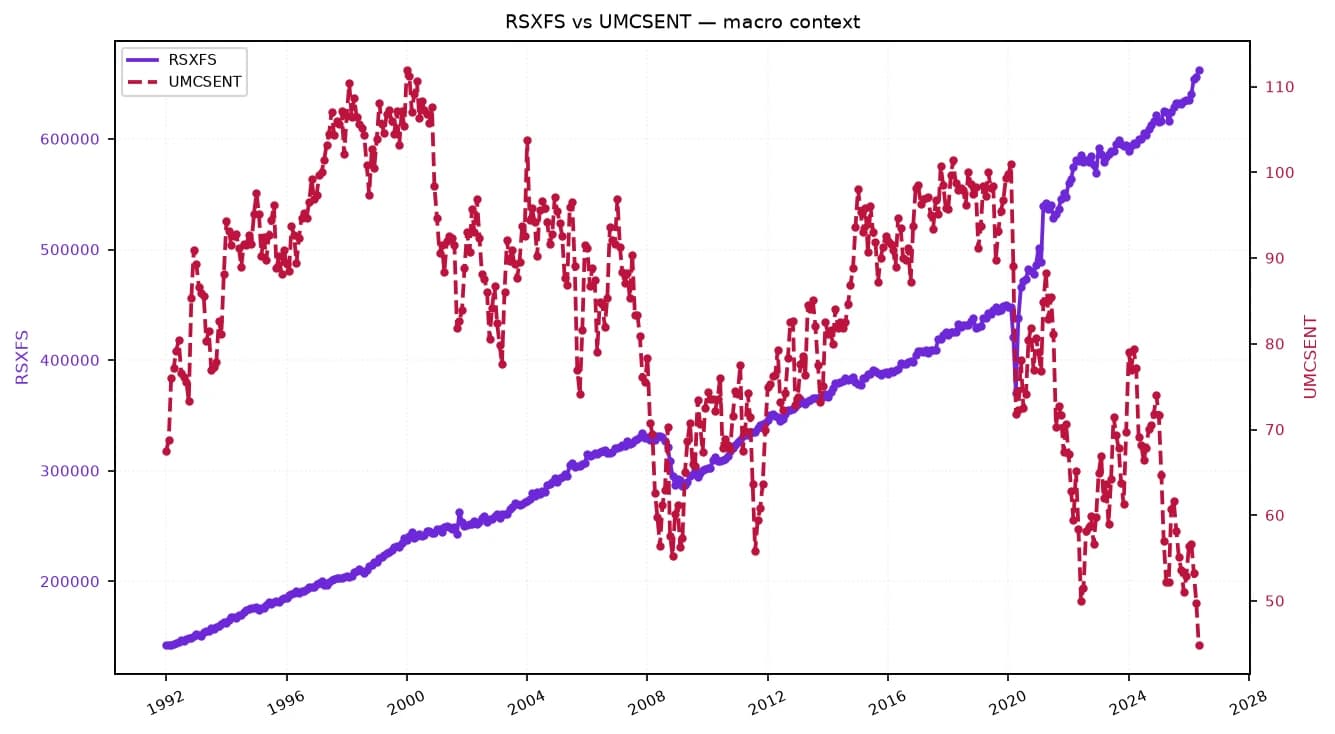
U.S. household demand remained resilient in May and is set to edge higher in June, suggesting the consumer is still doing enough to keep the economy expanding even as confidence slumps to recession-like levels.
That matters because consumption is the main engine of U.S. growth. A modest increase in retail spending after a soft May would help offset weakness in parts of the economy that are more exposed to higher rates, tighter credit and a still-uneven labor market. It also reduces the immediate risk that a cooling consumer tips the economy into a sharper slowdown just as investors are weighing whether the Federal Reserve has room to ease policy later this year.
The underlying message is one of strain, not strength. Household consumption, tracked by the RSXFS series, fell 0.88% in May from the prior month to 616,231, before a forecast rise of 1.22% in June to 670,839.1. Even with that improvement, the broader picture points to only moderate nominal spending growth rather than the kind of broad-based surge that would signal durable momentum.
Consumer sentiment is telling a very different story. The University of Michigan index dropped to 44.8 in May from 49.8 in April, and the June forecast is 43.18, among the weakest readings in the series’ modern history. That gap between spending and sentiment has become one of the defining features of the post-inflation economy: households are unhappy, but they are still spending, helped by wage gains, a low unemployment rate and a willingness to keep using credit.
The labor market is still providing that buffer. Unemployment was unchanged at 4.3% in May and is forecast to ease to 4.2% in June, levels that remain consistent with a relatively tight labor market by historical standards. For retailers and consumer-facing companies, that means traffic can remain stable even if shoppers are more selective and value-conscious.
Markets have already been signaling that split. The consumer-discretionary ETF XLY and the broader S&P 500 ETF SPY have both recovered from earlier spring weakness, while retail shares have shown the usual sensitivity to any hint that consumer demand is stabilizing. XRT’s 50-day and 200-day moving averages have converged around the mid-80s, and the ETF’s relative strength reading has improved, a sign traders are no longer pricing in an outright collapse in spending. Still, the rebound looks more like relief than conviction.
The better-performing names are likely to be those serving necessity and value-led demand, including mass merchants and warehouse clubs, while more discretionary categories remain vulnerable if confidence keeps deteriorating. That fits the latest corporate guidance from major retailers, where managements have emphasized ticket growth, frequency and price competitiveness rather than outright volume expansion.
There is also a political overlay. Rising defense spending across NATO and other governments may support industrial demand, but it does little to improve household mood and can crowd out other public outlays over time. For investors, the key question is whether the consumer’s ability to keep spending can outlast the psychology of caution now embedded in sentiment data and credit-card usage indicators.
For now, the economy appears to be getting a break from household demand rather than a full restart. If June spending comes in as expected, it would confirm that consumers are still carrying growth, but only barely — and that leaves the market highly dependent on labor-market stability, inflation remaining contained and the Fed avoiding a policy mistake.
| Entity | Gains | Losses |
|---|---|---|
| Consumers | ▲Keeps purchasing power intact | ▼Confidence remains depressed |
| Retailers | ▲Sustained traffic and sales | ▼Margin pressure from value-seeking shoppers |
| S&P 500 / XLY | ▲Less recession risk in the near term | ▼Higher scrutiny on consumer durability |
| Fed / economy | ▲Short-term growth cushion | ▼Fewer signs of broad economic momentum |