Coursera falls as investors weigh AI upskilling demand

AI is intensifying anxiety around entry-level jobs, but the bigger economic story is that investors are starting to separate companies that sell broad online learning from those that can prove they help workers reskill for a labor market being rewired by automation.
That distinction matters because the value of education spending is shifting. Employers are under pressure to invest in training that maps to concrete productivity gains, while governments and households are questioning whether adding a few AI modules to legacy curricula is enough to prepare students for jobs where routine tasks are increasingly automated. The result is a more demanding market for digital learning providers: growth will likely accrue to platforms that can demonstrate job placement, enterprise adoption and credentialing relevance, rather than generic course libraries.

Coursera, which has become a bellwether for the sector, has been fighting to show it can convert AI disruption into demand. Its filings say rapid AI adoption is changing the skills required across the workforce and that future performance depends on its ability to develop, reskill and upskill employees for those technologies. That is the right strategic pitch, but the market remains skeptical. Coursera shares have fallen to $6.47 from $12.07 in late September 2025, a drop of about 46%, even after a recent bounce. The stock is still trading below both its 50-day moving average and 200-day moving average, a sign investors have not yet fully embraced a durable growth reset.
The technical picture underscores that caution. Coursera’s 50-day average stands at $5.74, slightly below the latest close, while the 200-day average is $6.27, near current levels, suggesting the stock is testing a recovery rather than confirming one. RSI readings around 69 indicate the rebound has become stretched in the near term, but not enough to erase the longer slide that has defined the name since early in the year.
Tree.com, which operates in consumer financial services and is also represented by the TREE ticker data, has seen a much sharper equity drawdown, with the stock sliding to $28.96 from $70.56 in late September 2025. While it is not a direct education business, its weakness speaks to the same macro backdrop: households facing a more uncertain labor market tend to become more cautious consumers, and platforms tied to discretionary borrowing or fee-based consumer activity can feel that pressure. The stock remains well below its 50-day and 200-day averages, with the latter near $44.25, reflecting a market still pricing in stress rather than stabilization.
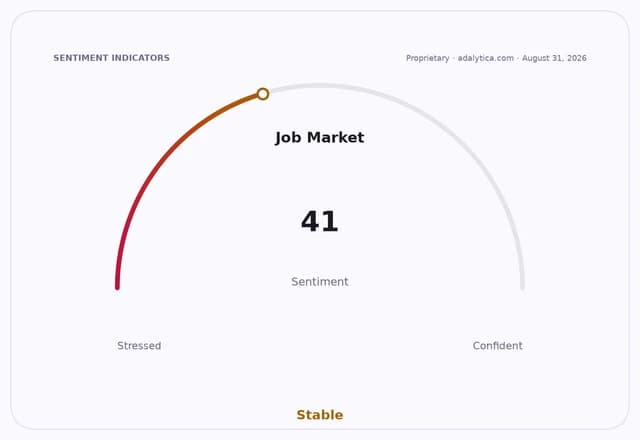
Adalytica’s Job Market Sentiment snapshot also points to a cautious environment. Job-market sentiment is neutral at 41, but awareness is in “fear” territory at 30, a combination that suggests people are paying attention to labor disruption without yet seeing a full recovery in confidence. That is consistent with the narrative behind the seed headline: AI is no longer just a technology story, but a labor-market and education-policy story.
The investment case for online learning firms remains split. The bull case is that AI creates an urgent, recurring need for upskilling at scale, especially in enterprise training, where companies may prefer cheaper, faster digital programs over traditional classroom instruction. The bear case is that most consumers and schools will not pay materially more for courses simply because they carry an AI label, and that the sector’s long-standing problem — weak pricing power and high customer-acquisition costs — will persist unless offerings translate into measurable employment outcomes.
For investors, the key catalyst is not whether AI appears in course catalogs, but whether education providers can show that their products help workers move into roles that still exist. If they can, revenue quality should improve and churn should fall. If they cannot, the market will continue to treat the sector as a collection of hopeful beneficiaries of a structural change rather than direct winners from it.
| Entity | Gains | Losses |
|---|---|---|
| Coursera | ▲Enterprise upskilling demand | ▼Generic course commoditization |
| AI-focused learners | ▲Job-relevant credentials | ▼Old curricula |
| Employers | ▲Lower-cost reskilling | ▼Productivity gaps |
| Legacy education models | ▲— | ▼Relevance to AI economy |