Cybersecurity stocks rise on US-China cyber tensions

The US-China cyber confrontation is moving from diplomatic noise to a budget catalyst, and that matters because every new accusation around state-backed hacking tends to push governments and enterprises toward more spending on network defense, threat detection and incident response.
Beijing’s denial of U.S. hacking allegations, after Washington said it disrupted a China-linked operation that reached into the Justice Department, NASA, the Federal Reserve and the Senate, underscores how cyber conflict has become a permanent feature of geopolitics rather than a side issue. The bigger economic point is that cyber risk is now embedded in the cost of running critical infrastructure, financial systems and corporate IT. That makes security spending more resilient than many other discretionary technology budgets.
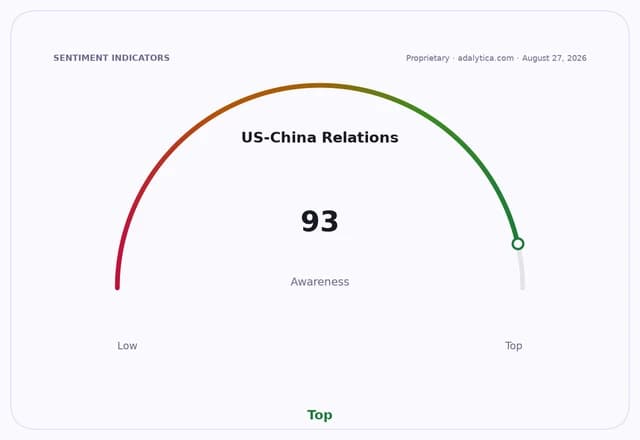
For investors, the key question is not whether the latest claims are true or false, but which companies gain when governments and boards decide they cannot afford to be underprepared. That is where the market still underestimates the secular opportunity. Cybersecurity vendors are increasingly the toll roads of the digital economy: every escalation in nation-state activity strengthens the case for broader platform adoption, higher renewal rates and more urgency around premium tools that promise faster detection and response.
The price action is consistent with that thesis. Palo Alto Networks has rebounded sharply from a late-March low of $147.02 to $339.31, while CrowdStrike has recovered to $189.18 after sliding as low as $94.29 earlier in the year. Fortinet has also steadied around $157.54 after a pullback from recent highs near $225.53. Those moves do not mean the trade is over; they suggest the market is already paying up for durable demand in cybersecurity, even as standard technical indicators show some near-term cooling. On Palo Alto’s latest reading, the 50-day moving average remains well below the stock price, while RSI has eased from overbought levels. CrowdStrike’s RSI and MACD have also cooled after a powerful run, and Fortinet has pulled back toward its 50-day average.

What matters next is the second-order effect. The more cyber operations are linked to nation-state conflict, the more buyers will prioritize integrated platforms, subscription software and managed security over point products. That should keep the strongest names in the group attractive on any volatility, especially as AI is making attacks faster, cheaper and harder to spot. Microsoft and Oracle have already warned that threat actors are using AI to accelerate reconnaissance and exploit vulnerabilities, reinforcing the idea that the security cycle is still in the early innings.
My view is simple: the market is still underpricing the persistence of the cyber spend cycle. If US-China tensions keep cycling through espionage claims, retaliation and public warnings, the beneficiaries are not the attackers — they are the vendors that help defend networks, identities and cloud workloads. For long-term investors, that argues for staying constructive on cybersecurity leaders and using pullbacks to build exposure to the names with the most complete platforms and the biggest enterprise foothold.
| Entity | Gains | Losses |
|---|---|---|
| Palo Alto Networks | ▲More platform demand | ▼Enterprise buyers delaying upgrades |
| CrowdStrike | ▲Endpoint and detection urgency | ▼Point-solution rivals |
| Fortinet | ▲Network security refreshes | ▼Customers trading down on spend |
| China-linked operators | ▲Strategic disruption | ▼Higher scrutiny and defensive spending |