DJT Falls to $9.06 as Trump Midterm Concerns Grow
President Donald Trump’s reported concern that his first two years in office could cost Republicans control of Congress lands at a moment when the market is already signaling unease over the political and policy backdrop around his administration — with Trump Media & Technology Group shares sliding to $9.06, near the lower end of their recent trading range.
The political significance is straightforward: if Trump is privately signaling that his agenda may be turning into a midterm liability, it raises the odds of a more defensive policy posture in Washington and a louder push from Republicans to distance themselves from the most costly or controversial parts of the administration’s program. For investors, that matters because the second half of a presidential term is often when markets begin pricing not just policy outcomes, but policy durability.
Trump Media, which trades under the DJT ticker and is tightly linked to the president’s political brand, reflected that uncertainty in the tape. The stock has fallen sharply from a 2025 peak above $16 and now sits below both its 50-day moving average and its 200-day moving average, a technical setup that suggests momentum has weakened. The latest reading also shows the 14-day relative strength index at 50, down from overbought levels earlier in the year, after a volatile run that has repeatedly pushed the shares into and out of oversold territory.
That price action matters beyond one company. DJT has become a proxy for Trump-linked sentiment, which means it can swing on expectations around the administration’s political standing as much as on fundamentals. A softer Republican outlook ahead of the midterms could reshape how investors think about regulatory priorities, tax policy, trade, immigration enforcement and the pace of executive action. It could also change the tone in sectors that have benefited from a more market-friendly reading of Trump’s agenda, while increasing caution in areas exposed to tariff risk, federal spending shifts or sharper policy reversals after the election cycle.
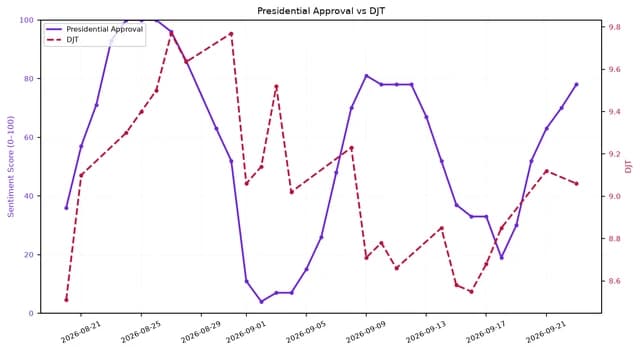
The broader market backdrop is mixed. S&P 500 trading signals remain in optimistic territory, suggesting investors are not broadly pricing a political shock. But the US White House policy-direction gauge from Adalytica shows extreme fear, highlighting a sharp gap between equity market confidence and policy uncertainty. That divergence suggests investors may still be complacent about the risk that a weakened White House agenda translates into slower implementation, more congressional resistance and less visibility on fiscal and regulatory outcomes.
For Trump, the warning is a political problem; for markets, it is a governance problem. The closer the administration gets to the midterms with polls or internal signals suggesting damage ahead, the more likely it is that policy bets get repriced around continuity rather than ambition. That leaves Trump’s allies and opponents facing the same question: whether the next phase of the term produces a more disciplined White House, or a more disruptive one.
| Entity | Gains | Losses |
|---|---|---|
| Trump opponents | ▲Midterm momentum | ▼Trump policy leverage |
| Republican lawmakers | ▲Room to distance from risky policies | ▼Electoral comfort |
| DJT bears | ▲Weak technical trend | ▼Rebound risk on political headlines |
| Policy-sensitive sectors | ▲Clearer odds of moderation | ▼Certainty on Trump agenda continuity |