Dollar Supremacy Faces Strategic, Not Immediate, Risk

The United States is discovering that the dollar’s supremacy is not just a financial fact, but a geopolitical asset it can lose if trust erodes, and that makes the latest talk of summits with Russia more than diplomacy — it is a warning shot for markets.
For investors, the immediate issue is not whether the dollar disappears overnight. It is whether the world keeps treating U.S. assets as the safest place to park money when politics get messy. The answer still appears to be yes for now, but the strain is showing in the way currencies, yields and risk gauges are behaving. The 10-year Treasury yield is sitting around 4.75%, a reminder that the U.S. is paying up to borrow even as investors continue to demand safety. Credit risk is manageable, with high-yield spreads near 2.73 percentage points, but that calm can change fast if geopolitics or fiscal worries intensify.
That is why the dollar matters so much economically. It sits at the center of trade, commodity pricing, debt markets and reserve management. When confidence in the dollar weakens, borrowing costs can rise, import prices can shift and capital can flow toward alternatives. When confidence holds, the U.S. keeps an enormous advantage: cheaper financing, deeper liquidity and unmatched influence over global payment rails. That is the long game here, and it is why any discussion of the dollar’s future is really a discussion about American power.
The market is already telling a mixed story. The Invesco DB US Dollar Index Bullish Fund, UUP, has climbed to 28.58, above both its 50-day and 200-day moving averages, which says the dollar still has support in the tape. Yet the yen ETF, FXY, has slipped to 56.04 and remains below both those same moving averages, underscoring how much pressure Japan’s currency is still under. The euro ETF, FXE, has faded to 104.95, also below its 50-day and 200-day averages. In other words, the dollar may be under strategic pressure, but in the market it remains the cleanest bad option.
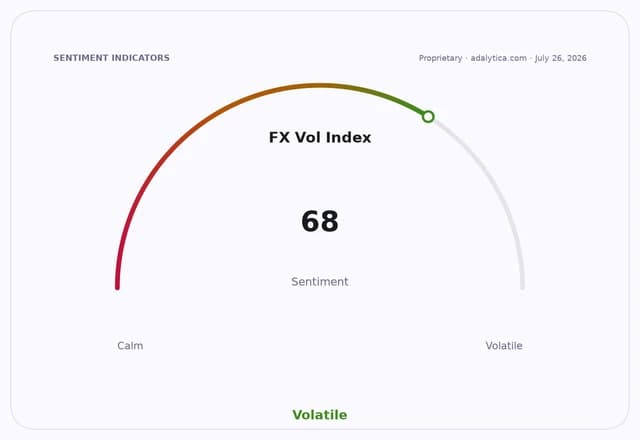
Adalytica’s US Dollar Trade Signals snapshot points to that tension. The model shows “Extreme Fear” for the dollar, even as broader market awareness remains neutral. That is not a prediction of collapse. It is a sign that investors are uneasy about the dollar’s path, particularly with policy uncertainty, tariffs and geopolitical friction all in play. FX volatility signals are also elevated, which tells you currency markets are pricing a wider range of outcomes than they were a few months ago.
There is a bigger narrative tying this together: de-dollarization is less about one dramatic break and more about a slow erosion of confidence. Russia being invited into summit-level diplomacy, sanctions politics, new trade barriers and renewed tension in the Middle East all feed the same question — does the world still want to keep its savings, invoices and reserves in dollars? The answer has been yes for decades because the U.S. offered rule of law, deep markets and relative stability. But those advantages have to be maintained, not assumed.
That is what makes this moment important for long-term investors. A weaker dollar can help some U.S. multinationals by making overseas earnings more valuable when translated back home. It can also support commodities and emerging-market assets. But a sustained loss of confidence in the currency would be a different animal entirely, pressuring Treasuries, lifting inflation expectations and forcing higher returns from every asset class.
The lesson for investors is simple: don’t build a portfolio around a single currency or a single country’s policy path. Own productive businesses, keep diversification broad and think in years, not weeks. The dollar still has powerful structural advantages, but the world is no longer treating them as automatic. That is worth watching closely — and it is a good reason to keep a global, diversified portfolio on your long-term list.
| Entity | Gains | Losses |
|---|---|---|
| U.S. exporters | ▲More overseas revenue in dollars | ▼Imported input costs |
| Dollar holders | ▲Short-term safe-haven support | ▼Long-term erosion risk |
| Foreign currencies | ▲Potential relief if dollar weakens | ▼Pressure when capital flees |
| Treasury buyers | ▲Higher yield opportunities | ▼Currency and policy uncertainty |