Egypt Labor Ministry Opens 140 Jobs
Egypt’s Labor Ministry is leaning on a fresh round of targeted job openings to support youth employment, a small but important sign that Cairo is trying to keep labor-market pressure contained without waiting for a broader pickup in private hiring.
The package covers 140 vacancies across industrial, tourism, logistics and agriculture roles, with monthly pay ranging from about 7,000 to 15,000 Egyptian pounds depending on the job and location. That matters because wage offers at this level speak directly to the segment of the labor market where underemployment, skills mismatch and informality are most visible: young workers with higher, intermediate or no qualifications who are often the first to feel the strain of weak private-sector demand.
The biggest tranche is in industry and engineering in Suez’s Ataqa industrial zone, where 80 positions include engineers, technicians, a chemist, quality control staff and machine operators. A further 50 tourism jobs are on offer in Giza’s Dokki district, while Damietta’s New Damietta industrial area is seeking production workers and a driver on a 15,000-pound salary. Another 10 agricultural jobs are being offered in East Oweinat, underscoring how the government is spreading openings across the country rather than concentrating them in Cairo alone.
For investors, the significance is less about the size of the program than what it says about Egypt’s labor market backdrop. A steady pipeline of vacancies can help cushion household income, support consumption and reduce the social cost of high youth joblessness, but it also highlights how much employment creation still depends on administrative matching rather than a full-scale private hiring cycle. That is why these announcements matter to banks, retailers and consumer-facing businesses: job access and wage stability are the first building blocks of demand.
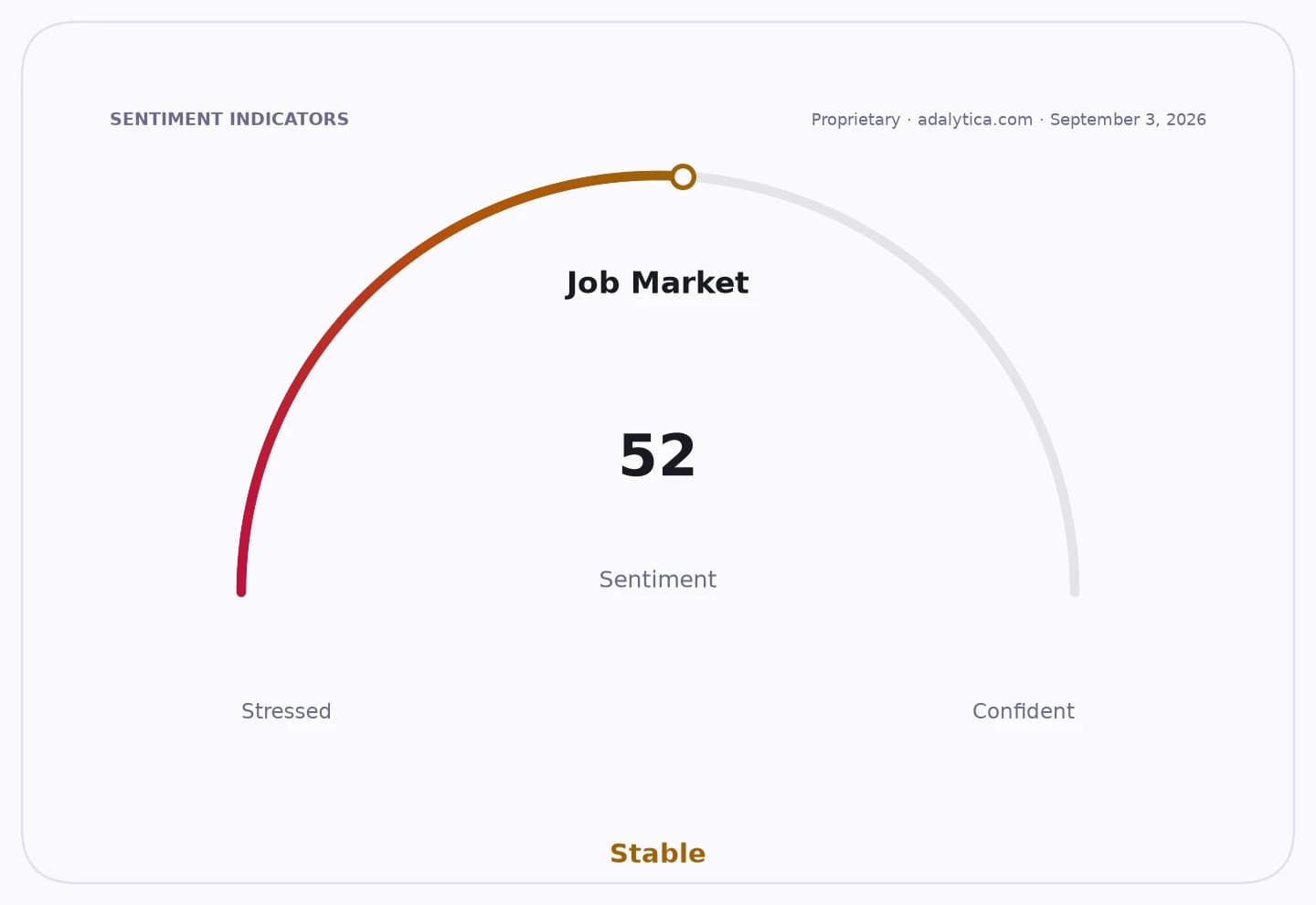
The macro backdrop remains mixed. Adalytica’s job-market sentiment is neutral at 52, while broader labor readings point to a labor market that is improving only gradually, with payroll sentiment still overheated and consumer-confidence recession sentiment stuck in fear territory. In that setting, even modest job announcements carry outsized weight because they help anchor income expectations and keep local spending from weakening further.
The investable takeaway is straightforward: the market should not ignore the second-order beneficiaries of any sustained employment push in Egypt. Industrial operators, logistics providers, tourism-related employers and consumer businesses tied to wage earners stand to benefit most if the Labor Ministry’s hiring drive becomes part of a broader stabilization effort. The risk is that without stronger private-sector capex and export growth, these openings remain a useful bridge rather than a lasting fix.
| Entity | Gains | Losses |
|---|---|---|
| Young job seekers | ▲More openings | ▼Tough competition |
| Industrial employers | ▲Faster hiring | ▼Higher wage pressure |
| Consumer businesses | ▲Better household income | ▼Weak demand if jobs stall |
| Informal labor market | ▲Less pressure | ▼More workers leave informality |