Egypt plans $1 billion Nvidia AI data center
Egypt is moving to anchor itself in the global AI infrastructure race with a planned $1 billion, 200-megawatt data center built around Nvidia technology, a bet that matters as much for power policy and geopolitics as it does for computing capacity.
The project, announced by Communications and Information Technology Minister Raafat Hindi, would be Egypt’s first large-scale AI data center and initially start as a 20-megawatt, $200 million build over three years before scaling up. That makes it a meaningful step for a country trying to position itself as a regional digital hub while also attracting foreign capital into an economy that has struggled with energy shortages.

The deal also underscores how AI infrastructure has become a new front in the competition between the US and China for influence across the Middle East and Africa. Bloomberg previously reported that Huawei had bid to build a data center in Egypt before Washington encouraged a competing proposal from US firms including Nvidia, AMD and Microsoft. Xi Jinping’s visit to Cairo did not produce a signed AI agreement, while Egyptian officials have since been talking to a US consortium of data center developers.
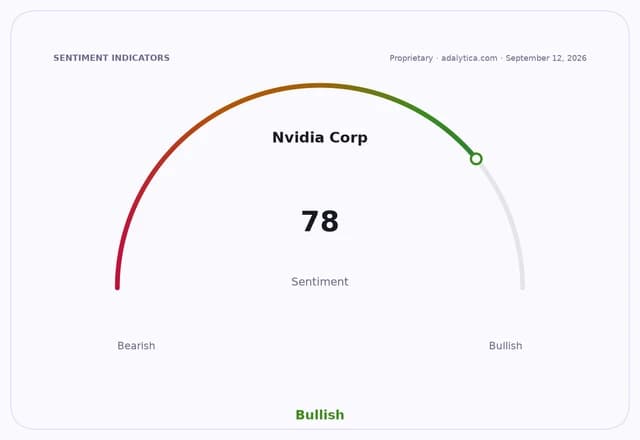
For investors, the story is less about near-term revenue than about the strategic spread of AI capex beyond the US, Europe and East Asia. Nvidia, whose accelerated computing chips power most major AI data centers, stands to benefit from any expansion in emerging markets that adopt its stack. The company’s data center business already remains the core engine of growth, and this project adds another proof point that demand for its hardware is becoming increasingly global.
It also highlights the limits and constraints of the AI buildout. Large AI facilities require enormous amounts of electricity — up to five times more than conventional data centers, according to the context provided — and Africa’s rollout has lagged because of unreliable grids. Egypt is not immune to that problem: the country has faced an energy shortage for years. That means the economics of the project will depend not just on chips and capital, but on whether Egypt can secure enough power, cooling and connectivity to operate at scale.
The partnership structure is also notable. Vodafone Business, Elsewedy Electric and Cassava Technologies, Nvidia’s main partner in Africa, are involved in the first phase. That suggests the project is being built as a consortium rather than a single-company effort, spreading technical and financing risk while tying together telecom, industrial and regional infrastructure interests.
The bull case is that Egypt uses the project to attract more cloud and AI investment, diversify its economy and carve out a role as a serving hub for North Africa and the Middle East. The bear case is that power constraints, financing pressure and the capital intensity of AI infrastructure slow the project’s expansion or keep utilization below what a 200-megawatt facility would require to generate attractive returns.
What happens next will show whether this is a headline-grabbing pilot or the start of a broader regional buildout. If Egypt can get the first 20 megawatts running on schedule, it would strengthen its case as a destination for future AI infrastructure and offer another route for Nvidia and its partners to deepen their footprint in a strategically contested market.
| Entity | Gains | Losses |
|---|---|---|
| Egypt | ▲Regional tech hub ambitions | ▼Energy and funding pressure |
| Nvidia | ▲More global chip demand | ▼Dependence on power-constrained markets |
| U.S. tech firms | ▲Influence in Egypt’s AI buildout | ▼Competition from Chinese bidders |
| Huawei | ▲Less access to flagship project | ▼Washington-backed rival proposal |