Energy Rotation Lifts Exxon, Schlumberger, FuelCell

FuelCell Energy is the standout in this week’s energy-stock push, with a fresh financing deal helping the fuel-cell developer extend a dramatic rally even as broader energy names gain from tighter oil-market sentiment and geopolitical risk.
That matters because the move is not just about one speculative stock catching a bid. It reflects a market still willing to pay for energy exposure when crude-linked volatility rises, while also rewarding companies that can tap capital markets to fund projects, restructuring or growth. For investors, the split is crucial: the trade is still favoring balance-sheet strength and commodity leverage over pure clean-energy promise.
FuelCell shares closed at $19.08 on July 13 after trading as high as $36.01 on June 30, a swing that underscores how quickly momentum can reverse in small-cap energy names. The stock is still far above its 50-day moving average of $20.77, but it has cooled from overheated levels, with RSI at 43.7 after hitting 78.9 two weeks earlier. Volume remains heavy at 9.5 million shares, suggesting traders are still active in the name.
The latest lift follows a July 9 underwriting agreement and a June 24 capital equipment purchase agreement with Fit Energy USA, both of which point to FuelCell’s continued dependence on outside funding and project execution. For a company in a cash-intensive business, access to financing is existential: it can keep the pipeline alive, but it also means dilution risk remains front and center for existing holders.
Exxon Mobil is moving for a very different reason. The oil major closed at $144.51 on July 13, recovering from $138.88 three days earlier, as the sector benefited from renewed concern over Middle East supply risks. Exxon’s 50-day moving average sits at $146.43, while RSI has climbed back to 61.9, a sign the recent pullback may be stabilizing.
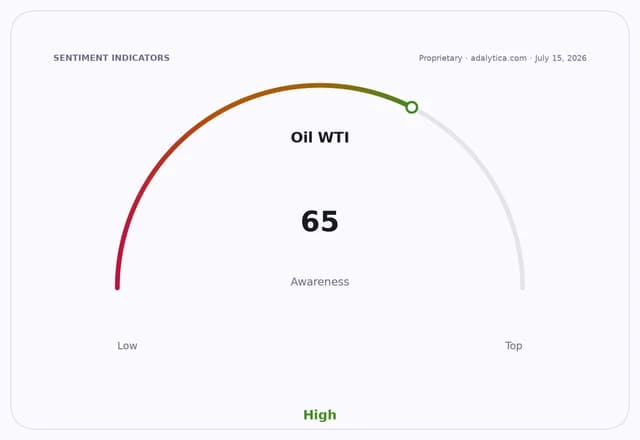
Oil sentiment remains fragile. Adalytica’s WTI trade-signal snapshot shows “Extreme Fear,” with sentiment at 12 and a 7-day drop of 81 points, even as awareness remains elevated. That combination usually supports defensive positioning in integrated producers and service names, particularly when investors are looking for cash flow and buyback support rather than pure beta.
Schlumberger, another bellwether for the sector, closed at $47.36 on July 13 after bouncing from $47.76 on July 10, still well below its 50-day average of $52.70. The stock’s weakening technical setup mirrors the market’s caution: energy is still in favor relative to the broader market, but not all parts of the group are participating equally.
The narrative connecting the names is a rotation into energy volatility winners. Exxon benefits from geopolitical supply risk and oil-linked cash flows, Schlumberger from upstream activity, while FuelCell trades more on financing and project optionality than on commodity fundamentals. The next move will likely be driven by whether crude holds its bid, how quickly capital markets stay open for smaller energy developers, and whether FuelCell can turn its financing into execution without another sharp dilution overhang.
| Entity | Gains | Losses |
|---|---|---|
| Exxon Mobil | ▲Oil-linked cash flow | ▼Consumers and refiners |
| Schlumberger | ▲Upstream spending tailwind | ▼Drilling cutbacks |
| FuelCell Energy | ▲Capital access and momentum | ▼Dilution risk holders |
| Energy bulls | ▲Sector rotation | ▼Broad-market defensives |