Engineer Keeps Paycheck While Building Rentals

An aerospace and government engineer earning $210,000 a year is confronting the central tension in real estate investing: the highest-return move may be to keep the salary and use it to finance the portfolio, not abandon it for another job in property.
That matters because the investor already owns 10 single-family rentals in the Midwest, yet the portfolio is still not generating enough cash flow to replace a six-figure wage. With many homes renting for only $1,200 to $1,600 a month and financing costs around 7.5% after repeated refinancings, the economics argue that the binding constraint is capital efficiency, not ambition. In a housing market where mortgage rates remain elevated and home prices have kept affordability under pressure, the story is less about whether real estate is attractive than which business model can survive expensive leverage.
The debate lands in a market that is still digesting a difficult mix for small landlords. The federal funds rate is 3.63%, but financing for borrowers remains materially higher, keeping debt-service costs elevated. Existing home prices, measured by the Case-Shiller index, have continued to rise to 336.7 in the latest reading, while housing starts have cooled to 1,239,000 in July from 1,415,000 in June, underscoring a market that is not short on price support but still constrained on new supply. For investors, that combination can be supportive for asset values over time, but it does not automatically solve the cash-flow problem that matters most to a would-be operator.
That is why commenters pushed back on the idea of quitting an engineering job to become a loan officer, agent, flipper or roofing-company owner. A license or a new side business does not create income by itself; it changes the source of labor income, often from a predictable salary to a more cyclical and commission-based one. The stronger financial logic, several argued, is to let the W-2 income subsidize acquisitions, deleveraged refinancing and better underwriting until the rental portfolio can stand on its own.
The alternatives each have a different economic profile. Becoming an agent can produce high income, but only with a pipeline of clients and marketing spend; a license is an entry ticket, not a business. Flipping can work in a low-inventory market, but it is capital-intensive and margin-sensitive, with one builder estimating roughly $1.5 million in annual property sales would be needed to replace a $210,000 salary. Property management may be the most scalable real estate-adjacent business for someone with systems experience, but it is still an operating company with staffing, tenant, maintenance and compliance risks.
The strongest bull case for making a career move is control: a hands-on operator can accelerate deal flow, extract higher returns through value-add work and compound expertise inside the sector. The bear case is that the current setup is already the best risk-adjusted engine available — a high salary funding a growing portfolio — and leaving it too early would trade certainty for volatility.
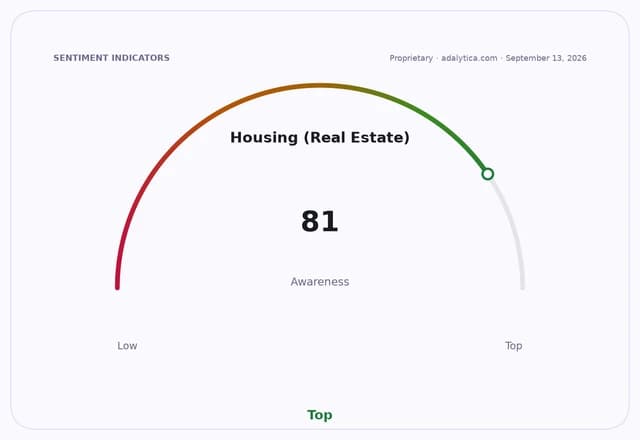
Adalytica’s Housing Fear & Greed Index sits at 37, a neutral reading after a sharp pullback from much hotter levels earlier in the year, while its housing and rent inflation gauge is also neutral at 56. That combination suggests investors are not in a panic about housing, but they are no longer pricing in effortless gains either. The message for investors is that real estate remains a viable wealth-building asset, but in a higher-rate environment the winners are likely to be owners who can hold, de-risk and scale patiently — not those forced to rely on thin transaction margins or income replacement too soon.
For this engineer, the question is less “Which real estate job should I take?” than “How do I convert a strong salary into a durable balance sheet?” The answer may be to keep the engineering paycheck, improve the portfolio’s cash yield, and only later decide whether real estate has become a full-time business rather than an expensive hobby.
| Entity | Gains | Losses |
|---|---|---|
| High-income engineer-landlords | ▲Capital to scale | ▼Time and flexibility |
| Cash-flowing rental owners | ▲Higher equity base | ▼Rate-sensitive leverage |
| Agents and flippers | ▲Deal flow and upside | ▼Income stability |
| Lenders and transaction intermediaries | ▲More activity and fees | ▼Borrowers under pressure |