Ethereum Rises on CLARITY Act Policy Progress

Ethereum is at the center of a policy-driven rerating as Washington advances the CLARITY Act, easing one of the biggest overhangs on the asset and giving traders a credible path back toward $3,000.
The significance is less about a single vote than the market structure it could create. A clearer US framework would help determine whether Ethereum is treated more like a commodity, a security or a regulated digital asset class, reducing the legal ambiguity that has kept institutional capital cautious and exchanges, custodians and payment firms on the defensive. For an asset that sits at the intersection of speculative trading, blockchain infrastructure and tokenized finance, that distinction matters for liquidity, product design and capital allocation.

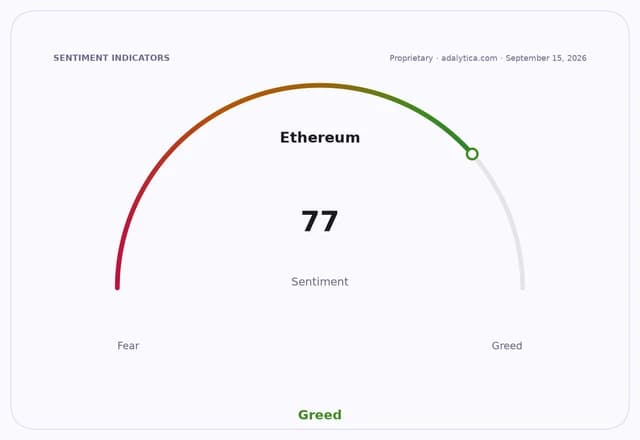
ETH last traded at $2,398.28, down from $2,514.41 a day earlier and well below its recent highs, but the pullback has come with a sharp improvement in market mood. Adalytica’s Ethereum Fear & Greed Index is at 77, in “Greed,” up 10 points on the day and 36 points over the past week. That jump suggests traders are pricing in more than just a short-term relief rally: they are assigning greater odds to a friendlier rulebook that could broaden access to ETH through brokerages, funds and derivative markets.
The technical picture is still mixed, which is why the policy catalyst matters. ETH is trading just above its 50-day average of $2,207.41 and above its 200-day average of $2,062.58, indicating the longer-term trend remains intact even after a recent selloff. At the same time, RSI readings have eased to 48.4 from overbought levels above 90 in August, giving the market room to run if regulatory headlines continue to improve. Momentum has cooled, with MACD still positive but slipping below its signal line, suggesting the breakout thesis needs follow-through rather than enthusiasm alone.
The broader crypto backdrop adds to the case. US authorities have stepped up enforcement against illicit crypto activity, including sanctions on the Xinbi scam marketplace and frozen assets, underscoring that Washington’s approach is not deregulation but selective legitimacy: tougher policing paired with clearer operating rules. That combination tends to favor large, compliant venues and established tokens over smaller, opaque rivals. Coinbase, as the main listed US crypto exchange, stands to benefit if clearer rules lift trading volumes and institutional participation; MicroStrategy is more exposed to Bitcoin-specific flows, but still trades as a high-beta proxy for digital asset risk appetite.
For investors, the question is whether the CLARITY Act changes the valuation framework. A more settled regulatory regime could compress the “policy discount” embedded in ETH and support higher multiples across exchange operators, custody providers and token-linked infrastructure names. The bull case is that improved clarity unlocks pent-up institutional demand and pushes ETH back above $3,000. The bear case is that the market is getting ahead of Congress and that any final bill leaves enough ambiguity to disappoint traders after the recent run-up.
What to watch next is not just whether the legislation advances, but whether ETH can hold above its short-term support and reclaim momentum above recent resistance. If policymakers deliver even partial clarity and risk appetite stays firm, Ethereum’s move may prove less like a speculative spike and more like the start of a regulatory revaluation.
| Entity | Gains | Losses |
|---|---|---|
| Ethereum (ETH) | ▲Lower policy risk | ▼Regulatory ambiguity |
| Coinbase (COIN) | ▲Higher trading volumes | ▼Compliance uncertainty |
| Institutional investors | ▲Clearer access rules | ▼Legal overhang |
| Smaller crypto rivals | ▲Niche compliance gaps | ▼Scrutiny and enforcement |