Ethereum trades at $1,870.91 on July 31

Ethereum turned 11 with its most important engine firing on several cylinders: institutional investors are buying in, ETFs are drawing fresh money and the token has recovered from this year’s slump. Yet the network’s celebration comes with an asterisk — usage and scaling gains are not translating into the kind of growth that would justify the market’s more bullish narratives on their own.
That tension matters because Ethereum now sits at the intersection of two different investment theses. One is the mature, increasingly institutional trade: a base-layer asset with ETF access, corporate treasury interest and a growing role in crypto market plumbing. The other is the original network story: a decentralized settlement layer whose long-run value depends on activity, developer adoption and the economics of its fee-bearing infrastructure. The first is improving. The second remains frustratingly uneven.
ETH-USD traded at $1,870.91 on July 31, down 2.4% from the prior session and still far below its 2025 peaks, but comfortably above its 50-day moving average of $1,773.30. The token has also reclaimed momentum on a technical basis, with the RSI at 53.6 and the MACD still positive, suggesting the market has stabilized after a sharp February washout. Ethereum remains below its 200-day moving average of $2,110.02, though, underscoring how much damage the previous downturn did to the trend.
The market is being pulled higher less by speculative exuberance than by the slow institutionalization of the asset. More than 100 backers have now lined up behind Ethereum, and Ethereum ETFs have taken in $96 million, even as some funds, including BlackRock’s product, have seen outflows. That matters for investors because it broadens the buyer base and reduces Ethereum’s reliance on retail flows and leverage. It also gives ETH a different catalyst set from smaller crypto assets: fund issuance, treasury accumulation and asset-allocation decisions by institutions that once stayed away from the sector.
Those flows are already visible in the market structure. Bitmine’s 5.78 million ETH holdings, worth about $11.8 billion, highlight how large holders are treating Ethereum less like a trade and more like a strategic reserve asset. For bulls, that accumulation supports the idea that Ethereum is becoming the preferred institutional crypto beta, especially now that spot access has improved. For bears, the same concentration raises questions about whether demand is durable or simply front-loaded by a few aggressive buyers.
The problem for Ethereum’s longer-term narrative is that on-chain growth still looks less convincing than the price action. Layer 2 total value locked has fallen to a two-year low, a sign that parts of the scaling ecosystem are losing momentum even as the base asset benefits from financialization. That disconnect matters economically because Ethereum’s valuation ultimately depends on more than token scarcity and ETF demand; it depends on whether the network continues to capture meaningful activity from finance, gaming, payments and developer applications.
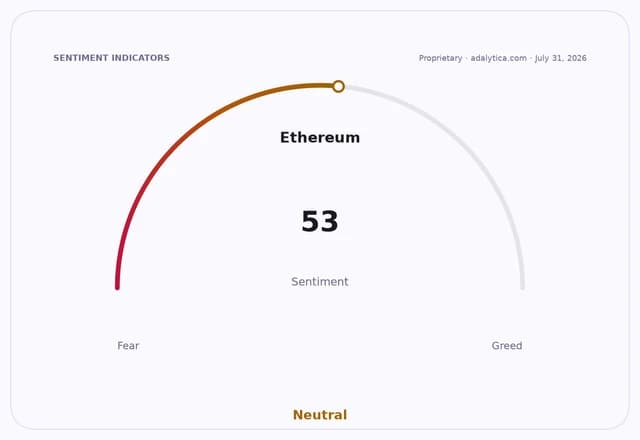
The latest price action reflects that split. Ethereum has regained ground versus Bitcoin and posted a three-month high in relative terms, which supports the case that ETH is being re-rated as the larger, more institutionally acceptable altcoin. But the market is still not pricing a full-throated network renaissance. Adalytica’s Ethereum Fear & Greed Index is neutral at 53, while awareness remains muted at 38, suggesting sentiment has improved without breaking into the kind of crowded optimism that typically drives explosive upside.
That leaves Ethereum at a familiar inflection point. The bull case is that ETF access, corporate adoption and treasury buying create a stronger floor, allowing the network time to rebuild its usage case. The bear case is that Ethereum becomes increasingly owned for macro-financial reasons while the underlying network economy grows too slowly to support a premium multiple versus competing blockchains. Either way, the next leg will likely be determined less by anniversary rhetoric than by whether institutional inflows can be matched by a deeper rebound in network activity and Layer 2 engagement.
| Entity | Gains | Losses |
|---|---|---|
| ETH institutional buyers | ▲ETF access, deeper liquidity | ▼Higher entry prices |
| Ethereum network bulls | ▲Broader adoption narrative | ▼Weak Layer 2 TVL |
| Large holders such as Bitmine | ▲Balance-sheet appreciation | ▼Concentration risk |
| Competing blockchains | ▲— | ▼Loss of relative attention |