Ethereum trades near $2,458 after rebound
Ethereum’s five-year performance remains underwater for many buyers even after a sharp rebound, underscoring how the world’s second-largest cryptocurrency has struggled to sustain value through one of crypto’s most volatile cycles.
At around $2,458 on Aug. 24, ETH was still well below the levels it reached in the 2021 boom, meaning an investor who bought near that peak five years ago would still be sitting on a heavy loss despite a recent surge in interest. The gap matters because it captures the central tension in Ethereum: strong long-term adoption and renewed speculative demand have not yet translated into a clean recovery for late-cycle entrants.
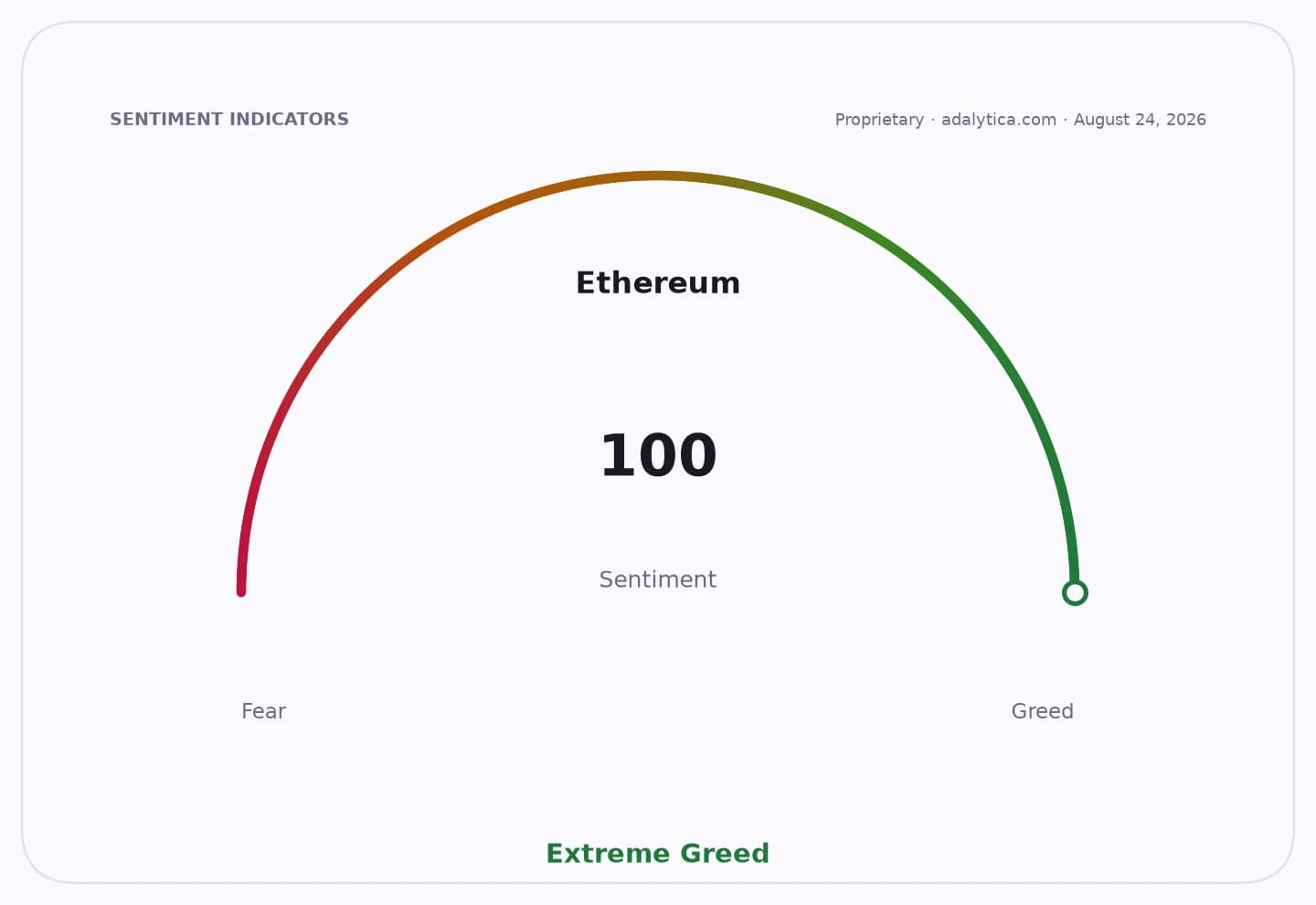
For the broader market, that underperformance is a reminder that crypto rallies often reward timing more than conviction. Ethereum has benefited from a burst of risk appetite, strong ETF-related flows and a wider rebound in digital assets, with Adalytica’s Ethereum Fear & Greed Index at 100, or extreme greed. But sentiment extremes can also mark crowded conditions, especially when the asset is trading just under the upper Bollinger Band and its 14-day RSI is elevated at 86.4, suggesting the move is stretched in the short term.
The comparison with Bitcoin is instructive. BTC was also in extreme greed territory, but its five-year narrative has been stronger, helped by institutional demand and a more established store-of-value case. Ethereum’s valuation still leans more heavily on network utility, smart-contract activity and the growth of tokenized finance, which leaves it more exposed when market enthusiasm fades or competition intensifies.
That is why the “how much would you have lost?” calculation matters beyond the headline. It speaks to the cost of buying into a structurally promising asset at the wrong point in the cycle. Ethereum bulls can point to renewed inflows, a stronger technical backdrop and the possibility that scaling improvements and broader on-chain finance adoption eventually close the gap. Bears will note that a market this overbought can correct quickly, and that Ethereum still has to prove it can convert periodic bursts of demand into durable outperformance.
For investors, the key question is whether ETH is entering a sustainable repricing phase or simply another sentiment-driven spike. If inflows and usage continue to improve, the token can justify a higher long-run multiple. If not, the five-year loss calculation will remain a cautionary marker for anyone treating crypto momentum as a substitute for timing.
| Entity | Gains | Losses |
|---|---|---|
| Ethereum bulls | ▲Rebound momentum | ▼Risk of overheating |
| Late 2021 buyers | ▲Recent recovery | ▼Large unrealized losses |
| Short-term traders | ▲Volatility and range trade | ▼Chasing stretched momentum |
| Bitcoin | ▲Relative stability and stronger demand | ▼Less upside from rotation |