The European Union has laid out a new package of sanctions against Russia, and markets are already pricing in the risk that tighter pressure on Moscow could further disrupt crude flows and keep energy prices elevated.
EU sanctions on Russia lift oil-risk premium

That matters because Russia remains one of the world’s key oil exporters, and every additional round of sanctions raises the odds of supply bottlenecks, longer shipping routes and higher insurance costs across the energy market. Brent and WTI have both been sensitive to the prospect of restricted Russian flows, while the latest move comes with the global backdrop already skewed toward tighter conditions: WTI was recently forecast at $88.70 a barrel, after trading as high as $129.17 on July 31, and the 10-year US Treasury yield has climbed back to around 4.76%, reflecting a less forgiving macro environment for risk assets.
Sentiment IndicatorsⓘProprietary · adalytica.com · August 5, 2026
This is a snapshot — live sentiment, awareness and momentum for 130+ markets update continuously in the dashboard.Open AlphaPulse
Energy equities are responding more constructively than the broader market. The Energy Select Sector SPDR Fund, XLE, closed at 58.52 on Aug. 4, up from 55.89 on May 29 and near the top of its recent range, while its 50-day moving average remains supportive at 56.48. The fund’s relative strength index was 62.3, indicating momentum without yet reaching extreme overbought levels. USO, which tracks crude exposure, fell to 115.78 on Aug. 4 from 129.17 on July 31, but that pullback follows a sharp move higher and leaves it well above its 200-day moving average of 100.71. The drop in its RSI to 45.8 suggests the market is digesting gains rather than reversing the broader bullish setup.
For investors, the sanctions package creates a familiar split. Bulls will argue that tighter Russian restrictions reinforce a firmer floor under oil and improve cash generation for producers such as Exxon Mobil and Chevron, whose earnings remain leveraged to commodity prices. Bears will counter that the market has already priced in a meaningful geopolitical premium, and that any rally driven by sanctions could be vulnerable if demand softens or if OPEC+ offsets part of the squeeze with higher output.
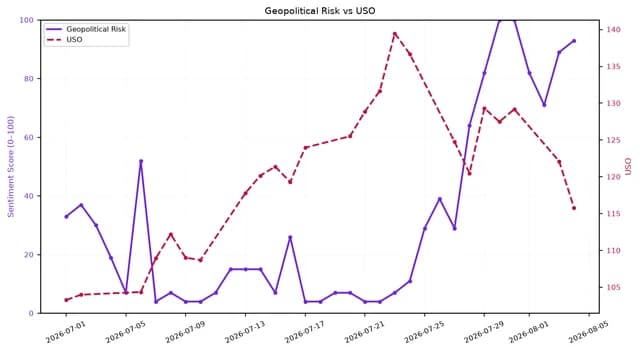
The policy move also fits a wider geopolitical pattern: Europe keeps tightening economic pressure on Russia while trying to sustain support for Ukraine, even as markets weigh the inflationary cost of doing so. Adalytica’s Global Stability Sentiment gauge stands at 93, in “Extreme Greed,” while its oil trade signals show “Greed” at 77, underscoring how quickly geopolitical developments are feeding into commodity positioning.
For now, the key investor question is whether the EU measures translate into a durable supply shock or just another short-lived spike in risk premium. If implementation bites harder than expected, oil and energy equities should stay supported; if the sanctions prove incremental, crude may fade back toward fundamentals, leaving refiners, airlines and other fuel consumers as the clearer beneficiaries.
| Entity | Gains | Losses |
|---|---|---|
| Oil producers | ▲Higher crude prices | ▼Demand risk if prices rise too far |
| Energy equities | ▲Stronger earnings leverage | ▼Valuation risk on reversal |
| Fuel consumers | ▲— | ▼Higher input costs |
| Russia | ▲— | ▼Export and revenue pressure |