The euro’s rebound against the Australian dollar may look encouraging in the very short term, but the bigger picture still points to a bearish EUR/AUD setup for investors and currency watchers.
EUR/AUD Bounce Looks Tactical, Trend Still Bearish
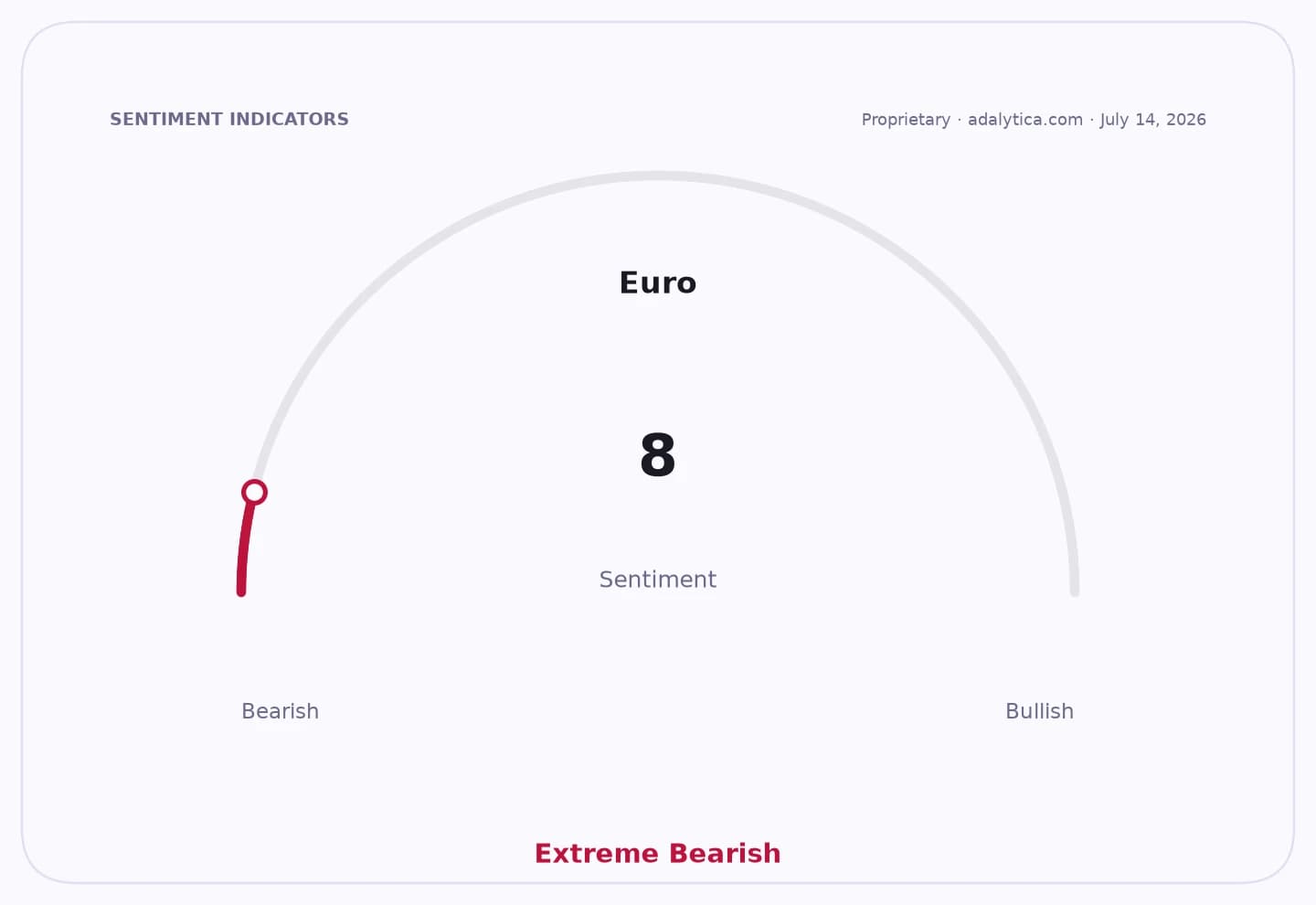
That matters because currency pairs often move on changing interest-rate expectations and growth differentials, and right now the euro still looks vulnerable relative to the Aussie. On Adalytica’s Euro Trade Signals, sentiment has fallen to 8, an extreme-fear reading, while awareness sits at 13, also extreme fear. The U.S. dollar is hardly loved either, but the euro’s mood has deteriorated much faster over the past week, suggesting traders remain skeptical that the recent bounce can turn into a durable trend.
Sentiment IndicatorsⓘProprietary · adalytica.com · July 14, 2026
This is a snapshot — live sentiment, awareness and momentum for 130+ markets update continuously in the dashboard.Open AlphaPulse
The price action tells the same story. EUR/AUD is sitting around 1.65, only modestly above its 50-day moving average of 1.64, while the 200-day moving average is still higher at 1.70. That keeps the pair below a longer-term trend marker that investors often watch for direction. Momentum is only neutral to slightly positive, with RSI near 50 and MACD hovering just above its signal line, which is consistent with a market that is pausing rather than reversing. In plain English: this is a bounce inside a still-soft longer-term structure, not evidence that the downtrend is over.
For long-term investors, that distinction matters. A weaker euro can cushion European exporters, but it can also reflect a region where growth, policy support and capital flows are lagging. The Australian dollar, meanwhile, tends to benefit when commodity demand is firmer and global risk appetite is stable. If that relative backdrop holds, EUR/AUD weakness could persist even if the pair stages periodic rallies.
FXE, the euro-tracking ETF, also shows why caution is warranted. It remains below both its 50-day and 200-day moving averages, with momentum still negative despite some stabilization in recent sessions. FXA, which tracks the Australian dollar, has held up better on a longer-term basis, even though it too has cooled recently. That divergence reinforces the idea that the euro’s problem is not just one bad day of trading but a broader valuation and sentiment gap versus peers.
The macro setup is the real driver here. When one currency’s economy looks sluggish and its policy outlook is less supportive than another’s, the exchange rate eventually reflects that. Traders may chase quick countertrend moves, but investors with a multi-year horizon should care more about the underlying relative strength — and right now, the euro still looks like the weaker side of this pair.
For patient investors, the takeaway is simple: EUR/AUD’s latest lift is worth watching, but the bearish longer-term case has not gone away.
| Entity | Gains | Losses |
|---|---|---|
| Australian dollar | ▲Relative strength | ▼Less upside pressure |
| Euro | ▲Brief rebound traders | ▼Longer-term bearish holders |
| FXA | ▲Better relative resilience | ▼Fewer deep-value concerns |
| FXE | ▲Stabilization attempts | ▼Trend-following bulls |