EUR/NZD Holds Near 2.00 After Fed Hike

EUR/NZD slipped on Wednesday, but the bigger market story is that the Federal Reserve’s latest signal for more tightening has reinforced the dollar-supportive backdrop that has kept the cross biased higher over time.
The Fed raised its benchmark rate to 3.75%-4.00% and flagged scope for at least one more 25-basis-point increase by year-end, with 16 of 18 policymakers projecting another move. That matters for EUR/NZD because the cross is not just a euro story or a kiwi story: it is also a function of relative policy expectations, U.S. yields and the broad risk appetite that steers flows into higher-beta currencies such as the New Zealand dollar.
Treasury yields were already firm, with the 10-year yield around 4.96% and the 2-year at 4.63%, levels that keep U.S. carry attractive and tend to support the greenback against commodity and European currencies alike. The Fed’s projections imply the policy rate could reach 4.00%-4.25% by year-end and stay there through 2027, underscoring a longer period of restrictive monetary conditions even as inflation remains elevated. For FX markets, that reduces the odds of a quick easing cycle and keeps pressure on pairs where neither the euro nor the kiwi has a decisive macro advantage.
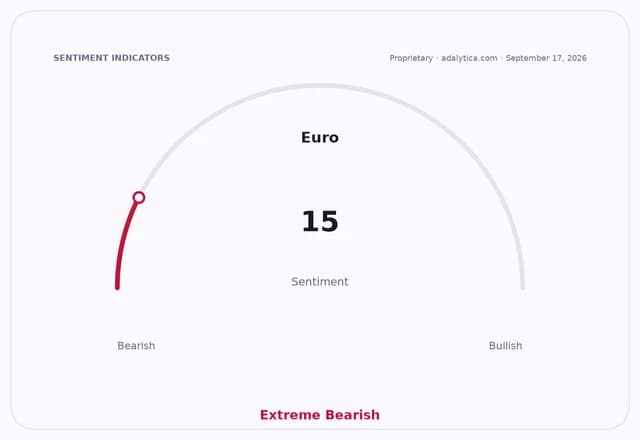
The euro side of the equation remains mixed. Adalytica’s Euro Trade Signals snapshot shows sentiment at 15, or “Extreme Fear,” even though awareness is high at 81, suggesting interest in the currency is strong but positioning is cautious. That combination often leaves room for sharp rebounds if macro data improve, but it also reflects a market that is reluctant to chase the single currency without clearer evidence of ECB policy support or growth resilience.
For New Zealand, the picture is no stronger. NZD/USD has drifted lower to around 0.57, and the pair’s RSI has fallen to 14.5, a deeply oversold reading under conventional technical analysis. That kind of setup can invite short-covering, but it also shows how vulnerable the kiwi remains when global rates stay elevated and risk sentiment softens. The local story about a pilot scams program preventing $23.8 million in consumer losses is positive for financial stability, but it is not enough to alter the currency’s macro driver set in the near term.
Technically, EUR/NZD is still trading near a key zone around 2.00, with resistance at 2.0117 and then 2.021, and support at 2.0007 before 1.9843. The pair was last around 2.00 to 2.01, just below the recent 2.01 area that has capped advances. Conventional indicators suggest the cross remains constructive rather than broken: the 50-day moving average is below spot but the broader structure has not rolled over decisively, while a strong RSI reading earlier in the month showed momentum had been stretched to the upside before the latest pause.
That leaves the bullish EUR/NZD narrative intact despite the day’s modest decline. In practice, the cross still looks like a market that is pausing inside a broader uptrend, with Fed tightening, higher U.S. yields and a soft kiwi offering support. A sustained move above 2.0117 would reinforce that view, while a clean break below 2.0007 would be needed to suggest the bullish setup is fading.
| Entity | Gains | Losses |
|---|---|---|
| U.S. dollar bulls | ▲Higher yield support | ▼No near-term easing |
| EUR/NZD longs | ▲Trend remains intact | ▼Short-term pullback risk |
| New Zealand exporters | ▲Softer kiwi supports receipts | ▼Stronger imported costs |
| Euro bulls | ▲Potential oversold rebound | ▼Hawkish Fed backdrop |