EUR/USD Stays Near 1.15 as Dollar Remains Firm

The euro-dollar pair is stuck near 1.15 as a still-firm U.S. dollar and a widening policy gap between the Federal Reserve and the European Central Bank continue to define the trade.
That matters because EUR/USD is the most liquid currency pair in the world and a key barometer of relative growth, inflation and rate expectations between the U.S. and the euro area. When the dollar holds firm, it tightens global financial conditions, weighs on European exporters less than it does on dollar borrowers, and shifts the cost of hedging for corporates and investors with cross-border exposure.
On Tuesday, EUR/USD was unchanged at 1.15, with the pair sitting just below its 50-day moving average and below the 200-day average of 1.16. The relative strength index was 25.1, a reading that points to oversold conditions in conventional technical analysis, while the MACD remained negative. The picture is one of a market that has sold euro strength but has not yet found a strong catalyst to reverse the move.
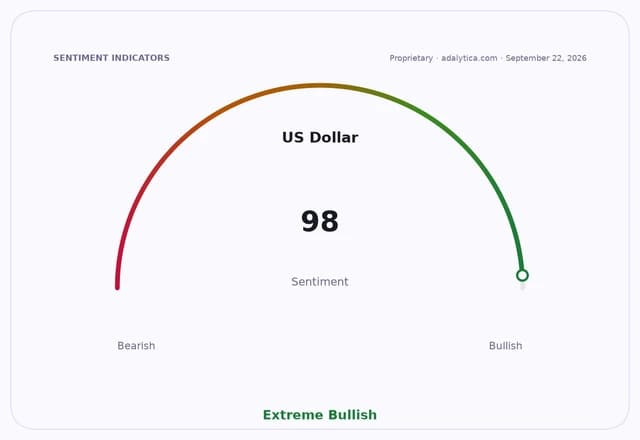
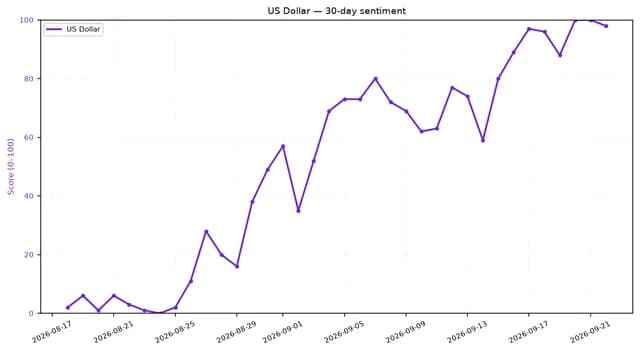
The dollar’s own signals are more forceful. The U.S. Dollar ETF UUP was trading at 28.48, above both its 50-day and 200-day moving averages, while its RSI was 64.8, indicating momentum remains constructive. Adalytica’s U.S. dollar trade signals also showed “Extreme Greed” with a sentiment score of 98, even as awareness stayed in “Fear,” suggesting the market is leaning heavily into dollar strength but with some caution about how crowded the trade has become.
The macro backdrop still favors the dollar. The Federal Reserve funds rate is projected around 3.626%, while the 10-year Treasury yield stands near 4.96%. Even with inflation cooling from its peak, the Fed remains well above zero, and that yield premium continues to support the dollar against the euro. In euro terms, the market is still pricing a world in which U.S. rates remain relatively attractive and U.S. assets continue to absorb global capital.
For investors, that makes EUR/USD less a directional bet on one-off headlines than a relative-value trade on policy divergence, growth differentials and risk appetite. A stronger dollar typically benefits U.S. importers and pressure-sensitive consumers, but it can squeeze multinational earnings translation and make European revenues look weaker when converted back into dollars. For euro-based investors, it raises the value of dollar assets but also increases hedging costs and can obscure the real return on foreign holdings.
The euro, meanwhile, remains supported by the fact that the pair is deeply liquid and the market’s narrative can change quickly when the interest-rate gap narrows or U.S. growth softens. A sharper ECB turn toward tighter policy, or a Fed easing cycle that comes sooner than expected, would likely force a repricing. But for now, the burden of proof sits with the euro bulls.
That leaves EUR/USD trading as a macro expression of dollar dominance rather than a clean rebound story. Unless U.S. yields retreat or risk sentiment shifts enough to unwind the dollar bid, the pair is likely to stay range-bound to lower, with 1.15 a near-term pivot and 1.16 the first technical area to watch.
| Entity | Gains | Losses |
|---|---|---|
| U.S. dollar | ▲Yield advantage | ▼Euro buyers |
| Eurozone exporters | ▲Cheaper competitiveness | ▼Import costs |
| U.S. importers | ▲Stronger purchasing power | ▼Multinationals’ overseas earnings |
| FXE holders | ▲Potential rebound if euro stabilizes | ▼Mark-to-market pressure from weak euro |