Euro Falls to $1.15 as Dollar Gains

The euro fell to $1.15 on Wednesday, extending a slide that has left the common currency trading below its 50-day average and near the lower end of its recent range, as investors leaned into the dollar despite a modest easing in U.S. Treasury yields.
That matters because the move is not just a day-to-day currency wobble: it reflects a market still pricing a wide policy and growth gap between the euro zone and the United States. A weaker euro can cushion exporters, but it also raises imported inflation, complicates the European Central Bank’s room to cut rates, and underscores how fragile confidence remains in the region’s recovery.

The euro’s decline came even as the benchmark 10-year U.S. Treasury yield held around 4.73%, up sharply from the low-rate era and still attractive enough to keep dollar assets in demand. The dollar currency ETF, UUP, edged higher to 28.20, while the euro ETF, FXE, slipped to 106.34, a sign that the move was broad-based rather than isolated to the spot market. On conventional technical indicators, the euro is now sitting at roughly its 50-day moving average of 1.15, below its 200-day average of 1.16, while RSI readings have eased from overbought levels earlier in the year but remain far from signalling a capitulation.
For investors, the key question is whether this is the start of a deeper repricing or just another leg in a choppy, range-bound market. Adalytica’s Euro Trade Signals show sentiment at 75, marked “Greed,” with awareness at “Extreme Greed,” suggesting the currency remains heavily watched even after a 7-day pullback. That combination usually means flows can reverse quickly if U.S. data soften or if the ECB turns less cautious than expected.
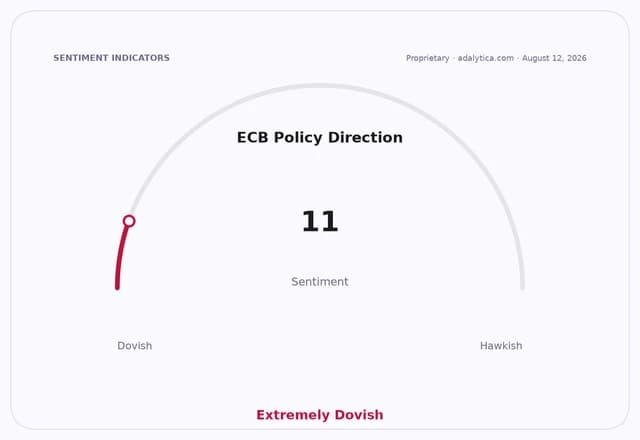
The bearish case for the euro rests on the still-dominant dollar carry, U.S. yields that remain high by post-pandemic standards, and the ECB’s uneasy policy backdrop. Adalytica’s ECB policy sentiment sits at 11, or “Extreme Fear,” reinforcing the idea that markets see the central bank as constrained by weak growth and inflation risks that are not yet fully settled. The bullish counterargument is that the euro has already absorbed much of the bad news, and any narrowing in yield differentials or improvement in European activity could trigger short covering.
In the near term, traders will watch whether the euro can hold the 1.15 area and whether U.S. yields stay anchored near 4.7%. A break lower would likely strengthen the dollar further, help European exporters at the margin, and pressure import-sensitive sectors, while giving central bankers one more reminder that exchange-rate weakness is becoming part of the inflation and policy story again.
| Entity | Gains | Losses |
|---|---|---|
| U.S. dollar holders | ▲Higher returns on dollar assets | ▼None |
| Euro zone exporters | ▲Better price competitiveness | ▼Importers facing higher costs |
| ECB policymakers | ▲Weaker currency may support growth | ▼Less room to ease policy |
| Euro bulls / longs | ▲Potential rebound from oversold levels | ▼Mark-to-market losses |