Euro Holds Near $1.16 as Dollar Softens

The euro’s daily reference rate has held near $1.16 against the dollar, underscoring a foreign-exchange market being driven less by euro-specific stress than by shifting expectations for U.S. policy and a broadly softer greenback.
That stability matters because the ECB’s reference rates are the benchmark used across contracts, invoices and reserve management, making even modest moves economically significant for exporters, importers and asset allocators. A euro that stays firm against the dollar tends to ease imported inflation for the currency bloc while pressuring the competitiveness of European manufacturers and multinationals with large overseas earnings.
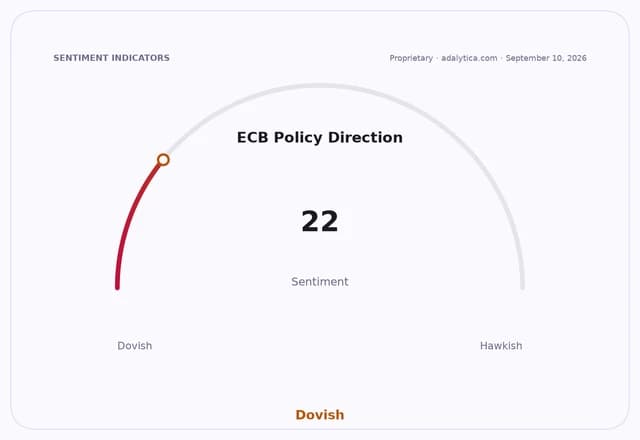
The latest market tone points to a currency pair caught between two opposing forces. The dollar has lost ground as investors reassess the path of U.S. rates, while the euro has not generated enough independent momentum to break out decisively on its own. Adalytica’s euro trade signals show sentiment at 15, described as “Extreme Fear,” even as awareness remains elevated at 88, suggesting investors are highly attuned to the currency but reluctant to chase it higher.
On the charts, FXE, the euro-tracking fund, closed at 107.33 on Sept. 9, above its 50-day moving average of 106.18 and just below its 200-day average of 106.97. The relative strength index at 42.3 points to a market that is neither oversold nor overbought, while the MACD remains positive. That mix implies a market that has recovered from earlier weakness but lacks the momentum normally needed for a sustained breakout.
For investors, the key issue is whether the euro’s recent resilience reflects durable support or merely a pause in dollar strength. A steadier euro can improve the outlook for European consumers through cheaper imports, but it can also weigh on euro-zone earnings translation and raise questions for cyclical exporters if the move extends. Conversely, if U.S. growth or Fed expectations reassert themselves, the dollar could regain its bid and pull the euro back toward lower levels.
The ECB reference rate will therefore remain a barometer for cross-asset positioning as much as for foreign exchange itself. The next catalyst is likely to come from the U.S. rate outlook and any change in risk appetite, with the euro’s near-term path still more likely to be set by Washington than Frankfurt.
| Entity | Gains | Losses |
|---|---|---|
| Euro-area importers | ▲Cheaper dollar goods | ▼Export price competitiveness |
| European consumers | ▲Lower imported inflation | ▼None meaningful |
| Euro-zone exporters | ▲Stable funding costs | ▼Stronger euro revenues |
| U.S. dollar bulls | ▲Higher entry levels on pullbacks | ▼Softer greenback trend |