Europe AI Dependence, Lagarde Warns

Europe is missing from the highest-stakes AI safety debate just as Christine Lagarde warns the continent risks becoming dependent on U.S. and Chinese technology, a gap that matters for growth, sovereignty and the future cost of doing business.
The issue is economically important because Europe is trying to capture productivity gains from artificial intelligence without ceding control of the infrastructure, models and data centers that will shape those gains. Without a homegrown AI champion on the scale of Nvidia, OpenAI or Anthropic, the region has less influence over safety standards, model design and pricing power — and more exposure to technology decisions made in Silicon Valley and Beijing.

Lagarde said Europe faces a blunt choice: reject AI and lose growth, or adopt it and risk relying on tools built elsewhere. She also urged the bloc to build more data centers and develop its own AI systems, arguing that self-sufficiency would reduce the danger of being left behind.
Former European Commission competition chief Margrethe Vestager echoed that warning in a report calling for a “transformative” AI strategy for Europe. The report says the continent should expand data-center capacity, strengthen resilience against AI-driven crises and retain talent, while relying on the EU AI Act to force high-risk systems to report safety incidents and manage frontier-model risks.
That regulatory framework gives Brussels one of the few meaningful levers it has in the global AI debate, but it is not enough to make Europe a standard-setter on its own. The region remains dependent on U.S. technology from search to chips to cloud infrastructure, and experts say that reliance could deepen if European firms and governments simply import American models across the economy.
For investors, the split matters because it defines where the next wave of AI spending and margin pressure lands. U.S. giants such as Microsoft and Nvidia remain central beneficiaries of global AI buildout, while Europe risks becoming a large customer rather than an owner of the stack — a dynamic that could limit local tech valuations even as AI adoption spreads through the broader economy.
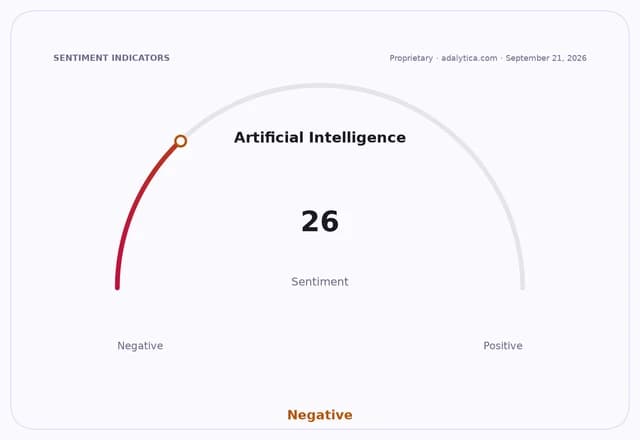
The debate is also being shaped by market sentiment. Adalytica’s AI sentiment reading is in “Fear” at 26, while Microsoft’s earnings sentiment stands at “Extreme Greed” at 89, underscoring the investor split between enthusiasm for AI monetization and caution over governance and concentration risk.
The immediate catalyst is whether Europe turns its regulatory influence into industrial capacity, or remains a rule-maker with little say in the platform layer. Any move by the EU to accelerate data-center investment, local model development or broader safety supervision will matter for cloud providers, chip suppliers and European companies trying to avoid a deeper dependence on foreign AI systems.
| Entity | Gains | Losses |
|---|---|---|
| U.S. AI giants | ▲More demand, pricing power | ▼Less regulatory leverage in Europe |
| European regulators | ▲Rule-making relevance | ▼Industrial influence |
| European companies | ▲Clearer AI safety rules | ▼Dependence on foreign models |
| Nvidia/Microsoft | ▲AI infrastructure spending | ▼Scrutiny over concentration risk |