Europe Firms Add Security to Business Decisions
Geopolitical risk is no longer a background issue for European companies, but a direct input into investment, supply-chain and technology decisions, Lithuanian political scientist L. Kojala said, arguing that businesses must now factor security into the same calculations that once centered on margins and logistics.
That shift matters economically because it marks the end of the long post-Cold War assumption that firms could optimize mainly for cost and speed. Kojala said the world has entered a more uncertain phase since 2014, and that Russia’s war in Ukraine, instrumentalized migration, drone incursions and other forms of pressure have made security a business constraint rather than a distant policy concern. For companies, that changes the price of capital, the location of production, the resilience of suppliers and the pace at which technology is adopted.
The broader European economy is already responding. Kojala said Europe had “lazied” on defense for years, but that the region is now increasing support for Ukraine and raising military spending. That spending will ripple through industrial policy, procurement and public finances, while also forcing governments and firms to confront chronic inefficiencies in a fragmented European market. More funding alone will not solve the problem, he argued; the larger challenge is whether Europe can move fast enough, streamline procedures and coordinate across borders to keep pace with technological and military change.
For investors, the implication is that geopolitics is becoming a structural valuation factor across sectors. Firms with exposed supply chains, heavy energy dependence or limited geographic diversification face higher execution risk, while defense, cybersecurity, resilient infrastructure and companies that can localize production or re-route logistics stand to benefit. The upside case is that Europe’s security spending cycle becomes durable and supports a broader industrial upgrade. The bearish case is that costs rise faster than productivity, leaving margins under pressure and capital expenditure less efficient.
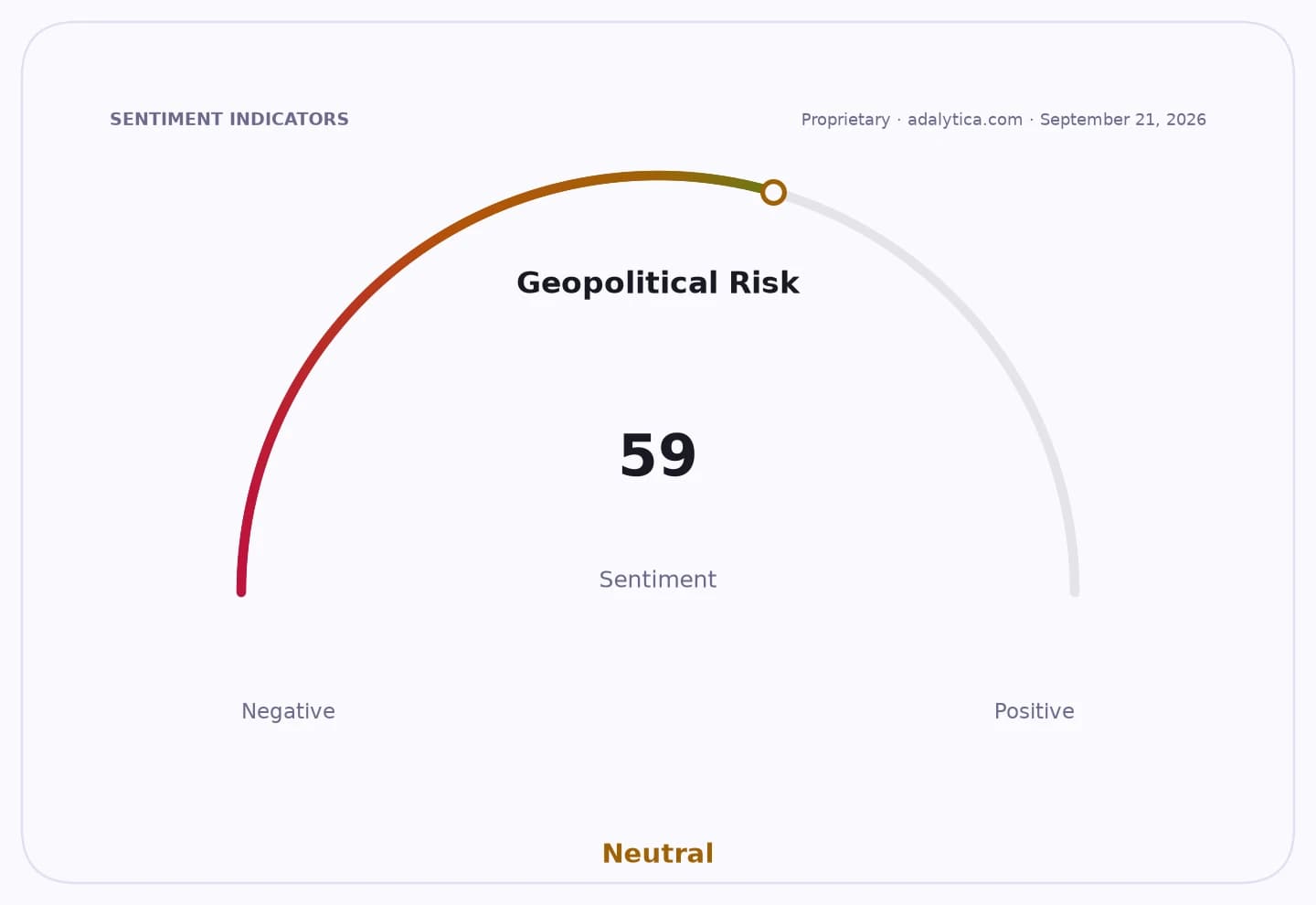
Kojala’s message also fits a wider market backdrop in which uncertainty itself is becoming tradable. Adalytica’s Global Stability Sentiment gauge sits in neutral territory at 59, but its fear reading remains elevated, while FX volatility signals are in “extreme greed” mode, suggesting investors are pricing a more turbulent macro and currency environment. The dollar signal is also at an extreme, underscoring how quickly capital can move toward perceived havens when geopolitical stress rises.
That makes the key question for companies and policymakers less about whether disruption will return than whether they can build resilience before the next shock. Kojala’s argument is that the old model of assuming cheap supply chains and stable borders is gone. The winners, he suggested, will be those that treat security as part of strategy rather than an afterthought.
| Entity | Gains | Losses |
|---|---|---|
| Defense and cybersecurity firms | ▲Higher demand | ▼Complacent legacy suppliers |
| Resilient European manufacturers | ▲More strategic relevance | ▼Thin-margin globalized peers |
| Governments and NATO allies | ▲Stronger deterrence | ▼Budget flexibility |
| Investors in havens | ▲Safer positioning | ▼Risk-asset holders exposed to shocks |