Financial literacy across parts of Europe remains far lower than in the US, and that gap is helping keep households on the sidelines even as European equities and banks recover.
Europe's Retail Caution Limits Banking Upside
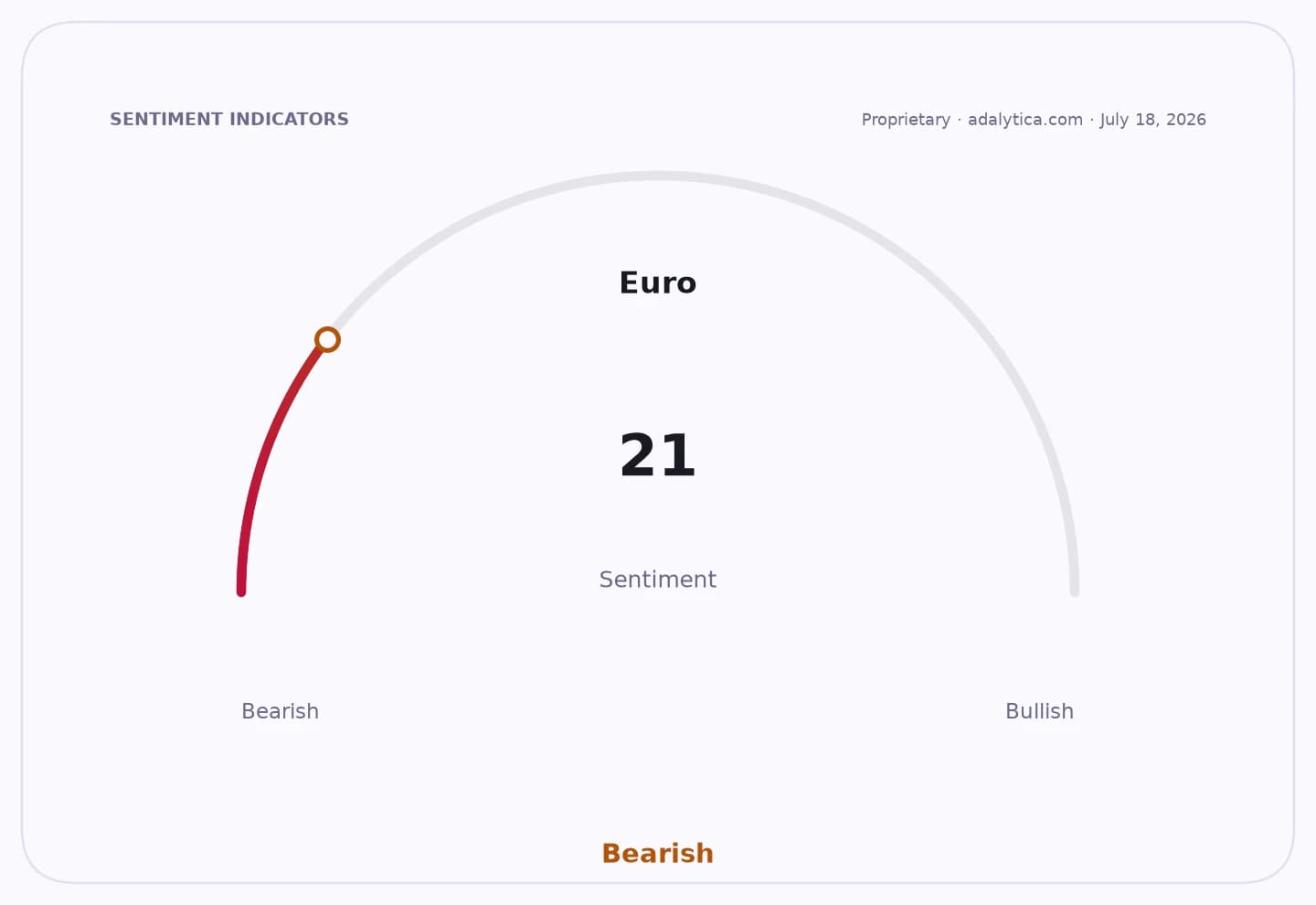
That matters because a chronically cautious retail base changes how capital is allocated, how fast savings move into stocks and funds, and how much domestic financial firms can rely on fee income and asset growth. In markets where investors are more comfortable with risk, households tend to provide a steadier bid for equities, ETFs and wealth products; where they are not, money stays in deposits and low-yielding cash-like instruments, dulling the transmission of rising markets into broader household wealth.
Sentiment IndicatorsⓘProprietary · adalytica.com · July 18, 2026
This is a snapshot — live sentiment, awareness and momentum for 130+ markets update continuously in the dashboard.Open AlphaPulse
The market data points to that same caution. Deutsche Bank’s shares have rallied from a March low near 27.50 euros to 35.20 euros, but the stock remains below its 50-day and 200-day moving averages and has lost momentum in recent sessions, with RSI readings around 59 rather than overheated levels. The picture suggests investors are willing to pay for a turnaround in European banking, but not yet to chase it aggressively. That hesitancy is consistent with a retail audience that still prefers familiar balance-sheet names over more volatile growth or capital-markets exposure.
For Deutsche Bank, the issue is not just sentiment. A more financially literate, more risk-tolerant investor base could deepen demand for savings products, brokerage services and market-linked investments across Europe, supporting fee pools and reducing the region’s structural dependence on bank deposits. It would also broaden the pool of domestic capital available to fund listed companies, which in turn could help European markets command higher and more stable valuations relative to the US.
The contrast with the US is stark. Adalytica’s S&P 500 trade signals are neutral, while the euro gauge shows fear and extreme fear, underscoring how much more defensive positioning still is around European assets. That matters for cross-border capital flows: when European households remain conservative, US-style appetite for equities, leverage and active trading is less likely to take root, leaving European brokers, asset managers and banks with a smaller addressable market.
There is a bull case. If financial education improves and households become more comfortable with investing, Europe could see a gradual shift from cash to capital markets, lifting volumes, commissions and asset-gathering for banks and brokers. That would be especially supportive for firms with pan-European platforms, trading franchises and wealth-management divisions.
The bear case is that risk aversion stays entrenched. In that scenario, European savings continue to sit idle, the region’s markets remain more dependent on foreign capital, and banks such as Deutsche Bank may have to rely more heavily on institutional and wholesale revenue rather than a durable retail investing culture.
For investors, the key question is whether Europe’s recovery in financial assets is being backed by a real broadening of participation or just by short-term trading flows. If the latter, the rally may remain vulnerable. If the former, it would mark a more durable shift in how European capital markets function.
| Entity | Gains | Losses |
|---|---|---|
| European banks and brokers | ▲Higher fee and trading revenue | ▼Slower retail asset growth |
| US-style equity investors | ▲Larger pool of future buyers | ▼Less differentiated capital flows |
| Cash savers | ▲Lower perceived risk | ▼Missed market upside |
| Deutsche Bank | ▲Stronger wealth-management demand | ▼Continued deposit-heavy culture |




