EURUSD Gains as Dollar Softens

The euro is emerging as the clearest beneficiary of a softer U.S. dollar, with EURUSD rated extremely bullish even as the greenback’s broader trade signal remains only neutral. That divergence matters because it points to a market that is no longer simply waiting for the next Fed move — it is starting to price a sustained rotation out of dollar strength and into non-U.S. currencies, a shift that can rewire capital flows across global assets.
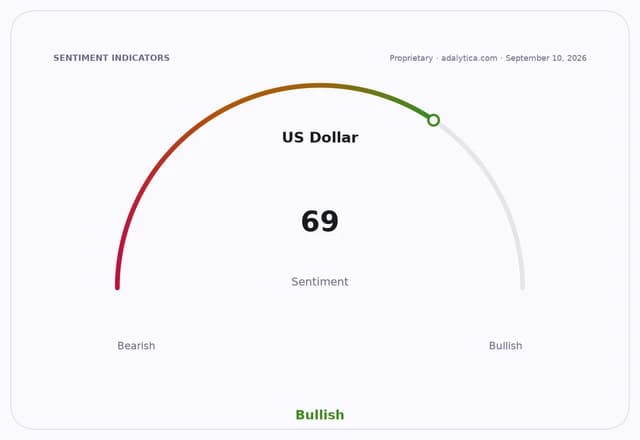
The immediate economic significance is the dollar’s loss of directional control. Adalytica’s trade signals show the U.S. dollar with a neutral sentiment reading of 69, but with momentum cooling on a one-day basis even after a sharp 30-day improvement. Against that backdrop, the euro’s own signals have deteriorated in sentiment but surged in awareness and trend, a combination that often captures a market crowded on one side and vulnerable to a squeeze. In plain terms: the dollar is not collapsing, but it is losing its edge, and that opens the door for currencies with better cyclical leverage and rate sensitivity to outperform.

The strongest read-through is in USDCAD, which is flagged extremely bearish. That is consistent with a market that sees the dollar weaker not just versus the euro, but against commodity-linked currencies as well. For investors, that is important because a softer dollar tends to support global risk assets, ease financial conditions outside the U.S., and boost the translated earnings of multinationals with overseas revenue. It can also be a tailwind for commodities priced in dollars, from energy to industrial metals, while pressuring U.S. importers and other dollar-sensitive sectors.
AUDUSD being labeled bullish reinforces that broader theme. The Australian dollar typically benefits when investors lean back into cyclical growth and commodity demand, so a bullish signal there suggests the market is not just trading on narrow interest-rate differentials. It is beginning to favor currencies tied to global trade, resources and risk appetite. That is the kind of backdrop that can matter far beyond FX desks, because it often accompanies a broader rerating of emerging-market assets, miners, energy names and international equities.
The other side of the story is that the dollar’s retreat comes amid persistent market fragility elsewhere, including volatility tied to concentrated equity exposure and leverage in Asia. That makes the currency move more interesting, not less. When investors remain nervous about concentration risk but still rotate out of the dollar, it usually reflects an active search for relative value rather than a clean “risk-on” burst. In that environment, the most attractive trades are often the ones that benefit from improving liquidity and a weaker dollar without requiring a full-blown global growth boom.
Adalytica’s proprietary signals also underline the asymmetry. The euro’s sentiment is weak but its awareness is extreme, which often means the market is heavily focused on the pair. That can create room for a sharp move if positioning is already skewed. For investors, the practical takeaway is that the first and most durable beneficiaries of a dollar fade are often not the obvious high-beta names, but the second-order winners: exporters, commodity producers, non-U.S. equity markets and currencies with supportive technical momentum.
I believe the market is underestimating how fast FX leadership can change once the dollar stops being the obvious shelter. EURUSD looks like the cleanest expression of that shift, AUDUSD offers the cyclical trade, and USDCAD points to continued pressure on dollar bulls. The next phase is likely to be less about one central-bank headline and more about whether global capital keeps rotating out of dollar cash and into regions where growth, commodities and valuation are more compelling. Position accordingly.
| Entity | Gains | Losses |
|---|---|---|
| EURUSD bulls | ▲Dollar-weakness upside | ▼Dollar longs |
| AUDUSD bulls | ▲Cyclical and commodity tailwind | ▼Safe-haven FX holders |
| USDCAD bears | ▲Lower-dollar trade | ▼USD/commodity-currency long bets |
| U.S. multinationals | ▲Translation lift abroad | ▼Dollar-heavy importers |