EWU Holds Near Highs as Ukraine Peace Talk Grows

Russia’s signal that it welcomes “the efforts of any country” to help settle the Ukraine war underscores a fragile but meaningful shift in the geopolitical backdrop, one that matters less for rhetoric than for energy, defense and European risk assets.
For investors, the key point is not that peace is imminent. It is that any credible opening for negotiations can begin to unwind the war premium embedded across European markets, even if only at the margin. That helps explain why the iShares MSCI United Kingdom ETF, EWU, has stayed resilient, closing at 48.37 on Aug. 31, just below its 52-week high and well above its 50-day moving average of 47.49. The fund’s relative strength suggests investors are already positioning for a more stable European backdrop, or at least for a market in which the worst-case tail risks are being priced a little less aggressively.

The catalyst comes as Indian Prime Minister Narendra Modi pressed Vladimir Putin to move from “endless war to the end of war,” giving Moscow a diplomatic off-ramp while keeping pressure on Kyiv and its backers to search for a political track. That matters economically because war is not just a battlefield story; it is a capital allocation story. A durable de-escalation would ease pressure on energy markets, improve visibility for European corporates and potentially support sectors that have been trading with a geopolitical discount since the invasion began.
The broader signal is one of markets trying to separate headline diplomacy from hard reality on the ground. Adalytica’s Global Stability Sentiment sits in “Greed” at 74, even as awareness remains in “Extreme Fear” at 4, a combination that points to investors wanting to believe in stabilization while still hedging against escalation. That tension is exactly where opportunity tends to emerge: not in the certainty of peace, but in the repricing that follows even a modest probability of it.
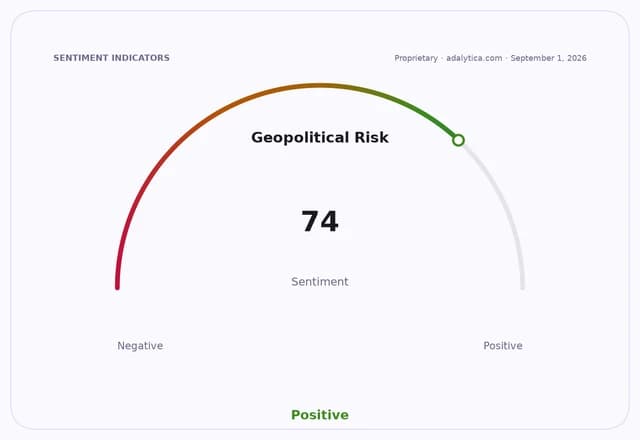
EWU is not a direct Ukraine trade, but it is one of the cleaner ways to express a view that Europe can absorb geopolitical noise without losing macro footing. The ETF’s price is above its 200-day moving average of 45.57, and momentum indicators remain constructive despite recent volatility. That tells us the market is not waiting for a peace treaty to act; it is already rewarding lower-risk, higher-quality exposure to developed Europe.
The implication for investors is straightforward: if diplomacy gains traction, the upside is likely to show up first in European cyclicals, banks, industrials and broad equity ETFs before it becomes obvious in the headlines. If talks fail, defense, energy and safe-haven assets keep the bid. Either way, the market is entering a phase where geopolitical optionality matters again, and that makes positioning more important than prediction.
| Entity | Gains | Losses |
|---|---|---|
| EWU holders | ▲Lower war premium | ▼Missed upside if talks fail |
| European cyclicals | ▲Better risk sentiment | ▼Geopolitical discount |
| Defense stocks | ▲Less if peace advances | ▼Higher if war drags on |
| Energy importers | ▲Softer price pressure | ▼Energy exporters |