Fujitsu expands hiring as AI talent demand rises

Fujitsu’s decision to expand hiring underscores how AI is reshaping white-collar work by creating new roles even as workers fear displacement.
The Japanese technology group’s move fits a broader corporate pattern in which firms are bidding up scarce AI expertise rather than cutting staff outright. That matters economically because AI investment is increasingly being used to lift productivity, support growth and offset labor shortages in aging economies such as Japan, where companies are under pressure to do more with fewer workers.
The backdrop is a labor market that remains relatively tight. U.S. unemployment stands at 4.1%, a level that suggests employers are still competing for talent rather than retreating from hiring altogether. Openings for jobs, a rough measure of labor demand, were still running at 7,359 in June, above the forecast for 7,715.2 in July, indicating that demand for workers remains resilient even as hiring shifts toward more specialized skills.
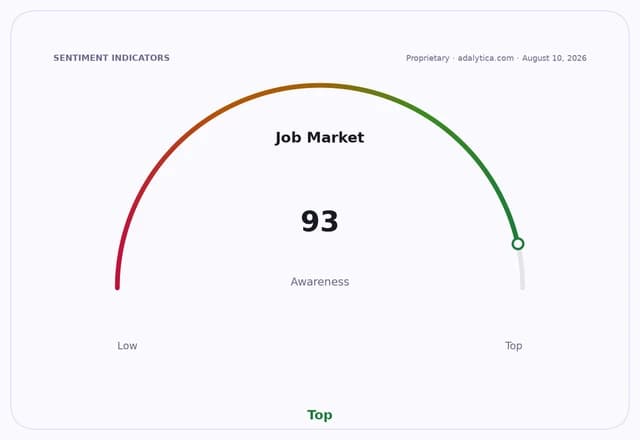
That helps explain why fears of AI-driven mass unemployment are running ahead of the evidence. Adalytica’s Job Market Sentiment gauge shows fear at 18, even as awareness sits at 93, reflecting how quickly the subject has moved from theory to boardroom priority. Companies are not just automating tasks; they are reorganizing around AI, with sales, operations and engineering functions increasingly expected to use it to raise output.
For investors, the significance is twofold. First, AI spending is not only a software story but a labor-allocation story: companies that can deploy AI effectively may gain margin leverage without broad layoffs. Second, the winners may be those that can attract and retain scarce technical talent, from cloud and enterprise software leaders to consultants and systems integrators that help customers deploy AI. Microsoft’s stock, near $500, and Salesforce, around $193, both sit well above their 50-day moving averages, reflecting market conviction that AI remains central to long-term revenue growth, even if valuations now leave less room for execution missteps.
The bear case is that the hiring boom becomes a cost burden if AI adoption fails to translate into measurable productivity gains. The bull case is that it marks the early phase of a long capex and staffing cycle, with firms such as Fujitsu using AI not to eliminate work but to redesign it. In that sense, the key investment question is less whether AI kills jobs than which companies can use it to reshape labor faster than rivals.
What to watch next is whether AI hiring spreads beyond the largest technology groups into industrials, banks and services firms, and whether wage competition for AI specialists begins to show up in margins.
| Entity | Gains | Losses |
|---|---|---|
| Fujitsu | ▲Access to AI talent | ▼Higher hiring costs |
| AI job seekers | ▲More opportunities | ▼More competition for skills |
| Incumbent employers | ▲Productivity gains | ▼Margin pressure from wage inflation |
| Workers in routine roles | ▲Reassigned work | ▼Displacement anxiety |