German producer prices rise on August inflation outlook
German producer prices are set to post their strongest gain since 2023, a sign that pipeline cost pressures are reasserting themselves just as Europe’s largest economy is trying to secure a fragile recovery.
The move matters because producer prices tend to feed through to consumer prices with a lag, and a sustained pickup would complicate the European Central Bank’s path on interest rates. It also comes at a time when markets are already repricing inflation risk: Germany’s benchmark 10-year yield has climbed to about 4.7%, while inflation-linked and rate-sensitive assets have reflected a firmer pricing backdrop.
The latest context points to a broadening of price pressure rather than a one-off spike. German producer price inflation is forecast to rise 2.01% in August, up from a 0.78% decline in July, according to the data context provided. That would mark the strongest increase since 2023 and follow a trough earlier in the summer, suggesting the disinflation phase at the factory gate may be ending for now.
For investors, the implications run across rates, equities and currencies. Higher producer prices can support nominal growth expectations, but they also raise the odds that policy easing stays limited. That is a headwind for duration-heavy assets and a potential tailwind for sectors with pricing power. German equities, as tracked by the EWG ETF, have already firmed, with the fund closing at 44.04 on Aug. 19, above both its 50-day and 200-day moving averages. The euro, via FXE, also strengthened to 107.78, while the dollar was softer at 27.88 on UUP, a pattern consistent with markets leaning toward a more inflation-resistant European backdrop.
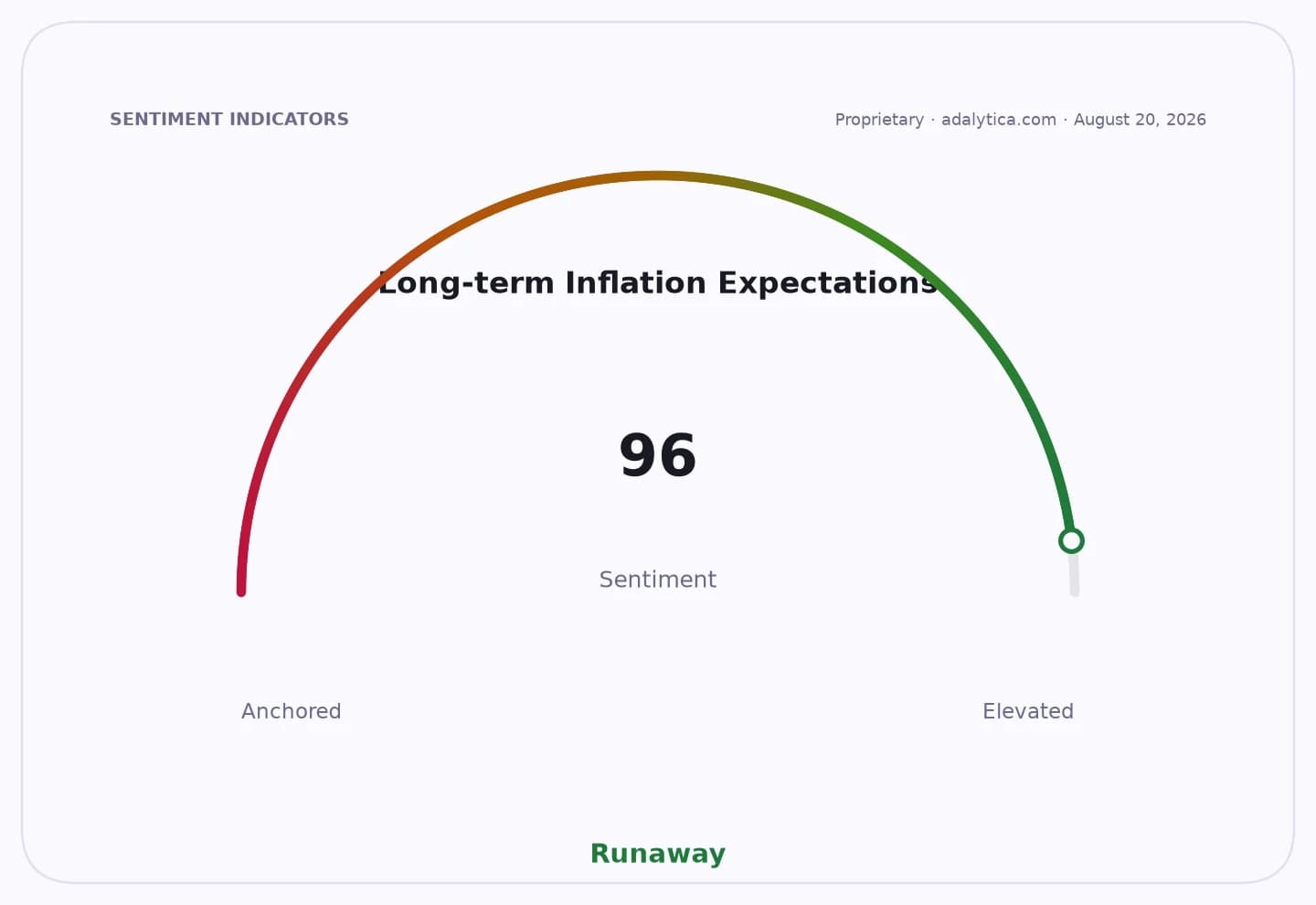
The broader macro narrative is one of sticky inflation expectations rather than a clean return to the pre-shock regime. Adalytica’s confidence measures for the Fed’s 2% target, long-term inflation expectations and five-year breakevens are all in extreme-greed territory, underscoring how sensitive markets remain to upside inflation surprises. If German factory-gate prices keep rising, that could reinforce the case for cautious central bank messaging and keep bond yields elevated.
The key question now is whether August marks the start of a durable reacceleration in input costs or merely a temporary rebound driven by energy and supply effects. A persistent upside surprise would strengthen the case for firmer pricing power in European industry, but it would also make life harder for consumers, rate setters and long-duration investors.
| Entity | Gains | Losses |
|---|---|---|
| German producers | ▲Better pricing power | ▼Higher input-cost scrutiny |
| European equity investors | ▲Firms with pricing power | ▼Rate-sensitive stocks |
| Bondholders | ▲— | ▼Higher yields and inflation risk |
| ECB doves | ▲— | ▼Less room for rate cuts |