German property stocks under pressure from higher rates

German listed property stocks are under renewed pressure as higher long-term interest rates keep loan-to-value ratios elevated, squeezing valuations, refinancing flexibility and the case for new acquisitions.
The move matters because leverage is the central transmission channel between rates and real estate equity. When borrowing costs stay high, property values tend to reset lower, which pushes LTVs up even if debt is unchanged. That makes refinancing harder, limits dividend capacity and raises the risk that companies must sell assets into a weak market. For investors, the issue is not just income yield; it is whether balance sheets can absorb a prolonged period of expensive capital.

The 10-year U.S. Treasury yield has climbed to about 4.8%, while the 2-year is around 4.56% and the federal funds rate stands at 3.63%, underscoring that global financing conditions remain restrictive even after the peak inflation shock faded. In Europe, those levels feed directly into pricing for commercial property and listed landlords, where cap rates and debt costs have not normalized enough to restore the cheap leverage that supported valuations in the previous cycle.
That backdrop helps explain the divergence across German names. Vonovia, the sector bellwether, has fallen to 17.98 euros from 22.71 euros at the start of the year, while Aroundtown, which trades through ticker AT1.DE, has dropped to 1.80 euros from 3.08 euros in late November. Grand City Properties has slipped to 8.60 euros from 10.77 euros in October. The technical picture on all three remains weak, with prices below their 50-day and 200-day moving averages and RSI readings in oversold territory, a sign that the market is still discounting balance-sheet risk rather than treating the sector as a pure income trade.
The fundamental split is between landlords with longer debt maturities and fixed-rate protection, and those more exposed to refinancing. That is why the market still favors names with conservative leverage and recurring rental cash flow, such as Hamborner REIT and DEFAMA, over more highly geared or more office-heavy peers. Fixed interest rates buy time, but they do not solve the underlying problem if asset values continue to drift lower or if banks demand tougher covenants. In that sense, LTV is now the key variable investors are watching more closely than headline dividend yields.
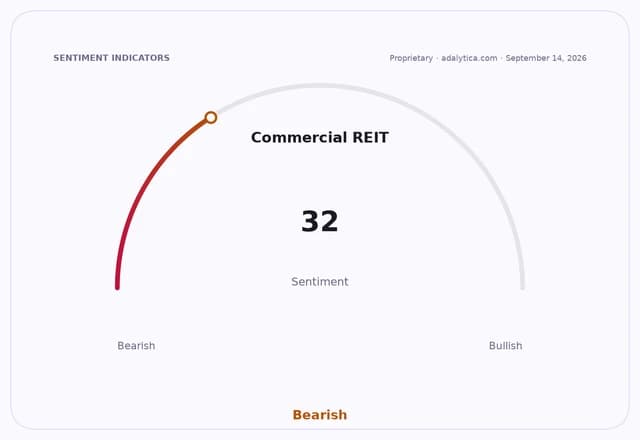
There is a counterargument. If rate cuts arrive faster than expected, financing costs could ease, asset values could stabilize and sentiment could recover quickly, particularly for listed property groups trading at deep discounts to net asset value. Adalytica’s commercial REIT sentiment gauge remains neutral at 32, but down sharply over the past month, suggesting that any improvement in bond markets could trigger a sharp re-rating from depressed levels.
For now, the market is still telling a simple story: in European real estate, higher-for-longer rates are not just compressing multiples, they are keeping leverage and refinancing risk at the center of the investment case.
| Entity | Gains | Losses |
|---|---|---|
| Fixed-rate borrowers | ▲More breathing room | ▼Less sensitivity to rate spikes |
| Highly levered landlords | ▲Potential upside if rates fall | ▼Higher LTV and refinancing risk |
| Vonovia / Aroundtown / Grand City | ▲Possible rebound if bond yields ease | ▼Current valuation pressure |
| Hamborner REIT / DEFAMA | ▲Relative safety | ▼Less upside from a rate rally |