Germany weighs AfD access to defense plan

Germany is considering whether to deny the far-right Alternative for Germany access to its classified national defense plan if the party takes control of Saxony-Anhalt, a move that would deepen the political and security clash over how much state power an anti-establishment force should be allowed to wield.
The issue matters beyond one eastern state because OPLAN Deutschland maps how Germany would respond to a crisis or war, including military and civilian measures and the movement of allied troops through German territory to NATO’s eastern flank. Restricting access would underline the extent to which Berlin views the AfD as a potential security risk, while refusing to do so would risk putting sensitive defense planning in the hands of a party widely criticized by mainstream German parties and security officials.

Defense Minister Boris Pistorius told lawmakers that limiting access was under consideration if the AfD forms a government in Saxony-Anhalt after winning a clear plurality in the state election. The AfD took 43.8% of the vote on Sept. 6 and will hold 39 of 83 seats in the regional parliament, making it the strongest force in the chamber even though it remains short of a majority on its own.
The OPLAN Deutschland debate also exposes a structural tension in Germany’s federal system: state governments and related authorities are normally part of the chain that helps coordinate civil defense and logistics in a crisis, but Berlin may now feel compelled to narrow that circle. That would create practical complications for intergovernmental cooperation, as Saxony-Anhalt’s chief of staff, Rainer Robra of the CDU, warned that excluding a state from security and defense information could make constitutionally required coordination difficult.
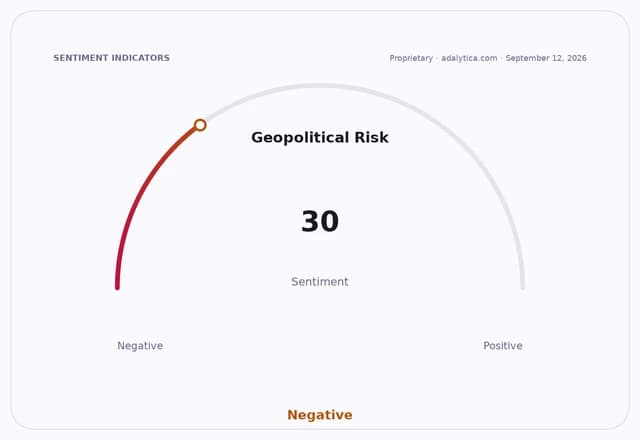
For investors, the immediate market impact is likely limited, but the broader read-through is political risk in Europe’s largest economy. A stronger AfD in regional government raises questions about policy continuity, defense coordination and the durability of consensus on NATO support, all of which matter for the euro, German government bonds and defense contractors over time. Adalytica’s Global Stability Sentiment gauge stands at 30, in fear territory, and its euro trade signals show elevated awareness, reflecting how political uncertainty can quickly feed into cross-asset positioning even when there is no direct market shock.
The near-term focus will be whether Berlin can preserve secrecy around OPLAN without appearing to sideline a democratically elected state government. If it moves too aggressively, it risks strengthening the AfD’s argument that the political establishment is trying to overrule voters; if it does too little, it risks exposing sensitive NATO-linked planning to a party many in Germany see as incompatible with the country’s security posture.
| Entity | Gains | Losses |
|---|---|---|
| Federal government / Defense Ministry | ▲Controls classified planning | ▼Faces federal-state friction |
| AfD | ▲Electoral legitimacy in Saxony-Anhalt | ▼Greater scrutiny over security access |
| NATO / allied planners | ▲Can test security protocols | ▼Potential confidentiality risk |
| Euro / German assets | ▲Little direct immediate change | ▼Higher political risk premium |