Germany shuts Russian consulate amid retaliation risk
Germany’s decision to shut a Russian consulate marks a fresh deterioration in already fraught Russia-Germany relations, underscoring how the war’s spillover into European security is now feeding directly into policy, markets and investor risk appetite. Moscow’s accusation that Berlin’s case is “baseless” and “contrary to common sense” points to another round of retaliation risk at a time when Europe is already bracing for a more hostile security environment.
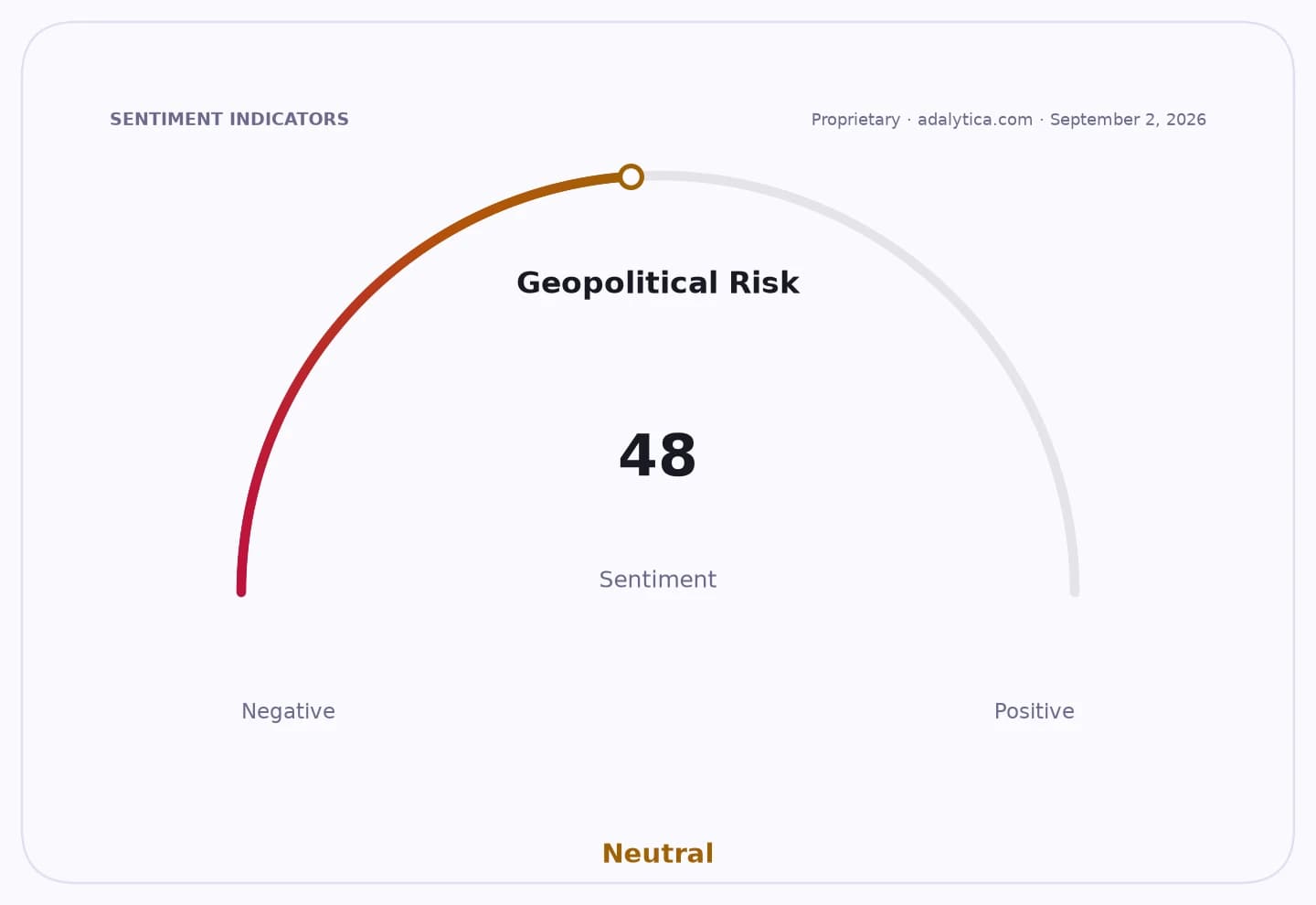
The immediate economic significance is less about trade with Russia, which has already been battered by sanctions, and more about the added premium investors are attaching to European instability. The latest move reinforces the view that the conflict is not contained on the battlefield: it is raising the cost of doing business, complicating energy and security planning, and keeping pressure on German and wider European assets that are sensitive to geopolitical shocks. Adalytica’s Global Stability Sentiment gauge dropped to 48, a neutral reading but one that reflects sharp recent deterioration, with awareness at an “Extreme Fear” level of 4.
That backdrop matters for markets because Germany sits at the center of Europe’s industrial and financial system. Any escalation that raises the odds of retaliatory steps from Moscow can weigh on German equities, compress risk appetite and keep defense, energy security and safe-haven trades in focus. The iShares MSCI Germany ETF, EWG, has already been volatile, but it was still trading at 43.44 on Sept. 1, above both its 50-day moving average of 42.58 and 200-day average of 41.59, after a strong late-August run. Deutsche Bank shares have also held up, closing at 39.58 on Sept. 1, near recent highs and above both major moving averages, suggesting investors have not yet abandoned German financials despite the geopolitical noise.
The oil market adds another layer. Brent and WTI-style crude benchmarks have been elevated enough this year to keep Europe sensitive to any further disruption in energy flows or sanctions enforcement. Even if the consulate closure itself has no direct oil impact, it reinforces the broader risk that Russia-West relations can still produce secondary effects in commodities, transport, insurance and industrial costs. For Europe’s exporters and manufacturers, that keeps a lid on confidence at a time when growth is already fragile.
There is also a policy dimension. Berlin’s move signals that European governments are still willing to impose diplomatic costs in response to alleged Russian activity inside the bloc. That raises the odds of broader coordination with NATO and the EU, but it also increases the chance of tit-for-tat retaliation, including expulsion of diplomats, restrictions on consular services and more friction around cross-border activity. For investors, the bear case is that each escalation adds another layer of uncertainty to an economy already dealing with weak demand, high financing costs and the lingering consequences of the energy shock. The bull case is that Europe’s response strengthens deterrence and reduces the probability of further covert activity, limiting the long-term damage.
For now, the trade is straightforward: geopolitical risk in Europe has become harder to ignore, and German assets are likely to stay hostage to headlines until there is evidence the confrontation is stabilizing. Investors will be watching for Moscow’s response, any EU or NATO coordination, and whether security concerns start to bleed more visibly into German corporate sentiment and capital flows.
| Entity | Gains | Losses |
|---|---|---|
| German government | ▲Hard-line posture | ▼Diplomatic flexibility |
| Russian government | ▲Retaliation leverage | ▼Consular presence |
| European defense sector | ▲Higher security demand | ▼Lower stability |
| German equities | ▲Limited benefit from risk rotation | ▼Geopolitical discount |