Gold’s sharp rebound and the latest pullback in mid-July underline a bigger message for investors: bullion is still behaving like the market’s preferred hedge against macro stress, even as the trade has become increasingly crowded and volatile.
Gold’s Rebound Signals Crowded Safe-Haven Trade
That matters because gold is no longer just a jewelry-store price point. It has become a barometer for confidence in the dollar, real rates and the durability of the global risk rally. When bullion swings this violently, it usually means capital is still looking for protection somewhere — and that has implications far beyond the gold counter. It is a warning sign for currencies, for rate-sensitive assets and for any portfolio that has become too comfortable with one-way risk.
Sentiment IndicatorsⓘProprietary · adalytica.com · July 16, 2026
This is a snapshot — live sentiment, awareness and momentum for 130+ markets update continuously in the dashboard.Open AlphaPulse
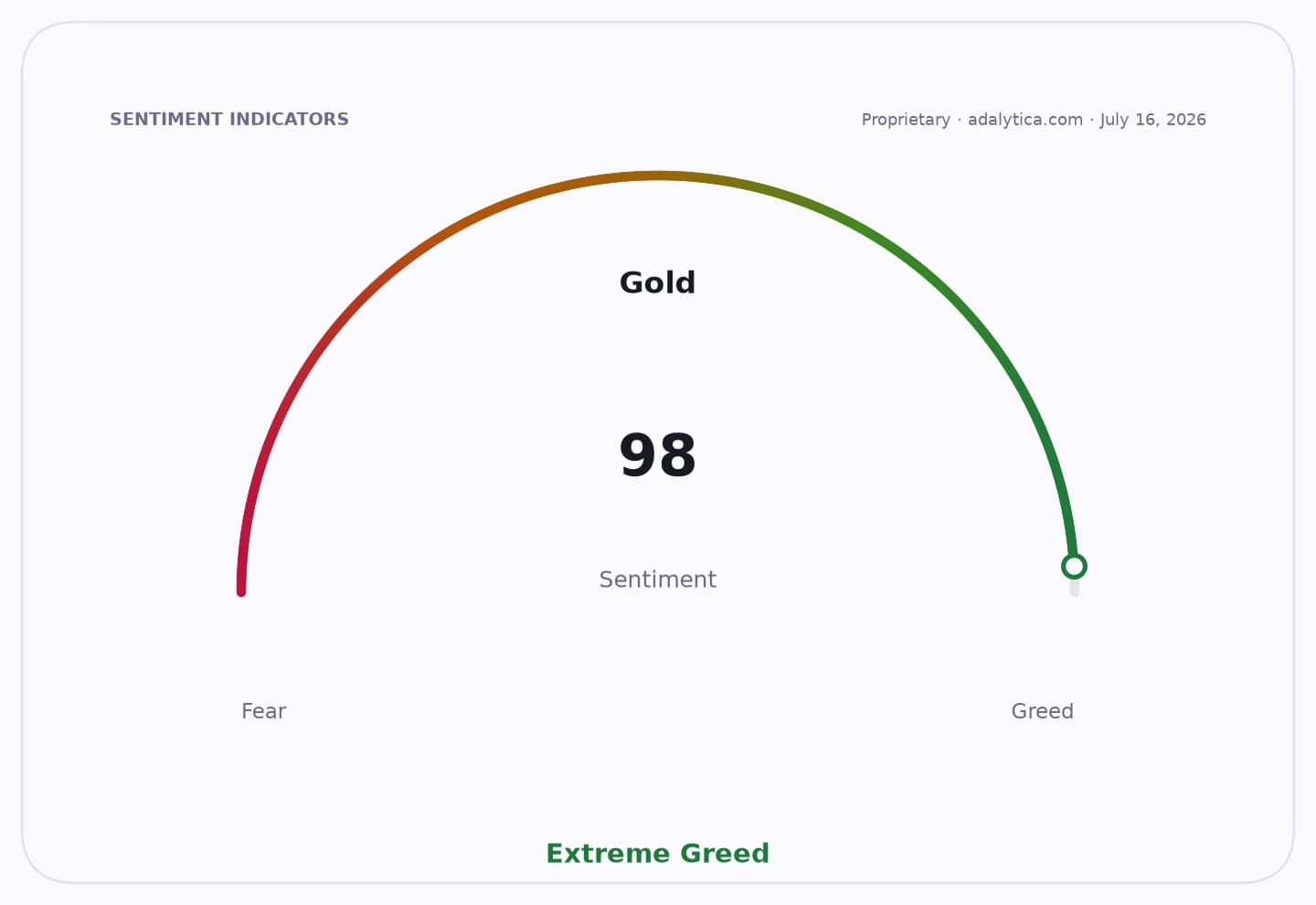
The move has been particularly telling in exchange-traded gold such as GLD, which has been trading above its 50-day moving average even as momentum cooled, and in futures, where prices remain elevated relative to where they started the year. Adalytica’s Gold Fear & Greed Index shows sentiment at 98, or Extreme Greed, while awareness sits at 12, or Extreme Fear — a classic late-stage positioning setup where enthusiasm is high but broad participation remains limited. That combination often precedes more volatility, not less.
The macro backdrop helps explain why. The U.S. dollar is still flashing weakness in Adalytica’s trade signals, with sentiment in Fear territory at 26 and awareness at 30, suggesting the market is leaning toward softer greenback conditions. A weaker dollar typically supports bullion, and gold’s resilience around the mid-$3,000s in ETF terms and above $4,000 in futures terms reflects that underlying bid. Even after the latest giveback, gold remains well above its long-term trend and continues to attract flows from investors seeking insulation from policy risk and geopolitical uncertainty.
Gold — 30-day sentimentadalytica.com
Explore this data interactively — full history, time series and cross-market comparisons.Open AlphaPulse
For investors, the key point is not just that gold is strong — it is that gold is now acting like a capital-allocation trade again. That opens a second-order opportunity in the companies and funds that benefit from persistent demand for hard assets: major gold miners, royalty names, and diversified precious-metals ETFs. It also raises the risk that crowded positioning will trigger sharp air pockets on any hint of stabilization in the dollar or a turn in real yields.
The market’s message is straightforward: this is not a broken trend, but it is a mature one. Investors who still want exposure should think less about chasing every spike and more about owning the infrastructure behind the trade — producers, royalty streams and selective bullion-linked vehicles — while the macro case for hard assets remains intact.
| Entity | Gains | Losses |
|---|---|---|
| Gold miners | ▲Higher cash flow | ▼Margin pressure if costs rise |
| Bullion ETFs | ▲Safe-haven inflows | ▼Volatility from crowded positioning |
| U.S. dollar | ▲Less support | ▼Weakness against hard assets |
| Jewelry buyers | ▲Better entry points on dips | ▼Higher replacement costs on rallies |