Gold Prices Fall as Treasury Yields Rise
Gold prices are falling as markets increasingly price in economic stabilization and firmer Treasury yields, weakening demand for bullion as a defensive asset.
The move matters because gold’s appeal is tightly linked to real interest rates, dollar direction and risk appetite. When investors see growth stabilizing and inflation pressures becoming more manageable, the case for holding a non-yielding asset like gold usually softens. That shift has been visible in the U.S. rates market, where the 10-year Treasury yield has climbed to 4.97%, with a forecast at 5.043%, levels that raise the opportunity cost of owning bullion.
The pressure is showing up across gold proxies. SPDR Gold Shares, or GLD, fell to $392.84 on Sept. 14 from $398.77 two sessions earlier, while the VanEck Gold Miners ETF, GDX, slipped to $94.14 from $97.10 over the same stretch. iShares Gold Trust, IAU, declined to $80.54 from $81.71. The latest technical readings reinforce the pullback: GLD’s relative strength index has fallen to 28.4, near oversold territory, while GDX’s RSI sits at 36.1 and IAU’s at 28.2. GLD also remains below its 200-day moving average, a sign that the broader trend has turned less supportive even after a strong run earlier this year.
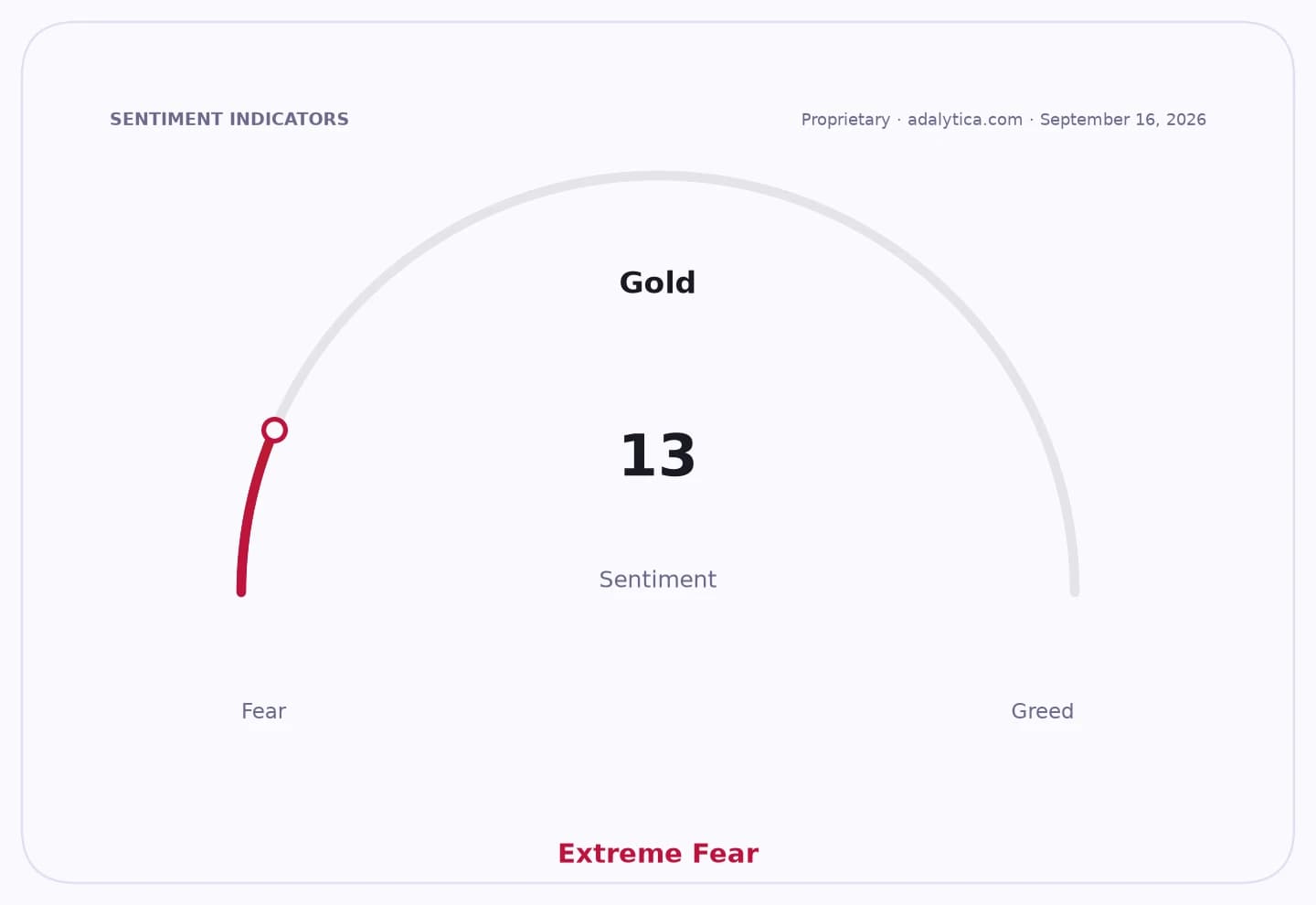
The macro backdrop helps explain the shift. U.S. inflation, measured by the CPI index, has been broadly stable in recent months, with the August reading at 334.131 after 332.813 in July and 332.568 in June. That steadier inflation profile reduces the urgency for a safety trade, especially when paired with higher nominal yields. Adalytica’s Gold Fear & Greed Index has also dropped to 13, labeled “Extreme Fear,” underscoring that sentiment has turned sharply weaker after a period of more aggressive buying.
For investors, the question is whether this is a correction within a broader bullish cycle or the start of a more durable repricing. The bull case for gold still rests on geopolitical uncertainty, central-bank buying and the possibility that growth data disappoints later this year. The bear case is that if the U.S. economy continues to stabilize while yields hold near cycle highs, capital could rotate toward cash, bonds and equities, leaving bullion vulnerable to further downside.
The near-term catalyst is whether the bond market keeps pushing real yields higher and whether risk assets continue to recover. If both hold, gold may struggle to regain momentum, while miners and gold ETFs could underperform broader markets until the rate backdrop turns more supportive.
| Entity | Gains | Losses |
|---|---|---|
| U.S. Treasury yields | ▲Attractive carry | ▼Gold demand |
| Equity markets | ▲Improved risk appetite | ▼Safe-haven flows |
| Gold ETFs and miners | ▲Bargain hunters on dips | ▼Near-term momentum buyers |
| Dollar holders | ▲Stronger relative returns | ▼Non-yielding bullion investors |