Gold hits record above $4,615 amid weak dollar

Gold pushed to a record above $4,615 an ounce as investors piled into safe-haven assets amid a weaker dollar, sticky inflation expectations and persistent demand for protection against policy and geopolitical risk.
The move matters because gold’s latest surge is not just another commodity rally: it reflects a broader repricing of macro risk. A softer dollar lowers the cost of holding bullion for non-U.S. buyers, while still-elevated core inflation keeps real yields under pressure and reinforces the case for holding assets that do not depend on earnings, credit or central-bank guidance.

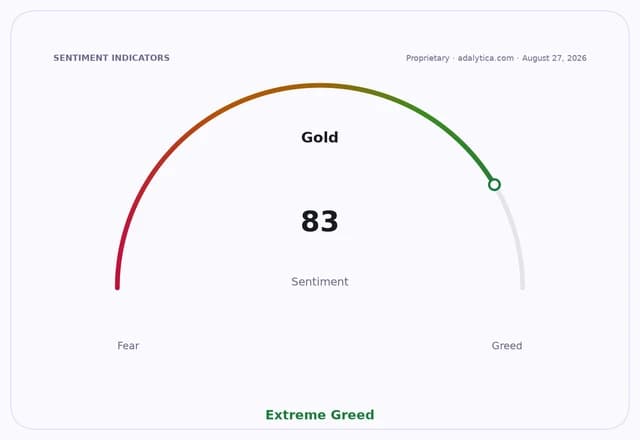
The dollar backdrop has turned increasingly supportive. Adalytica’s US Dollar Trade Signals show extreme fear at 11, with awareness still in extreme-greed territory, a combination that points to a brittle currency environment. Gold’s own Adalytica Fear & Greed Index sits at 83, or greed, after rising 27 points in the past week, suggesting momentum investors have joined traditional macro buyers.
The price action has also been unusually broad. The SPDR Gold Shares ETF rose to $421.32 on Wednesday, after touching $428.07 the prior session, leaving it well above its 50-day moving average of $385.16 and its 200-day average of $414.37. Its RSI reading of 71.4 indicates the fund is stretched but still in strong trend territory, while the MACD remains firmly positive. That kind of technical backdrop typically invites further inflows unless the macro narrative shifts sharply.
Gold miners are amplifying the move. The VanEck Gold Miners ETF climbed to $102.42, with Newmont closing at $131.60. Both names are trading far above their 50-day averages, reflecting the operating leverage miners get when bullion outpaces input costs. For investors, that is the bullish case: higher gold prices can expand margins and cash flow quickly.
The bear case is equally clear. RSI readings across GLD and GDX are elevated, and the pace of gains leaves the market vulnerable to a pullback if the dollar stabilizes, Treasury yields rise or inflation data cools enough to revive risk appetite. In that scenario, bullion’s safe-haven bid could unwind faster than miners’ earnings estimates adjust.
Still, the larger narrative is intact for now: investors are treating gold as a hedge against a policy mix that remains hard to trust and a global backdrop that still looks fragile. As long as the dollar stays under pressure and real-rate expectations remain uncertain, bullion is likely to keep attracting flows even after a move as large as this.
| Entity | Gains | Losses |
|---|---|---|
| Gold bullion | ▲Safe-haven demand | ▼Dollar-linked buyers |
| GLD holders | ▲Price momentum | ▼Late entrants |
| Gold miners | ▲Higher margins | ▼Cost-sensitive producers |
| U.S. dollar | ▲None | ▼Currency bulls |