Gold Hits Record Above $4,385 as Oil Eases
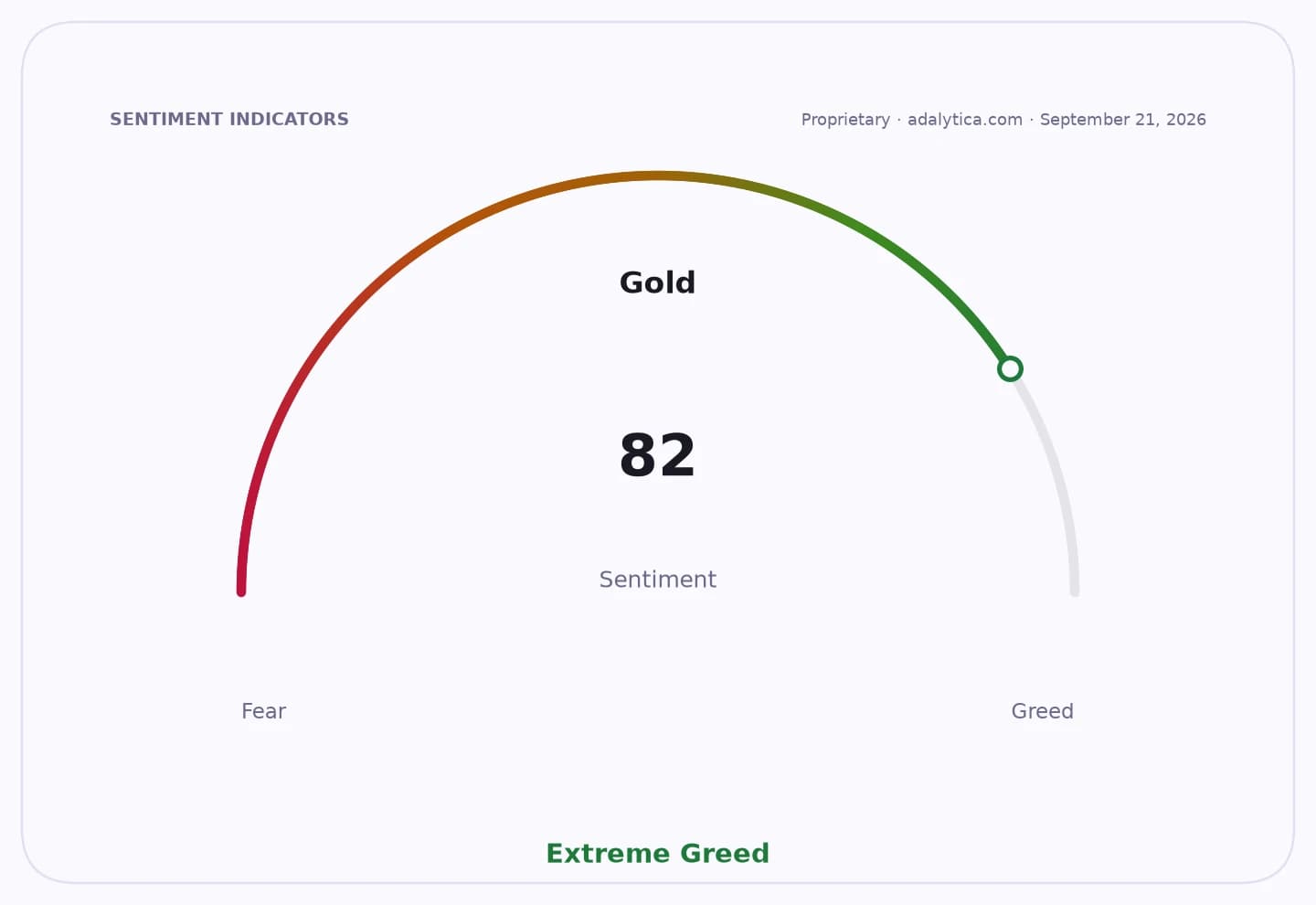
Gold surged to a record above $4,385 an ounce while oil and natural gas eased, underscoring a market that is pricing in tighter financial conditions, persistent geopolitical risk and a flight toward hard assets rather than broad commodity inflation.
That split matters because it says the commodity complex is not moving as one trade. Investors are rewarding the assets that benefit from uncertainty and policy stress, while rotating away from energy futures that had already rallied hard. For the real economy, that means higher hedging costs for miners and producers, mixed input relief for consumers, and a warning that central bank pressure can still lift gold even when inflation is not accelerating.
Gold’s move was the standout. The metal climbed 1.01% to $4,385.14, extending a powerful rally that has been reinforced by a weaker risk appetite and what Adalytica’s Gold Fear & Greed Index shows as extreme greed in the metal, even as broader awareness remains in “extreme fear.” That kind of positioning usually keeps momentum alive, but it also tells investors the market is no longer treating gold as a hedge alone — it is becoming a consensus macro allocation.
Silver, platinum and palladium also advanced, with silver jumping 2.18% to $66.64 and platinum and palladium rising 0.92% and 1.54%, respectively. That broad strength suggests the move is not just about one safe-haven trade. It reflects a deeper bid for scarce real assets, a pattern that often shows up when investors begin to doubt policy stability, currency purchasing power or the durability of growth.
Energy told the opposite story. Brent crude fell 1.06% to $103.71 a barrel and WTI dropped 1.94% to $99.93, even though both remain elevated by historical standards. Natural gas edged up to $2.91, but that barely offset the decline in oil and heating oil, which slipped 0.98% to $133.67. The message is simple: energy markets are still tight, but they are losing upside momentum at the same time that gold is accelerating. That divergence is important for inflation expectations, transport costs and corporate margins.
The technical picture in exchange-traded proxies reinforces the split. GLD, the gold ETF, has been steady around $399, with its 50-day moving average above the 200-day trend now giving way to a softer short-term consolidation after an enormous run. USO, the oil fund, has fallen back to $149.05 after surging into overbought territory earlier this month, with RSI readings still elevated even after the pullback. In plain English, the oil trade looks stretched, while gold remains structurally bid despite near-term volatility.
This is where the investable story gets interesting. The market is not simply betting on commodities; it is separating winners by balance-sheet strength, capital intensity and sensitivity to rates. Gold miners with low-cost production and disciplined capital returns can still outperform if bullion holds near record levels. Energy producers retain cash-flow power, but the easy trade is fading as oil backs off. And for industrial users, lower crude can provide some margin relief, but it won’t fully offset the cost pressure created by a pricey precious-metals complex and sticky geopolitical risk.
Adalytica’s U.S. Dollar Trade Signals also show extreme greed, which matters because a firmer dollar can cap some commodity upside while supporting gold’s role as a financial hedge rather than a pure inflation trade. Meanwhile, global stability sentiment has improved only to neutral, leaving enough uncertainty in the system to keep defensive commodity demand alive.
My view is that the market is underestimating how much this divergence can persist. Gold is behaving like the asset of choice in a world of higher-for-longer rates, policy noise and geopolitical fragility, while oil is trading more like a crowded cyclical hedge than a clean inflation winner. That creates an asymmetric setup: investors who want exposure should favor the assets that thrive when confidence weakens, not the ones that depend on a smooth macro landing.
The next catalyst is whether the Fed keeps financial conditions restrictive and whether geopolitical tensions continue to support safe-haven flows. If they do, gold and the miners remain the cleaner trade, while oil’s upside is more limited unless supply shocks reassert themselves. For investors, this is a moment to stay overweight gold exposure, keep energy positions selective, and treat the commodity market not as one theme, but as two very different trades.
| Entity | Gains | Losses |
|---|---|---|
| Gold / GLD | ▲Safe-haven demand | ▼Rate-sensitive buyers |
| Gold miners | ▲Higher bullion prices | ▼Higher-cost producers |
| Oil / USO | ▲Inflation hedge role | ▼Momentum traders on pullbacks |
| Industrial consumers | ▲Some fuel-cost relief | ▼Precious-metals users |