Happiest Minds merger seen as AI defense move
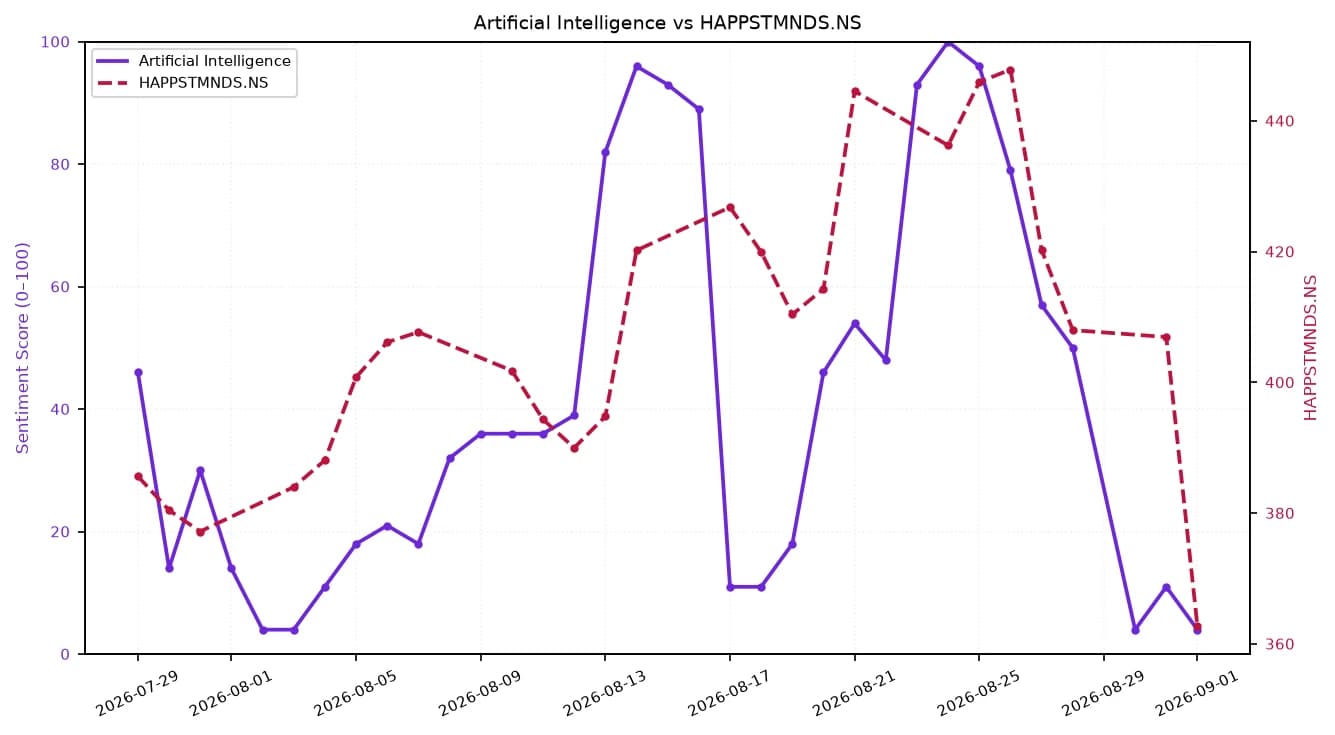
Happiest Minds Technologies’ planned merger with ITC Infotech is being driven less by scale for scale’s sake than by a tougher question facing mid-tier Indian IT services firms: how to defend revenue and margins as artificial intelligence changes what clients will pay for.
That is why the deal matters to investors. If AI-enabled automation is compressing billable hours and pushing customers to demand more outcomes for less money, then consolidation is becoming a survival strategy for smaller software exporters that lack the pricing power of larger rivals. The combination could give Happiest Minds more breadth across clients, industries and service lines, but it also underscores how much of the sector’s future growth will depend on whether companies can sell AI transformation rather than absorb AI-driven cost pressure.
Happiest Minds shares have been volatile through 2026, with the stock falling to 362.7 rupees on Sept. 1 from 444.55 rupees on Aug. 21. The drop pushed it below its 50-day moving average of 384.79 rupees and kept it under its 200-day moving average of 398.59 rupees, a sign that the market has already been discounting a weaker operating backdrop. The stock’s RSI reading of 42.9 is no longer deeply oversold, but it still reflects fragile momentum after a sharp selloff and heavy trading volume.
The transaction also lands in a sector where investors are increasingly separating AI beneficiaries from AI margin victims. Larger peers such as Infosys have steadier balance sheets, deeper enterprise relationships and more room to price consulting-led work, while smaller firms face greater pressure to stay relevant as clients automate testing, support and code generation. For Happiest Minds, combining with ITC Infotech could improve cross-selling and add scale in digital engineering and enterprise services, but it does not remove the central problem: if AI reduces the labor content of projects faster than firms can build new high-value offerings, revenue growth may be harder to sustain.
That dynamic helps explain the broader market reaction to IT services equities. Infosys ended Sept. 1 at 1,156 rupees, still below its 200-day average of 1,291.63 rupees, suggesting the sector remains under valuation pressure even for top-tier names. Investors are weighing whether AI will expand the addressable market through new spending on cloud, data and automation, or whether it will simply reprice delivery models and squeeze staffing-heavy revenue streams.
The bull case for the Happiest Minds-ITC Infotech merger is that scale now matters more than ever. In a market where clients are demanding fewer vendors, broader capabilities and measurable productivity gains, a combined platform could improve bargaining power and reduce duplication in sales, delivery and back-office functions. The bear case is that consolidation becomes defensive rather than accretive if the industry is forced to chase lower-price AI work just to preserve growth.
For investors, the key catalyst will be whether management can show that the merger expands higher-margin digital and AI-led work faster than it dilutes returns through integration costs. Until then, the deal reads as a response to structural revenue pressure, not a clean rerating event.
| Entity | Gains | Losses |
|---|---|---|
| Happiest Minds | ▲Greater scale, wider client base | ▼Integration risk, near-term margin drag |
| ITC Infotech | ▲Access to broader platform | ▼Loss of standalone optionality |
| Large Indian IT peers | ▲Relative pricing power | ▼Less room for smaller-firm weakness to stay isolated |
| Clients | ▲More vendor choice, AI-led efficiency | ▼Higher transition risk if consolidation slows service delivery |