High Rates Keep Mortgage Payoff Slow

The most important factor keeping borrowers from paying off mortgages faster is still the level of interest rates, which remains high enough to keep refinancing savings scarce and monthly cash flow tight.
That matters because the cost of money sets the pace of household debt reduction. The 10-year Treasury yield, a benchmark for mortgage pricing, was 4.54% on July 9 and 4.62% on July 13 before a slight forecast dip to 4.608% on July 14, while the federal funds rate sits at 3.63% to 3.64%. Even after the sharp collapse from the inflation-era peaks of more than 13% on the 10-year in the early 1980s, current borrowing costs remain elevated relative to the post-crisis era and far above the ultra-low-rate period that fueled the “buy now, refinance later” trade.
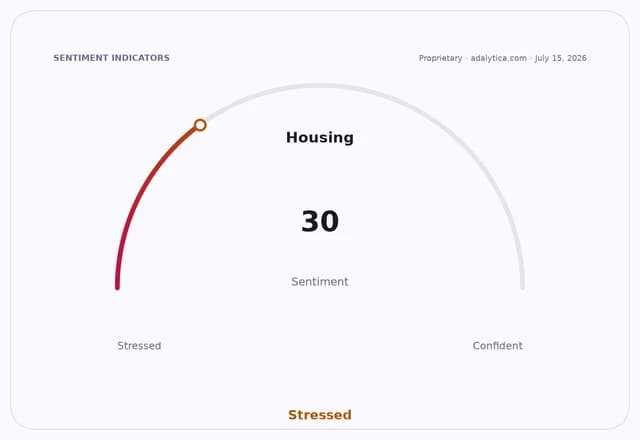
For homeowners, that means fewer chances to replace an old mortgage with a cheaper one and less incentive to accelerate principal payments through a lower-rate refinance. The housing market is still struggling with the hangover from years of cheap debt: housing starts fell to 1,177 in May from 1,392 in April, underscoring how high financing costs are suppressing construction and turnover. When rates stay sticky, sellers stay put, buyers face affordability pressure and existing borrowers are less likely to find a refinancing window wide enough to materially shorten their loan term.
The market signals point in the same direction. Adalytica’s Treasury-bond trade signal is showing “Extreme Fear,” reflecting persistent caution around duration assets, while its housing and rent inflation sentiment remains in “Fear” territory even after a brief rebound. That is consistent with a market still pricing a slower, bumpier decline in mortgage costs rather than a clean break lower. Rocket Companies and PennyMac Financial, two lenders closely tied to refinancing and servicing activity, have seen their shares swing sharply as investors handicap whether rate relief will finally arrive; PennyMac’s recent rebound and Rocket’s technical recovery from June lows suggest traders are still betting on some easing, but not enough to restore the refinance boom.
The bull case for faster mortgage payoff is straightforward: if long-term yields ease and the Fed continues to hold or cut policy rates, more borrowers could refinance into lower coupons, freeing up cash to make extra principal payments or refinance into shorter terms. The bear case is that sticky inflation, firmer Treasury yields and a still-fragile housing market keep mortgage rates high enough to preserve the status quo, leaving many households locked into loans that are expensive to prepay.
For investors, the key implication is that the mortgage market remains a rate story first and a housing story second. Until long yields fall decisively, the path to faster mortgage payoff will depend more on borrower discipline and wage growth than on refinancing. That keeps pressure on home sales, construction and mortgage originators, while supporting servicing portfolios and limiting the urgency for lenders that depend on refinance volume to drive earnings.
| Entity | Gains | Losses |
|---|---|---|
| Borrowers with low-rate cash flow | ▲Can chip away at principal | ▼Few refinance savings |
| Mortgage servicers | ▲Longer fee streams | ▼Less payoff volume |
| Homebuilders | ▲Limited rate relief supports supply discipline | ▼Higher rates curb demand |
| Refinance lenders | ▲Possible upside if yields fall | ▼Weak volumes if rates stay high |