Investors are waiting for a new debt-arrangement platform to open the 72-tranche menu, and the economic stakes are whether it reduces refinancing pressure or simply rolls it forward at a higher cost. With the US 10-year Treasury yield at 4.56% and the two-year at 4.21%, funding is still expensive enough to reward stronger borrowers and punish weaker ones.
Higher-for-longer rates favor strong borrowers

That matters because the spread between sovereign rates and credit risk remains the key price signal across the market. The US high-yield spread is about 2.69 percentage points, down sharply from recent highs, but not low enough to suggest debt markets are suddenly forgiving.
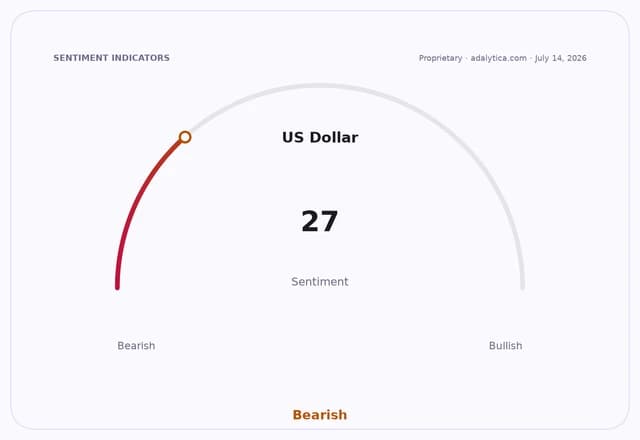
Sentiment IndicatorsⓘProprietary · adalytica.com · July 14, 2026
This is a snapshot — live sentiment, awareness and momentum for 130+ markets update continuously in the dashboard.Open AlphaPulse

For investors, the immediate winners are issuers that can extend maturities without needing distressed pricing, along with lenders and arrangers that collect fees from restructuring activity. The losers are highly levered borrowers that must tap the market in a rate environment where even investment-grade debt remains anchored above 4%, while riskier credits still face a material premium.
Treasuries have been volatile but not collapsing into the kind of rally that would make refinancing easy. TLT, the long-duration Treasury ETF, closed at 83.97 on July 13, below its 50-day moving average of 84.98 and 200-day average of 86.06, while its RSI sat at 31.3, signaling a weak technical picture rather than a decisive recovery in bond prices.
DGS10 vs BAMLH0A0HYM2 — macro contextadalytica.com
Explore this data interactively — full history, time series and cross-market comparisons.Open AlphaPulse
IEF, which tracks intermediate Treasuries, also drifted lower to 93.29, with the close below both its 50-day and 200-day moving averages. That keeps the broader message intact: debt costs are easing only marginally, not enough to remove the pressure on borrowers who need new terms.
The credit market is sending a slightly more constructive signal. HYG, the high-yield bond ETF, held at 79.52, above its 50-day average of 79.37 and 200-day average of 78.43, suggesting investors are still willing to buy risk, but cautiously. Adalytica’s US Treasury Bonds Trade Signals show “Extreme Fear” on TLT, underscoring how little conviction there is behind a sustained duration bid.
The broader narrative is that debt restructuring is becoming a selection game. Firms, households and sovereign-linked borrowers with cash flow and collateral can use the platform to buy time; those already stretched may only be converting today’s stress into tomorrow’s larger liability.
The next catalyst is whether the opening of the 72 tranches draws real demand or exposes how little room borrowers have left before higher-for-longer rates force more aggressive restructuring.
| Entity | Gains | Losses |
|---|---|---|
| Strong borrowers | ▲Maturity extension | ▼Lower-quality credits |
| Banks/arrangers | ▲Restructuring fees | ▼Delinquent lenders |
| HYG holders | ▲Carry from spread income | ▼Default-sensitive names |
| TLT/IEF bulls | ▲Little near-term gain | ▼Duration buyers |




