Hong Kong launches offshore Chinese bond futures

Hong Kong’s launch of offshore Chinese government bond futures is the clearest sign yet that Beijing is trying to build a deeper, more tradeable yuan ecosystem without fully liberalizing its onshore markets.
The new contracts matter because they give global banks, asset managers and hedge funds a cleaner way to hedge duration and interest-rate risk tied to Chinese sovereign debt, a market that has long lacked the kind of offshore derivatives infrastructure that supports the dollar, euro and yen. That makes the yuan more usable in day-to-day portfolio management and, over time, more credible as a settlement and reserve currency.

The initiative also fits a broader policy pattern: China wants the offshore yuan to do more of the heavy lifting in cross-border finance while preserving tight control over domestic capital flows. Hong Kong remains the natural venue for that effort, combining international market access with proximity to mainland policy-making.
For investors, the practical importance is less about near-term trading volume than about market plumbing. If the futures gain traction, they could lower hedging costs for holders of Chinese bonds and encourage more foreign participation in the market. That, in turn, would support demand for yuan assets and make Chinese fixed income easier to own through market cycles.
The launch comes at a time when the US yield backdrop still dominates global rates pricing. The 10-year Treasury was trading around 4.61%, with the 2-year near 4.26%, leaving the curve only modestly positive at about 0.47 percentage point. That remains a reminder that Chinese rate products will be priced against a high-yield dollar benchmark, not in a vacuum.
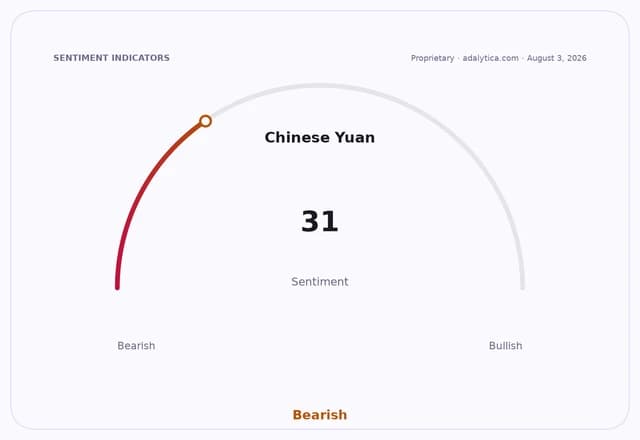
Still, the symbolism is important. Offshore yuan sentiment, while neutral in the latest Adalytica snapshot, has improved over the past week, while dollar trade signals remain extremely strong. That means the futures launch arrives into a market where the greenback still has the upper hand, but policymakers are actively trying to widen the yuan’s share of international flows.
The bull case is that Hong Kong’s contract becomes a standard hedging tool and deepens China’s financial infrastructure just as foreign institutions look for more ways to access onshore and offshore Chinese assets. The bear case is that liquidity stays thin, capital controls limit the link with the mainland bond market and the product remains more of a policy statement than a real market bridge.
For investors, the key test will be whether the contracts attract sustained participation from foreign real-money accounts, not just local traders. If they do, the launch could become an incremental but meaningful step in yuan internationalisation; if not, it will reinforce how far China still has to go to match the global reach of dollar-based markets.
| Entity | Gains | Losses |
|---|---|---|
| Hong Kong exchanges | ▲More trading activity | ▼Execution risk |
| Offshore yuan users | ▲Better hedging tools | ▼Thin initial liquidity |
| Chinese policymakers | ▲Yuan internationalisation | ▼Full capital-control flexibility |
| Dollar-based markets | ▲— | ▼Slight loss of market share potential |