Household finances hold up as consumer data steadies
Household finances are holding up better than many voters and investors may expect, and that matters because consumer strength still drives the U.S. economy, bank earnings and the market’s confidence in a soft landing.
The clearest signal in the data is the labor market. The unemployment rate is forecast to edge down to 4.09% in August from 4.1% in July, a level that remains low by historical standards and suggests households are still bringing home paychecks. Core inflation, meanwhile, is projected to rise only 0.21% on the month, pointing to a slower pace of price pressure than in the inflation spike that squeezed consumers over the past several years.
That combination helps explain why household balance sheets have been more resilient than the political debate often suggests. Consumer finances are not booming, but they are not breaking down either. The picture is one of cautious stability: job market support on one side, lingering price pressure on the other. For voters heading into an election, that tends to favor incumbents less than fully, but it also keeps the economy from tipping into recession.
Investors should care because household health sits at the center of almost every major asset class. Consumer discretionary stocks, bank shares and credit-sensitive names all depend on whether people keep spending, borrowing and paying bills on time. The consumer-discretionary ETF XLY has recovered to about $118, while financials ETF XLF has climbed to roughly $57.50 and regional-bank ETF KRE trades near $74.86, showing that markets are still willing to price in a durable consumer, even after bouts of volatility.
Technical readings back up that cautious optimism. XLF remains above both its 50-day and 200-day moving averages, while KRE is also trading above both long-term benchmarks, a sign that investors are still rewarding banks and lenders that benefit from steady deposits and loan demand. That matters for companies such as JPMorgan Chase, Bank of America and Wells Fargo, which have all reported deposit growth in recent filings, and for card lenders including American Express and Capital One, where consumer spending and repayment behavior are key to earnings power.
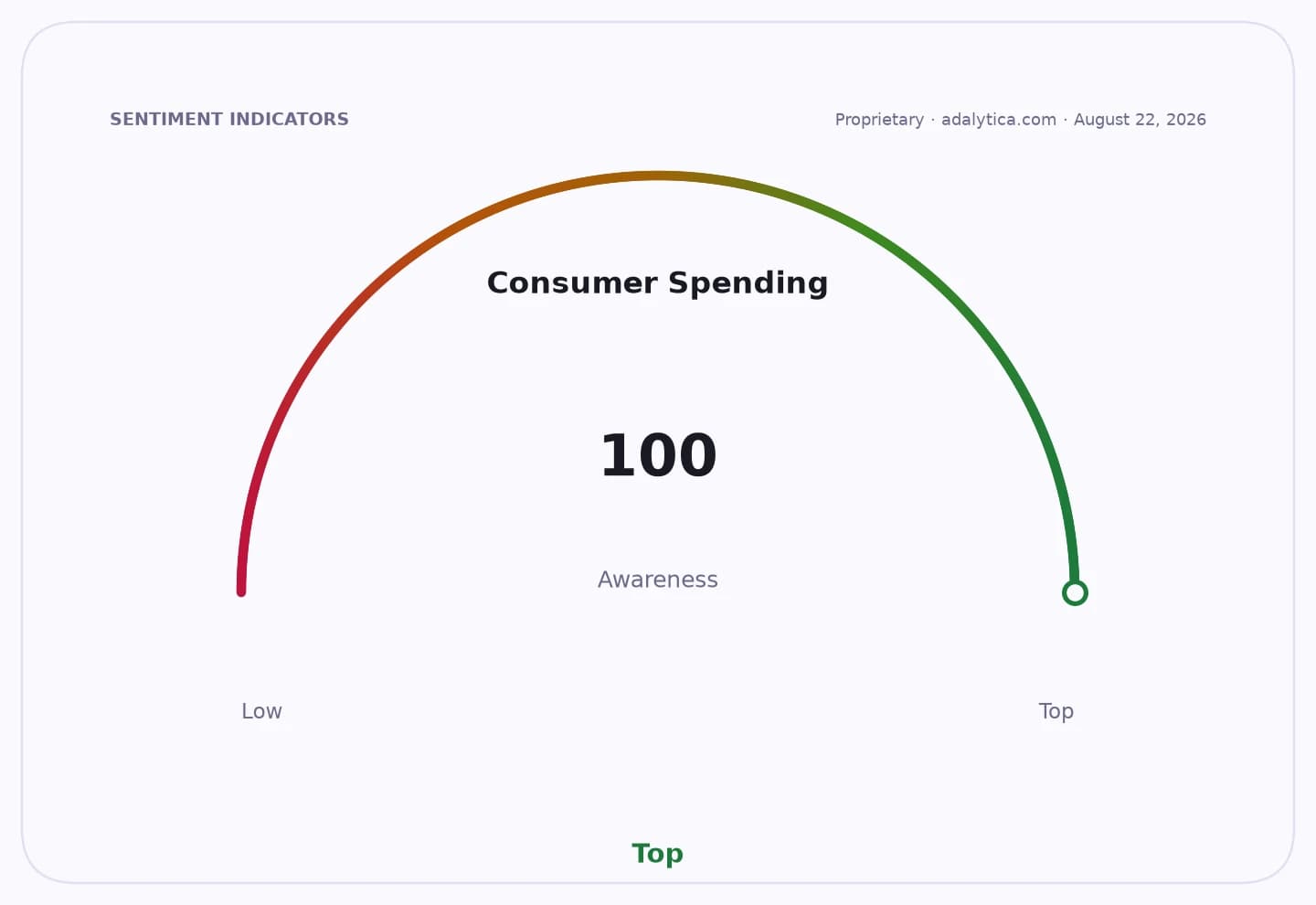
The consumer story is not uniformly cheerful. Adalytica’s Consumer Spending Sentiment gauge has dropped to 25, marked “Fear,” while its Credit Card Usage Sentiment is also at 25. That lines up with the reality that many households still feel squeezed even if macro data look fine. People can feel pressured and still keep spending, especially when employment remains steady. That disconnect is often what keeps retail sales, card volumes and bank fee income from rolling over all at once.
The broader narrative is simple: households are entering the election season in better shape than the mood music suggests, and that gives the economy a cushion. If unemployment stays close to 4% and inflation keeps cooling, consumers should remain the engine of growth, supporting earnings for banks, retailers and payment companies. For long-term investors, that argues for staying diversified, focusing on cash-generating businesses and using pullbacks in consumer and financial stocks as opportunities rather than reasons to flee. Worth watching, not panicking over.
| Entity | Gains | Losses |
|---|---|---|
| Households | ▲More stable finances | ▼Less urgency for relief |
| Banks and card lenders | ▲Steady lending and spending | ▼Fewer crisis-driven gains |
| Consumer stocks | ▲Better demand outlook | ▼Weak fear-driven trading |
| Policymakers | ▲Softer recession risk | ▼Less room for political credit |