India RBI proposal could curb NBFC revolving credit
India’s proposal to restrict revolving credit at non-bank lenders could tighten a crucial funding channel for small businesses and ripple through the broader credit market, with industry body FISME warning that millions of micro, small and medium enterprises may find working-capital access harder to secure.
That matters because revolving credit is not a niche product for India’s MSME sector; it is often the bridge that keeps inventories moving, wages paid and supplier bills current between receivables. If the Reserve Bank of India’s proposal is adopted in its current form, lenders may become more cautious on unsecured and flexible credit lines, forcing smaller borrowers toward term loans, informal finance or more expensive substitutes. For an economy that still relies heavily on MSMEs for jobs and supply-chain depth, even a modest tightening can have outsized effects on liquidity and near-term activity.
The warning comes as India’s domestic credit landscape is already uneven. Standard market gauges on the India ETF INDA show the fund trading at 49.35, below its 50-day average of 49.34 and under its 200-day average of 50.64, suggesting investors are not pricing in a broad reacceleration in growth. Financial-sector exposure has fared better, with the bank ETF IYF at 137.36 and comfortably above both its 50-day and 200-day averages, while HDB has slipped to 23.54, well below its longer-term trend. That split underscores a market that is rewarding balance-sheet strength while remaining wary of policy and credit-quality pressure in India-linked lenders.
For non-bank finance companies, the proposal could hit a business model built around flexibility. Revolving facilities typically generate fee income, help retain borrowers and allow NBFCs to finance short-cycle working-capital needs that banks often avoid. Limiting them would not just reduce asset growth; it could also compress margins and raise the cost of acquiring MSME customers. The biggest winners would be banks with lower funding costs and stronger deposit franchises, while the losers would be NBFCs that rely on turnover-driven lending and the smaller firms that depend on fast, repeat access to credit.
The policy debate is landing at a delicate moment. Supportive lending conditions have been part of India’s broader growth story, and lower borrowing costs have been intended to help businesses and stimulate activity. But regulators are also under pressure to rein in leverage and prevent credit from being extended too loosely through unsecured or revolving structures. That leaves the RBI trying to balance financial stability against the risk of choking off the very working capital that keeps small enterprises afloat.
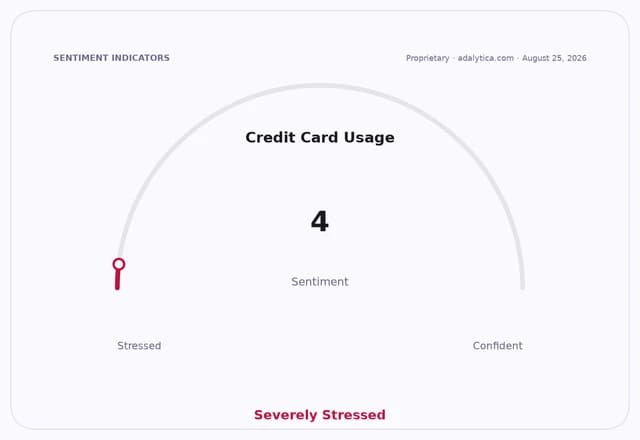
Adalytica’s proprietary sentiment gauges point to the same tension in household and credit conditions: payroll sentiment is in extreme greed, while credit-card usage sentiment is in extreme fear and household debt stress remains depressed. Those readings suggest consumers may still have income support, but revolving borrowing appetite is fragile, making any regulatory tightening more consequential for small-ticket lenders and consumption-linked MSMEs.
For investors, the key question is whether the RBI stops at tighter underwriting standards or moves toward a broader curb that materially limits product design at NBFCs. A narrower rule would likely be absorbed by larger lenders with diversified books. A tougher version would favor banks and disciplined deposit-funded franchises, while pressuring NBFC valuations, MSME credit growth and, by extension, the more cyclical parts of India’s domestic demand story.
| Entity | Gains | Losses |
|---|---|---|
| Banks | ▲More market share in working capital | ▼Slower NBFC competition |
| NBFCs | ▲Less regulatory ambiguity if rules are narrow | ▼Lower revolving-loan growth |
| MSMEs | ▲Clearer credit standards | ▼Tighter funding access |
| RBI / Regulators | ▲Lower leverage risk | ▼Growth slowdown risk |