Iraq’s signing of 48 economic agreements with U.S. companies is bigger than a ceremonial handshake: it is an attempt to turn a fragile geopolitical opening into the kind of long-term investment platform that global capital usually avoids until the risk premium comes down.
Iraq Seeks U.S. Investment Platform
That matters because Iraq still sits on one of the world’s most strategically important energy and infrastructure grids, and investors know that any serious improvement in security, governance and foreign partnerships can unlock decades of spending in oil, power, telecom and logistics. Deals involving Starlink, Exxon and GE point to exactly that mix — digital connectivity, upstream energy and industrial infrastructure — the three ingredients that can make an economy more investable over time.
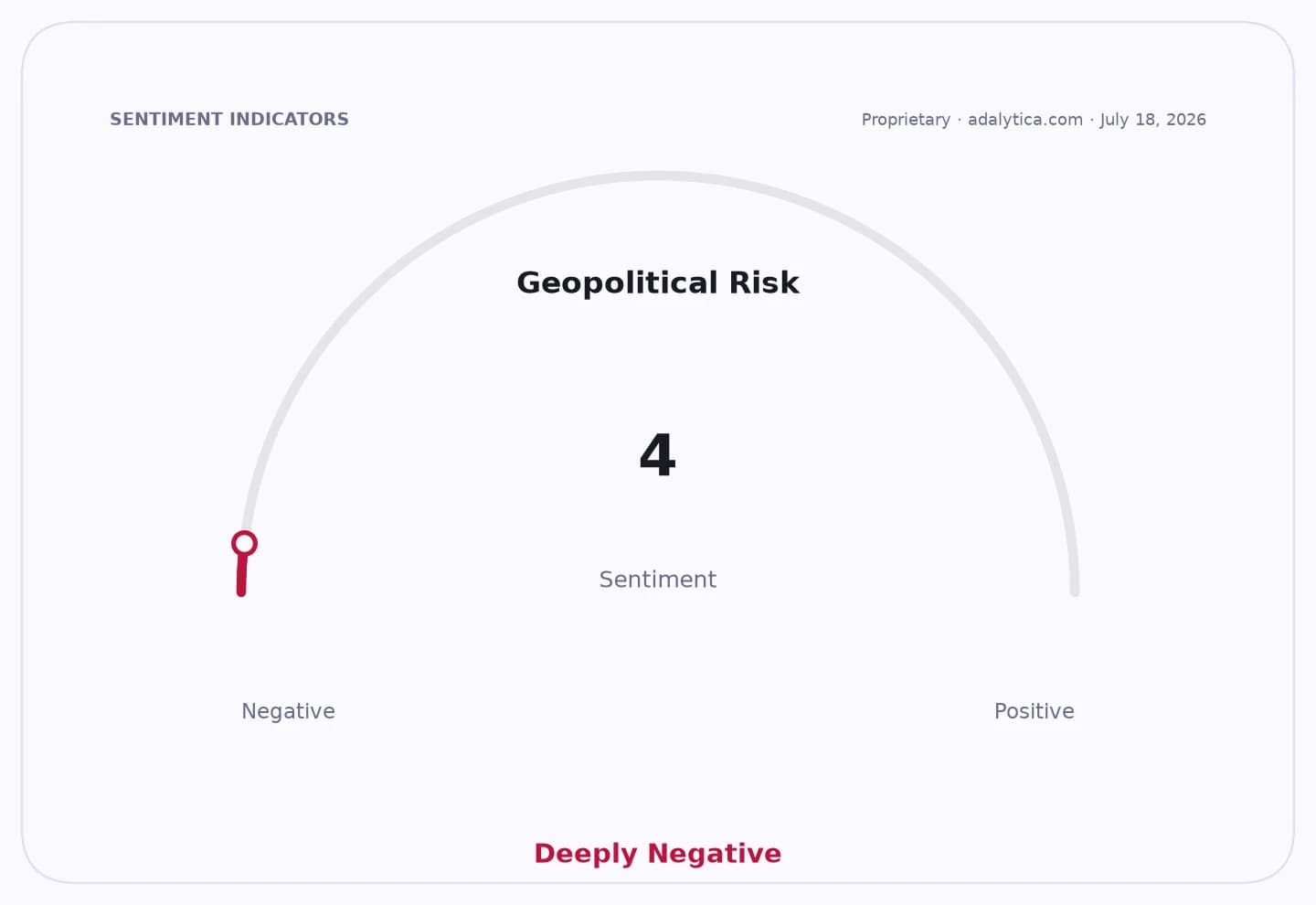
Sentiment IndicatorsⓘProprietary · adalytica.com · July 18, 2026
This is a snapshot — live sentiment, awareness and momentum for 130+ markets update continuously in the dashboard.Open AlphaPulse
For oil markets, the timing is important. Brent’s U.S. benchmark equivalent has swung sharply in recent months, with West Texas Intermediate now around $78 a barrel after trading above $109 in early May and sinking into the low $70s in July. That kind of volatility reminds investors that supply in the Middle East still has the power to move prices and sentiment quickly. Iraq’s effort to deepen ties with Washington can be read as a hedge against isolation and instability, and as an appeal for the capital and technology needed to keep production and exports competitive.
The broader macro backdrop also helps explain why this announcement lands with weight. The U.S. 10-year Treasury yield is sitting around 4.6%, a level that keeps global funding costs elevated and makes investors more selective about emerging-market risk. In that environment, countries need more than resources; they need credibility. Baghdad is signaling that it wants to be seen as a place where U.S. companies can win contracts, build networks and commit capital without having to price in constant political shocks.
That is where the corporate winners come in. Exxon stands to gain from any long-cycle expansion in Iraqi energy investment, especially if the country wants to sustain output and attract better technology. GE’s role suggests a push into power and industrial systems, which could help address chronic infrastructure bottlenecks that have long held back growth. Starlink’s inclusion is a reminder that modern investment stories are not just about barrels and turbines — they are also about data, communications and the ability to connect a large, underpenetrated economy to the rest of the world.
Investors should also notice what Iraq is trying to do diplomatically. The government’s moves to investigate alleged weapons smuggling and tighten regional balance are not separate from the investment story; they are part of it. Foreign capital usually follows improved state control, not the other way around. If Baghdad can show it is serious about sovereignty and predictability, these agreements could be the first step in lowering the country’s risk premium.
Of course, Iraq still carries the obvious risks: militia influence, regional friction and the possibility that headline-grabbing deals do not translate into execution. But for long-term investors, the important question is not whether Iraq becomes safe overnight. It is whether the country is building the institutions and partnerships that make future cash flows more durable. That is what this package of agreements is really about.
If the government follows through, this could become one of those slow-burn investment stories that compounds for years rather than weeks. For patient investors, Iraq is still a watchlist name, not a core holding — but this is exactly the kind of development that can matter a lot in a 5- to 10-year horizon.
| Entity | Gains | Losses |
|---|---|---|
| Iraq | ▲More foreign capital | ▼Higher execution pressure |
| U.S. firms | ▲New contracts and market access | ▼Political and security risk |
| Exxon & GE | ▲Long-cycle project opportunities | ▼Delays and policy uncertainty |
| Oil buyers/importers | ▲Potentially steadier supply | ▼Less leverage from chaos |