Japan-China parliamentary visit planned in September

Japan’s cross-party Japan-China Parliamentary Federation is arranging a trip to China within the month, a small but notable diplomatic opening as the two countries manage frictions over security, history and regional influence that can spill into trade and market sentiment.
The move matters economically because Japan and China are deeply intertwined through supply chains, tourism and corporate investment, and even modest shifts in tone can affect everything from consumer demand to capital flows. With China pressing Japan to distance itself from what it calls militarism, and Tokyo simultaneously deepening security cooperation elsewhere in Asia, the visit suggests both sides still see value in keeping communication channels open.

Moriyama Hiroshi, the federation’s chairman and former Liberal Democratic Party secretary-general, said on Sept. 3 that younger members are coordinating the trip, according to Kyodo. The planned visit comes against a backdrop of strained bilateral ties, including Beijing’s criticism of Japan’s hypersonic and underwater weapons development and its demand for accountability after a Japanese Self-Defense Forces officer was dismissed over an intrusion at the Chinese embassy.
For investors, the significance is less about an immediate policy shift than about the risk premium attached to Japan-China relations. Easing tensions could support sectors exposed to Chinese demand, including Japanese exporters, retailers and travel names, while a fresh deterioration would keep pressure on those same areas and could reinforce defensive positioning in regional assets.
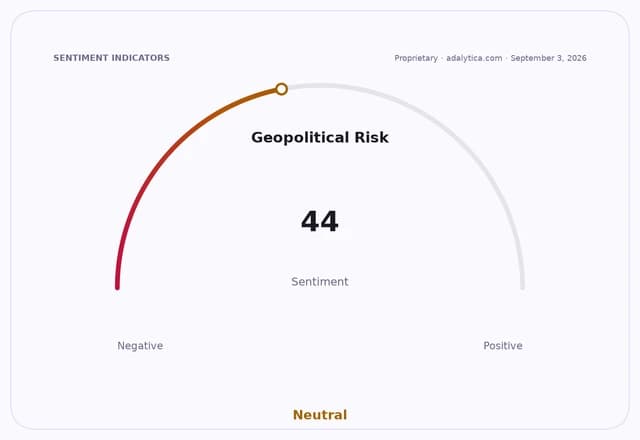
The market backdrop is already sensitive. Shares of iShares MSCI Japan ETF EWJ were at $96.04 on Sept. 2, above both its 50-day moving average of $94.02 and 200-day average of $88.19, while the iShares China Large-Cap ETF FXI closed at $35.54, still below its 200-day average of $36.53. That split suggests investors remain more constructive on Japan than China, even as diplomacy becomes the next catalyst.
Adalytica’s US–China Relations Sentiment gauge shows neutral readings, but China’s Communist Party policy-direction snapshot remains at extreme fear, underscoring how fragile the regional backdrop is. Any sign that the parliamentary visit leads to deeper political contact would likely be welcomed by markets, while failure to cool rhetoric could quickly revive geopolitical risk in Asian equities and currencies.
| Entity | Gains | Losses |
|---|---|---|
| Japan exporters | ▲Better China access, steadier demand | ▼Trade friction, weaker China sales |
| Chinese consumer and industrial names | ▲Lower diplomatic risk, improved sentiment | ▼More political tension, policy caution |
| EWJ holders | ▲Support from de-escalation, relative stability | ▼Regional risk repricing |
| FXI holders | ▲Possible thaw in Japan ties | ▼More geopolitical pressure, weaker confidence |