Japan-China Tensions, Japan ETF EWJ Above Averages

Japan and China are again being forced to confront the gap between regional slogans and regional reality, and that matters because the economic stakes of their relationship are far bigger than any opening ceremony promise of unity.
The immediate story is not about sport. It is about whether Asia’s two largest economies can sustain enough political cooperation to keep trade, investment and tourism flowing while their strategic rivalry deepens. The Aichi-Nagoya Asian Games are built around the slogan “IMAGINE ONE ASIA,” but the article’s sharper point is that slogans cannot override history, territorial friction or worsening geopolitical mistrust. That disconnect is now an investable risk.

For markets, the warning is clear: Asia’s growth model still depends on cross-border demand and supply chains, yet the region is entering a period where nationalism and security concerns are increasingly overriding economics. When Japan and China drift further apart, exporters, manufacturers and tourism-linked businesses face more volatility, while defense, industrial automation and supply-chain reconfiguration become longer-duration beneficiaries.
That tension is showing up in market signals. The Japan ETF EWJ has climbed to $96.04, above its 50-day moving average of $94.02 and its 200-day average of $88.19, suggesting investors are still willing to pay for Japanese exposure despite geopolitical noise. The China ETF FXI, by contrast, is at $35.54, below its 200-day moving average of $36.53, underscoring the market’s continued skepticism about China’s policy backdrop and external positioning. The divergence is even more striking in the currency-sensitive and shareholder-friendly Japan trade: the DXJ ETF sits at $180.15, well above its 50-day average of $176.58 and 200-day average of $161.77, reflecting persistent investor appetite for Japan equities hedged against yen swings.
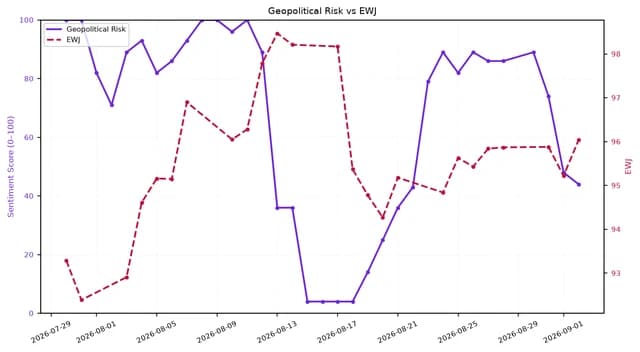
What the market underestimates is that strained Japan-China relations are no longer just a diplomatic headline; they are a capital-allocation story. As geopolitical sentiment weakens, companies with exposure to regional tourism, consumer demand and discretionary trade face a higher discount rate. Meanwhile, firms tied to domestic reindustrialization, semiconductor equipment, defense procurement and automated manufacturing gain from a world where governments want more resilient supply chains and less dependence on rivals.
Adalytica’s Global Stability Sentiment has fallen to 44, while its China policy-direction gauge is at an extreme-fear reading of 4, reinforcing the view that investors should not expect a quick normalization in regional politics. By contrast, the U.S.-China relations gauge has improved to 70, suggesting capital is still searching for relative rather than absolute stability — another reason Japan can attract flows even when broader Asia looks fragile.
The investment takeaway is simple: the Asian Games slogan is aspirational, but the trade is real. I believe the market continues to misprice the beneficiaries of fragmentation and to overstate the durability of “Asia as one” assumptions. Investors should favor Japan’s reindustrialization and currency-hedged equity exposure, while remaining cautious on businesses that need a smooth Japan-China détente to grow.
| Entity | Gains | Losses |
|---|---|---|
| Japan exporters and industrials | ▲Supply-chain rerouting, domestic investment | ▼Softer China demand |
| Tourism and consumer brands | ▲Regional stability and travel flow | ▼Diplomatic friction |
| Defense and automation names | ▲Higher security capex | ▼Low-friction globalization |
| China-facing cyclicals | ▲Policy easing if ties improve | ▼Geopolitical discount |