Japan Spending Weak, Exporters Still Lead Market

Japan’s economy is losing momentum because households are not spending enough to keep domestic demand ahead of external support from exporters, leaving growth vulnerable just as policy makers are trying to stabilize a fragile recovery.
That matters because Japan has spent years trying to escape a cycle of weak demand, low inflation and stalled wage growth. When spending softens, the economy becomes more dependent on overseas demand and a weak yen, a combination that can support manufacturers in the short run but does little to build a durable expansion at home. For investors, that split is crucial: it favors exporters and global earnings plays while pressuring retailers, consumer-facing companies and any policy trade that depends on a broad-based consumer rebound.
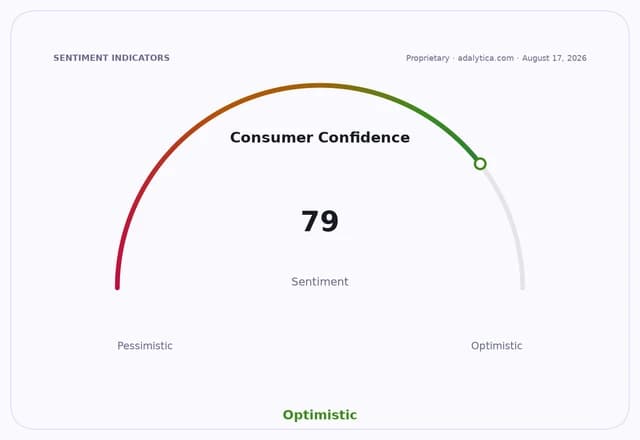
The latest data point to a sharp imbalance. Adalytica’s Consumer Spending Sentiment gauge, while still in greed territory at 75, has been volatile and recently swung from extreme caution back to optimism, suggesting confidence remains unstable rather than firmly entrenched. Retail-goods spending sentiment has only recovered to neutral at 54 after a recent drop, a sign that discretionary demand is not yet strong enough to drive a clean acceleration in GDP. That fragility is exactly why export support has not translated into stronger overall growth.
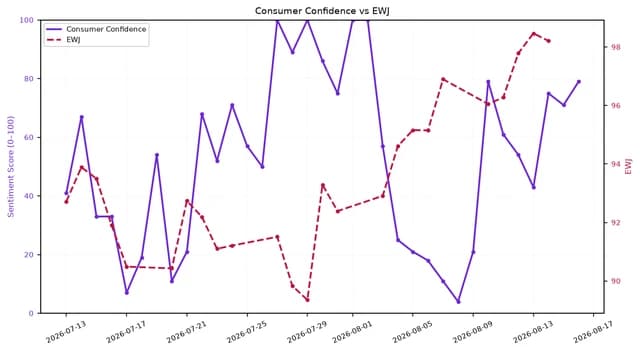
At the same time, the Japanese equity market has been rewarding the more obvious winners of a weak-yen, export-led backdrop. The iShares MSCI Japan ETF, EWJ, has climbed to 98.21 from 76.21 late last year, while the WisdomTree Japan Hedged Equity Fund, DXJ, has surged to 182.17 from 126.01. That divergence tells you the market is still preferring foreign-exchange hedged and exporter-heavy exposure over the domestic economy. Investors are effectively buying Japan’s global earners, not its consumer recovery.
The currency backdrop reinforces that message. Adalytica’s USD trade signals show extreme fear around the dollar, while the yen remains under pressure despite a rare coordinated U.S.-Japan intervention aimed at supporting it. A weaker yen can improve translated profits for exporters and bolster competitiveness abroad, but it also raises import costs and squeezes household purchasing power. If spending stays weak, the yen’s support for corporate profits may come at the expense of domestic demand.
That creates a clear investment map. The market underestimates how long Japan’s growth can remain bifurcated: exporters, auto suppliers and multinational industrials can keep outperforming, while domestic retailers, consumer staples and service names tied to real wage growth need stronger household spending to re-rate. Honda’s latest filing, which cited a weaker yen during the first quarter, is a reminder that exporters continue to benefit from the currency backdrop even as the domestic economy lags.
For investors, the opportunity is to stay aligned with the winners of Japan’s current imbalance rather than wait for a consumer-led recovery that is not yet visible. I would lean into hedged Japan exposure and export-heavy sectors, while treating domestic demand plays as a later-cycle trade until spending data show a convincing turn. The key catalyst to watch is whether wages and confidence can finally convert into sustained household outlays; until then, weak spending remains the economy’s biggest constraint and the market’s most important sorting mechanism.
| Entity | Gains | Losses |
|---|---|---|
| Japanese exporters | ▲Stronger overseas profits | ▼None from weak yen |
| Domestic retailers | ▲Potential future rebound | ▼Soft household demand |
| Hedged Japan ETFs (DXJ) | ▲FX insulation | ▼Less benefit from yen strength |
| Unhedged Japan ETFs (EWJ) | ▲Broad market upside | ▼Currency drag on returns |