MG Design Row Highlights China Auto Margin Pressure
MG’s presentation at Auto China drew accusations that the brand had copied rival designs, underscoring how fierce competition in the world’s largest auto market has pushed styling, pricing and product development into a new phase of scrutiny.
The immediate issue is not a one-off branding gaffe. It is a sign that Chinese automakers and China-based global brands are now fighting on an increasingly crowded design frontier, where differentiation matters as much as battery range and software. In a market under pressure from slowing domestic demand, the ability to stand out visually and technically has become a commercial asset, while accusations of imitation can quickly erode trust and pricing power.
That matters economically because China’s auto industry is no longer just chasing volume. It is trying to move up the value chain, build export brands and convert scale into margins. When rivals accuse one another of copying, the dispute speaks to how quickly product cycles are compressing and how aggressively manufacturers are benchmarking each other. That can be efficient for consumers, who get more features at lower prices, but it also intensifies deflationary pressure across the sector as companies compete on near-equivalent products.
The market is already pricing in that tension. Nio shares have staged a sharp rebound from a December low of 4.79 dollars to 4.78 dollars in the latest trading point after more than 90 per cent upside at one stage, but the stock remains volatile and technically mixed, with the 50-day moving average at 5.47 dollars and the 200-day average at 5.71 dollars. Tesla, meanwhile, is trading at 407.76 dollars after swinging above 490 dollars in December, with its price still below the 200-day average of 418.14 dollars. That suggests investors remain sensitive to any sign that Chinese competition is closing the gap on design, execution and brand cachet.
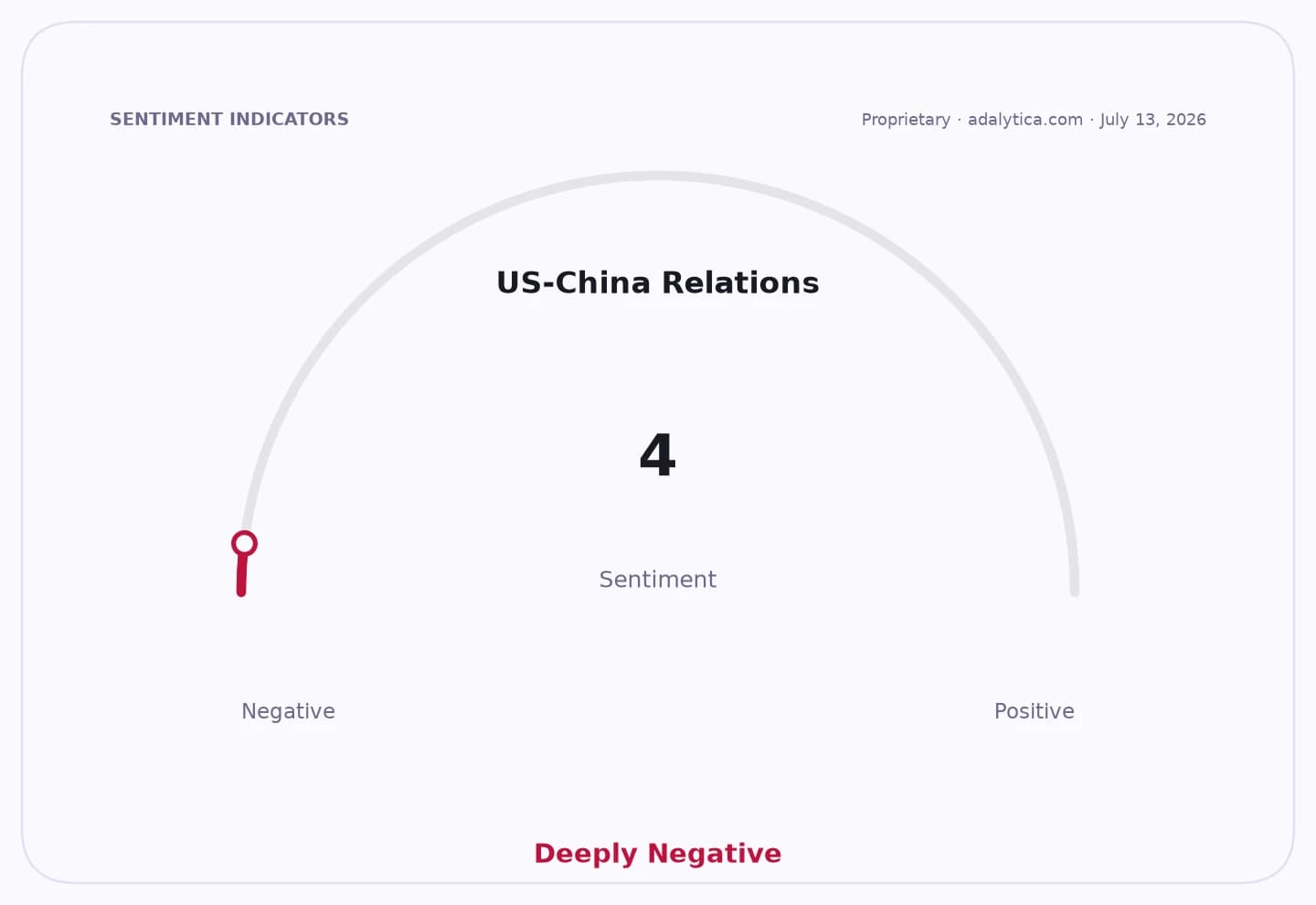
The China backdrop is also important. Adalytica’s US–China Relations Sentiment gauge shows “Extreme Fear,” even as awareness of the issue sits at “Extreme Greed,” a combination that reflects how heavily investors are tracking the strategic and commercial consequences of the rivalry. China’s own policy-direction sentiment is neutral, but the broader message from the Auto China controversy is that Beijing’s carmakers are pushing outward just as international trade and technology tensions make global expansion harder to execute cleanly.
For MG, the accusation could be a reputational problem if it reinforces the view that Chinese brands are still borrowing rather than leading. The bull case is that rapid iteration and competitive benchmarking are simply how the industry innovates now, and that consumers care more about price, range and software than styling disputes. The bear case is that design controversies weaken premium perception at the very moment Chinese automakers are trying to establish themselves abroad.
Investors should watch whether the row fades as a passing show-floor controversy or becomes part of a broader debate over originality in China’s auto export push. If the industry’s next phase is about global brand building rather than domestic market share, design credibility may prove just as important as scale.
| Entity | Gains | Losses |
|---|---|---|
| Chinese automakers with low-cost EVs | ▲Faster exports | ▼Design credibility |
| Consumers | ▲Lower prices | ▼Clear differentiation |
| Established rivals | ▲More scrutiny of peers | ▼Margin pressure |
| MG | ▲Brand attention | ▼Reputation risk |