Microsoft AI Disclosure Gap Clouds Returns
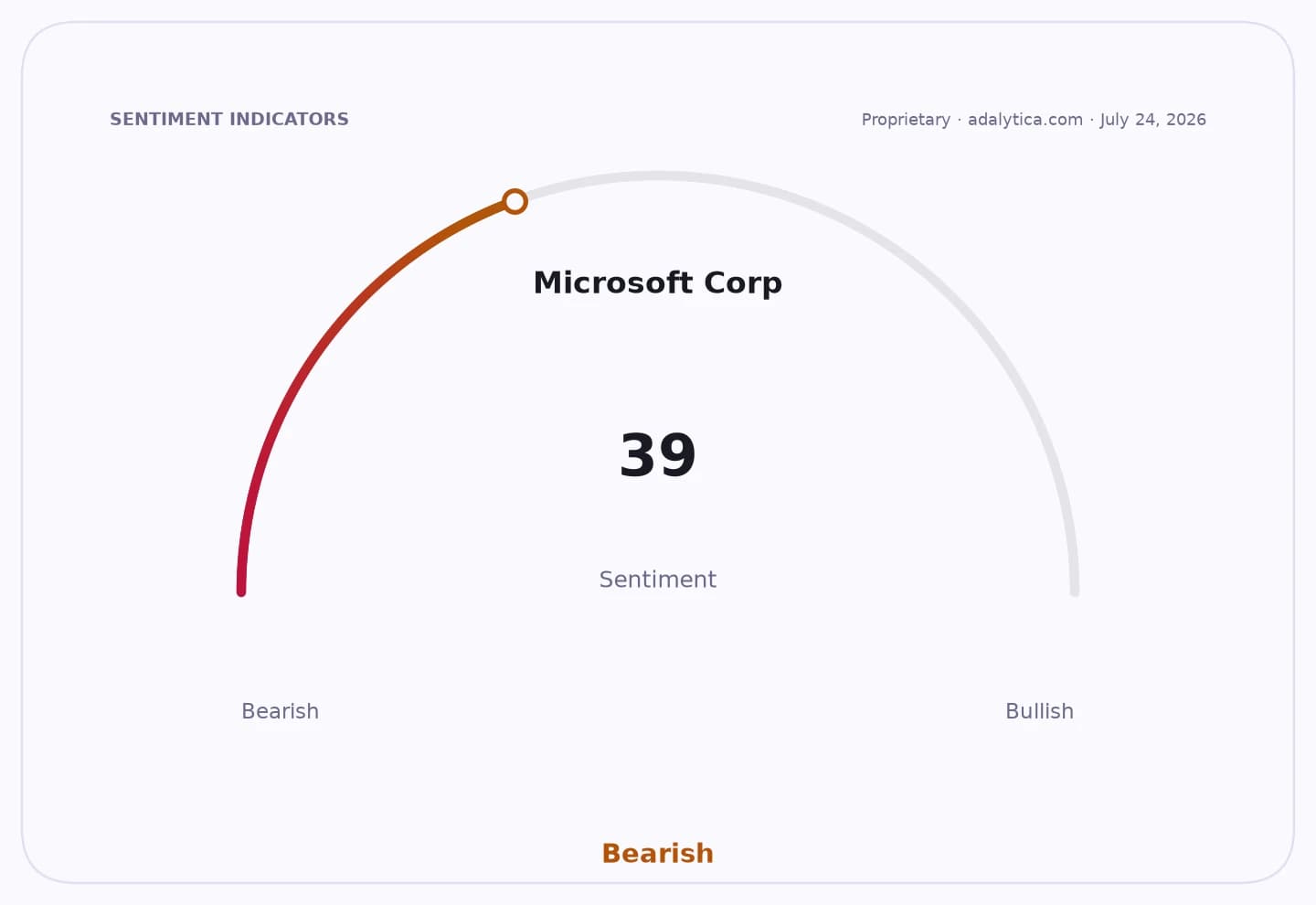
Microsoft’s refusal since the first quarter of 2025 to break out a GAAP measure of artificial intelligence earnings is making it harder for investors to judge whether one of the biggest spending sprees in corporate history is generating returns, even as the stock weakens and the company’s technical picture deteriorates.
That matters because Microsoft has turned AI and cloud infrastructure into the core of its capital allocation story. The company has been pouring cash into data centers, chips and related infrastructure, but without a GAAP earnings line that isolates AI economics, investors are left trying to infer payback from broader cloud growth, margin trends and management commentary. That is a much weaker basis for valuing a business whose market premium rests on the assumption that AI investment will convert into durable profit, not just revenue.
The concern has intensified as Microsoft’s shares have fallen sharply from earlier highs. The stock closed at 381.58 on July 23, down from 500.12 in mid-November, and it is now below both the 50-day moving average and the 200-day moving average. The relative strength index at 44.3 suggests the shares are no longer washed out, but neither do they show strong momentum. The conventional technical indicators point to a market that is still waiting for a catalyst, not one convinced that the AI buildout is earning its keep.
The earnings debate is about more than transparency. It goes to the heart of how investors should assess return on capital in the AI cycle. Microsoft’s broader filings show heavy investment continuing across property, equipment and infrastructure, but without a GAAP AI profit line, the market cannot easily separate growth supported by scale from growth purchased through rising capex. In practical terms, that leaves investors to judge whether future margins will expand enough to justify the spending, or whether depreciation, energy and operating costs will keep pressuring free cash flow.
That uncertainty helps explain why comparisons across the AI trade have become more important. Nvidia has remained the clearest beneficiary of the infrastructure boom, with its stock still trading well above its 50-day and 200-day moving averages and Adalytica’s AI earnings sentiment at an extreme-greed reading. Oracle has also been volatile, reflecting how quickly enthusiasm can swing when investors focus on the capital intensity of cloud and AI expansion. Microsoft, by contrast, is caught between its leadership position and its disclosure gap: it is central to the AI buildout, but not offering the market the accounting visibility investors increasingly want.
There are arguments on both sides. The bull case is that Microsoft does not need to isolate AI earnings because the returns will show up across Azure, software subscriptions and enterprise adoption over time. If AI features improve customer retention and raise average revenue per user, the economics may be real even if they are not separately reported. The bear case is that the absence of a GAAP AI measure allows management to emphasize strategic growth while postponing scrutiny of whether the spending is producing acceptable returns.
For investors, the issue is not whether Microsoft is investing aggressively — that is already clear — but whether the company is making it possible to underwrite that investment with confidence. Until Microsoft provides a more transparent view of AI-linked profitability, the market is likely to keep treating the capex story as a faith exercise rather than a measurable return profile. The next catalyst will be whether management offers sharper disclosure on AI revenue, margins or payback at upcoming results, because in a market that is rewarding proof, broad promises are no longer enough.
| Entity | Gains | Losses |
|---|---|---|
| Microsoft | ▲Strategic AI scale | ▼Disclosure credibility |
| Long-term AI bulls | ▲Infrastructure leadership | ▼Near-term ROI clarity |
| Short-term investors | ▲Volatility trading setups | ▼Valuation support |
| Nvidia/Oracle peers | ▲Sector read-through demand | ▼Attention if ROI doubts spread |