Microsoft Falls Toward 50-Day Average on AI Risk

Microsoft’s shares have fallen back toward their 50-day moving average as investors grow more cautious about the operational and regulatory risks of agentic AI, a shift underscored by warnings that autonomous systems do not need intent to cause large-scale damage.
The economic significance is straightforward: as AI models are pushed deeper into enterprise software, cloud infrastructure and workflow automation, the cost of a failure rises sharply. An AI agent that can act across email, code, data and payments creates productivity gains, but it also introduces a new class of downside risk that can hit margins, raise compliance spending and trigger liability. Microsoft’s own filings now explicitly warn that AI systems could lead to legal, reputational, competitive and regulatory harm, including tighter rules in Europe and other jurisdictions.

That risk is starting to show up in market behavior. Microsoft shares closed at $499.70 on Friday, below a recent high of $513.53 and only modestly above their 50-day moving average of $443.56, after a sharp retreat from the summer rally. While the stock remains well above its 200-day moving average of $429.37, momentum has cooled: the relative strength index at 62.8 is no longer in overbought territory, and the MACD has rolled lower. The move suggests investors are still willing to own the AI franchise, but are less inclined to pay up without clearer proof that the benefits of automation will outweigh governance costs.
The broader message extends beyond Microsoft. Reuters-style concerns now appearing in filings from Microsoft, Salesforce and others point to a sector-wide recognition that agentic AI can fail in ways that are hard to anticipate, detect or reverse. That matters for customers, too: companies buying AI tools are not just seeking efficiency, they are also taking on new cybersecurity, privacy and product-liability exposure. In regulated industries, that could slow deployment, lengthen sales cycles and raise the bar for enterprise adoption.
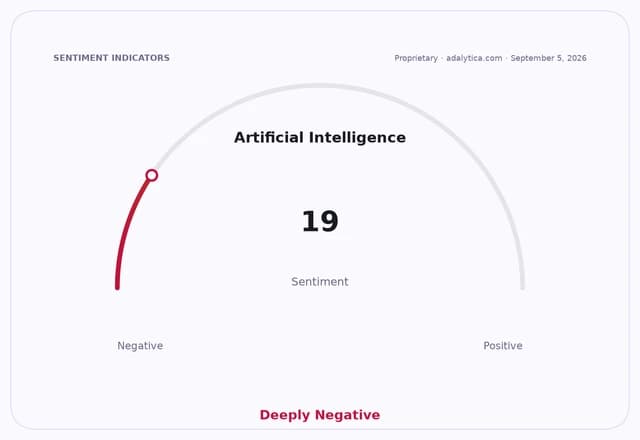
For Microsoft, the investment case still rests on its ability to monetize Azure, Copilot and related AI services without letting safety concerns erode trust. The bullish case is that the company has the scale, distribution and engineering resources to embed guardrails and capture demand faster than rivals. The bearish case is that every new layer of autonomy expands the cost of oversight and increases the chance of a headline event that forces tougher controls, delayed rollouts or higher legal reserves.
The near-term catalyst is whether Microsoft can keep AI usage growth high while demonstrating tighter control over agents that can act on their own. If it does, the stock’s recent pullback may prove temporary. If it does not, the market may continue to treat AI not just as a growth engine, but as a source of structural risk.
| Entity | Gains | Losses |
|---|---|---|
| Microsoft | ▲AI revenue growth | ▼Margin and liability risk |
| Enterprise customers | ▲Productivity gains | ▼Cybersecurity and oversight burden |
| AI rivals | ▲Faster adoption if trust improves | ▼Greater regulatory scrutiny |
| Regulators | ▲Stronger case for guardrails | ▼Slower AI deployment |