Microsoft, Nvidia, C3.ai on AI governance risk
AI spending is still driving the market, but the bigger economic question is whether governments can adopt these systems without eroding public trust or exposing themselves to operational and legal risk.
That tension sits at the center of sustainable digital governance for AI-based decision support systems in public administration: demand is real, the efficiency case is compelling, but the institutional capacity to oversee these tools is lagging. Recent market action in Microsoft and Nvidia shows investors continue to price the upside of AI infrastructure, even as sentiment in adjacent AI software names such as C3.ai remains fragile and governance concerns are intensifying.
Microsoft closed at $495.40 on Aug. 14, after touching $496.88 the prior day, rebounding sharply from a June low of $352.83. Nvidia finished at $225.16, near record territory, while C3.ai ended at $9.93, extending a collapse from $19.66 in early October 2025. The divergence matters: investors are still rewarding the firms that sell the picks-and-shovels of the AI build-out, but they are far less convinced about application-layer names that depend on public-sector adoption, procurement cycles and durable trust.
The macro implication is that AI governance is no longer a side issue. In public administration, decision-support systems touch welfare eligibility, tax collection, licensing, security and healthcare allocation. A failure can quickly become a political event, a legal dispute or a budget overrun. That raises the cost of deployment, especially where explainability, audit trails, data protection and human oversight are mandatory. The result is a slower, more selective rollout than the headlines around “AI-native government” might suggest.
That is where a socio-technical capacity framework becomes economically relevant. Public agencies do not just need models; they need data governance, procurement standards, model validation, staff training and escalation procedures. Without that, AI can reduce labor costs in narrow workflows but increase risks elsewhere through bad recommendations, automated bias or opaque accountability chains. The broader lesson is that the value of AI in government will accrue first to vendors able to package compliance, controls and integration, not just raw model performance.
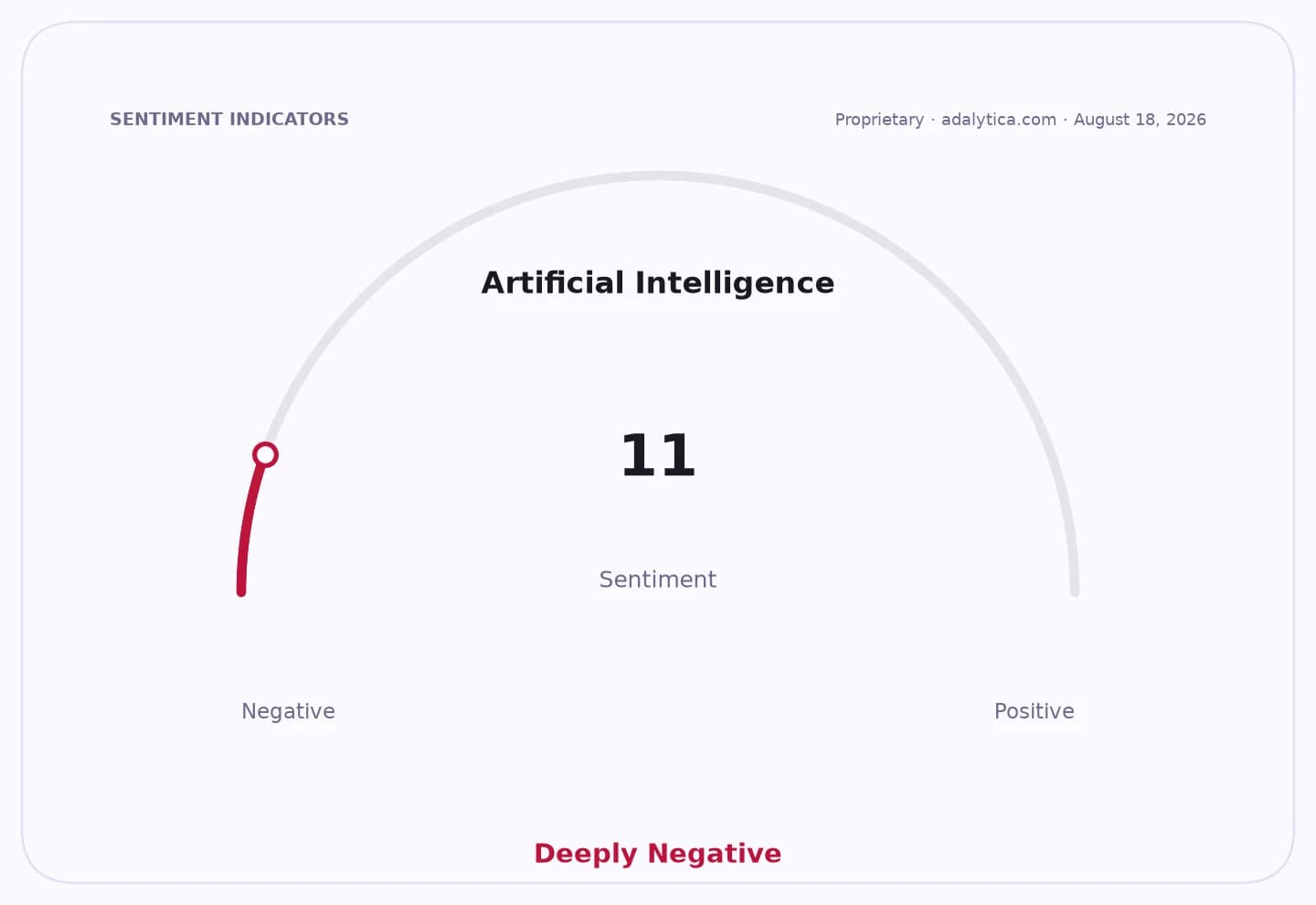
The technical backdrop in the shares reinforces that split. Microsoft’s price is extended relative to the 50-day moving average and its RSI reading of 75.4 suggests the stock is overbought even after the latest gains. Nvidia’s RSI at 75.4 is similarly stretched, with the shares trading well above both the 50-day and 200-day moving averages. By contrast, C3.ai is still below its 200-day moving average, and its Adalytica AI sentiment snapshot shows “Extreme Fear,” with sentiment at 11 and awareness at 7. That combination points to investor caution about smaller AI software names that may have the most to prove on governance, revenue quality and enterprise durability.
For investors, the narrative is not simply “AI wins, governance loses.” It is more nuanced: the winners are likely to be the infrastructure and platform providers that can make AI safer, auditable and easier to deploy inside regulated institutions. The losers are companies that rely on fast institutional adoption without proving control, transparency and return on investment. In public administration, the pace of AI uptake will probably be defined less by model capability than by whether agencies can build the management capacity to use those models responsibly.
The next catalyst is policy. As governments move from pilots to production, investors should watch for procurement rules, audit requirements and liability standards that could either accelerate adoption by lowering uncertainty or slow it by raising compliance costs. The market is already telling us that AI infrastructure remains the preferred trade; the real test is whether governance can catch up before public-sector confidence becomes the bottleneck.
| Entity | Gains | Losses |
|---|---|---|
| Microsoft | ▲AI platform demand | ▼Overbought valuation risk |
| Nvidia | ▲Data-center chip demand | ▼Governance-driven adoption delays |
| C3.ai | ▲Potential long-term public-sector use cases | ▼Weak sentiment and adoption skepticism |
| Public agencies | ▲Better decision support | ▼Higher compliance and oversight burden |