Microsoft Shorts Rise Ahead of Earnings

Microsoft is heading into quarterly earnings with short interest at a decade high, a sign that investors are increasingly willing to challenge the market’s assumption that its AI-led capital spending will quickly translate into profits.
That matters because Microsoft has become one of the market’s core AI trade. Its valuation, earnings multiple and index weight all depend on the idea that heavy spending on data centers, chips and cloud capacity will drive durable growth in Azure and Copilot without eroding margins for long. A surge in bearish bets suggests the burden of proof has shifted from proving demand exists to proving returns are coming fast enough.
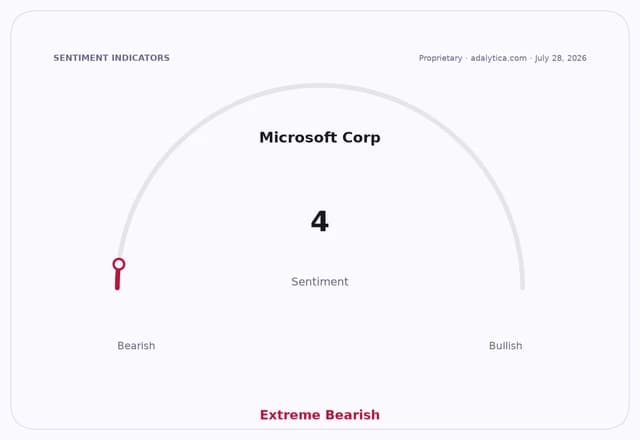
The stock’s recent price action reflects that tension. Microsoft closed at $393.35 on July 28, well below its 200-day moving average of $433.41, even as the 50-day average has flattened near $398.46. The shares have also rebounded from deeply oversold levels earlier in the year, with RSI readings recovering to 56.4 from 9.3 in late June, but the technical setup still points to a market that is unconvinced the move is sustainable. In Adalytica’s Microsoft Earnings Sentiment snapshot, sentiment sits at 4, or “Extreme Fear,” while awareness is at 96, labeled “Extreme Greed,” underscoring how intensely the stock is being watched ahead of results.
The concern is not that AI spending is slowing Microsoft’s growth story; it is that it is making the story harder to model. Microsoft’s latest 10-Q said gross margin percentage slipped slightly because of continued AI infrastructure investment and growing AI product usage. That is a familiar pattern across the hyperscale sector: cloud providers and platform companies are spending aggressively to secure future demand, but in the near term the capex bill lands before the monetization curve.
For bulls, that spending is exactly the point. Microsoft has one of the strongest positions in enterprise software, cloud and productivity, which gives it pricing power and a broad distribution channel for AI products. If Copilot adoption accelerates and Azure demand stays strong, the company can spread infrastructure costs over a much larger revenue base, eventually restoring margin leverage. The fact that Microsoft still trades far below its highs leaves room for a re-rating if earnings and guidance show that AI is already becoming a revenue driver rather than only a cost center.
For bears, the risk is that the market is extrapolating too much from AI enthusiasm and too little from near-term economics. A decade-high short position indicates some investors think the company’s earnings quality could weaken if AI spend keeps outpacing monetization, especially in a macro environment where high-multiple growth stocks are being punished when execution disappoints. That is a sharper issue for Microsoft than for smaller rivals because the stock is so widely owned that even modest disappointment can ripple through the Nasdaq and the broader AI complex.
The broader read-through is also important for peers. Nvidia remains one of the clearest beneficiaries of hyperscaler capex, while Amazon and other cloud spenders are also exposed to any slowdown in enterprise cloud budgets. If Microsoft’s results show that AI investment is still compressing margins without clear payback, investors may start to question whether the whole sector has moved too far ahead of fundamentals. If Microsoft instead delivers evidence that AI is lifting Azure consumption, software attach rates and enterprise demand, the short thesis could unwind quickly.
What happens next now hinges on guidance more than the headline numbers. Investors will want to hear whether AI capital spending is accelerating, stabilizing or starting to generate measurable operating leverage. In a market where Microsoft is both a defensive mega-cap and a leading AI beneficiary, the earnings call may decide whether the recent bearish positioning was prescient caution or an expensive bet against the company’s next phase of growth.
| Entity | Gains | Losses |
|---|---|---|
| Short sellers | ▲downside if AI spending disappoints | ▼if Microsoft guidance beats |
| Microsoft bulls | ▲upside from AI monetization | ▼if margins stay compressed |
| Nvidia | ▲if hyperscaler capex stays strong | ▼if Microsoft slows AI investment |
| Enterprise customers | ▲more AI capacity and tools | ▼if Microsoft passes on higher costs |