Moldova Plans to Place 100,000 People in Jobs
Moldova plans to help more than 100,000 people into work over the next four years, a scale-up that could tighten labour supply, lift household incomes and bring more of the country’s workforce into the formal economy.
The labour ministry’s target, announced by Natalia Plugaru at a social protection forum in Chisinau, would build on support for more than 20,000 people who found jobs in 2025. It comes as authorities try to turn employment policy into a broader economic lever, rather than a purely welfare measure, by pairing job placement with training, counselling, employer outreach and relocation support.
That matters because Moldova remains a small, labour-constrained economy where migration, informal work and weak skills matching have long held back growth. A programme that reaches 100,000 people in four years would be large relative to the country’s workforce and, if successful, could reduce pressure on the social safety net while improving tax collection and pension contributions. The ministry also said inspectors found more than 8,000 people working without contracts in 2025, up from about 80 a year in 2021, underscoring both the size of the informal labour market and the state’s push to pull workers into declared employment.
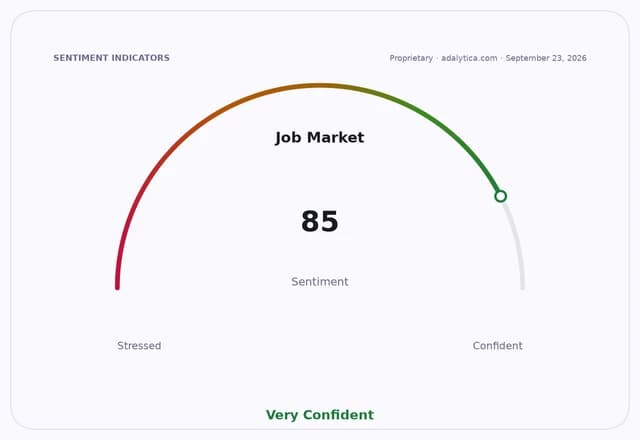
For investors, the immediate relevance is less about a direct market trade than about the broader policy direction. A stronger formal labour market supports consumer spending, bankable incomes and payroll-linked revenues for the state. It can also improve the operating environment for domestic employers facing worker shortages, especially if the government’s mix of subsidies and retraining increases labour mobility across regions and sectors. In Adalytica’s Job Market Sentiment gauge, labour-market mood is currently reading “Greed,” while awareness remains at “Extreme Fear,” suggesting the policy narrative is gaining attention faster than the market has fully priced in implementation risk.
The initiative also reflects a shift in how Chisinau is thinking about social policy after the “Restart” reform: less passive support, more activation. The ministry says the package includes professional training, retraining, employer subsidies and mobility assistance, while jobseekers are being steered through direct counselling and matching services rather than simply vacancy lists. That approach mirrors programmes used elsewhere in Europe to reduce structural unemployment and improve productivity, though outcomes depend heavily on the quality of training and whether employers actually absorb the workers being moved into the system.
The bullish case is that Moldova can use the programme to raise labour-force participation, formalise pay and ease shortages in services and manufacturing. The bearish case is that ambitious placement targets could run ahead of the economy’s capacity to create durable jobs, leaving the state to record headline gains while underlying underemployment persists. The next test will be whether the government can sustain the pace of placements, expand legal employment and show that the new jobs are not just temporary transfers into low-wage work.
| Entity | Gains | Losses |
|---|---|---|
| Job seekers | ▲More placements and training | ▼Higher compliance demands |
| Employers | ▲Subsidised hiring pipeline | ▼More labour-market scrutiny |
| Moldova government | ▲Higher formal employment | ▼Execution and fiscal risk |
| Informal workers | ▲Access to legal contracts | ▼Loss of undeclared income |