Moldova Risk Lifts Europe Defense Spending Outlook
Russia’s effort to stir instability in Moldova is back on investors’ radar, and that matters because the cheapest way to weaken Europe is not tanks on a border but political chaos inside the bloc’s neighborhood.
The strategic risk is obvious: Moscow has long sought to exploit fractures in countries on NATO and the EU’s edge, and Moldova sits directly on that fault line. Any renewed pressure there would keep the region’s security premium elevated, reinforce demand for military readiness in eastern Europe, and extend the case for higher defense spending across the continent. That is exactly the kind of background noise markets can ignore until it starts showing up in budgets, procurement and risk assets.
The macro backdrop is already supportive of that trade. The U.S. 10-year Treasury yield is sitting around 4.65%, while the closely watched 10-year/2-year spread is positive at roughly 0.51 percentage point, a combination that suggests growth is not collapsing but financing remains expensive. In that environment, governments facing geopolitical stress tend to protect security outlays even as they restrain other spending. For defense contractors, that is a durable tailwind.
Equity markets are behaving that way. The iShares MSCI United Kingdom ETF, EWU, has climbed to about $48.26, above both its 50-day and 200-day moving averages, with RSI readings still elevated, while the iShares MSCI EAFE ETF, EFA, has pushed to around $108.64 and is trading well above its 50-day and 200-day averages. The move tells you global investors are not pricing a Europe-wide crisis, but they are paying up for developed-market exposure with stability and cash flow. That is consistent with a world where geopolitical risk is persistent but not yet fully repriced.
Chinese equities are telling a different story. The FXI China ETF is still stuck near $34.89, below its 200-day moving average, underscoring how investors continue to prefer regions with clearer policy support and stronger strategic alignment. If Europe’s eastern flank stays unstable, capital should keep favoring defense, infrastructure security and energy resilience over cyclical Europe-exposed bets.
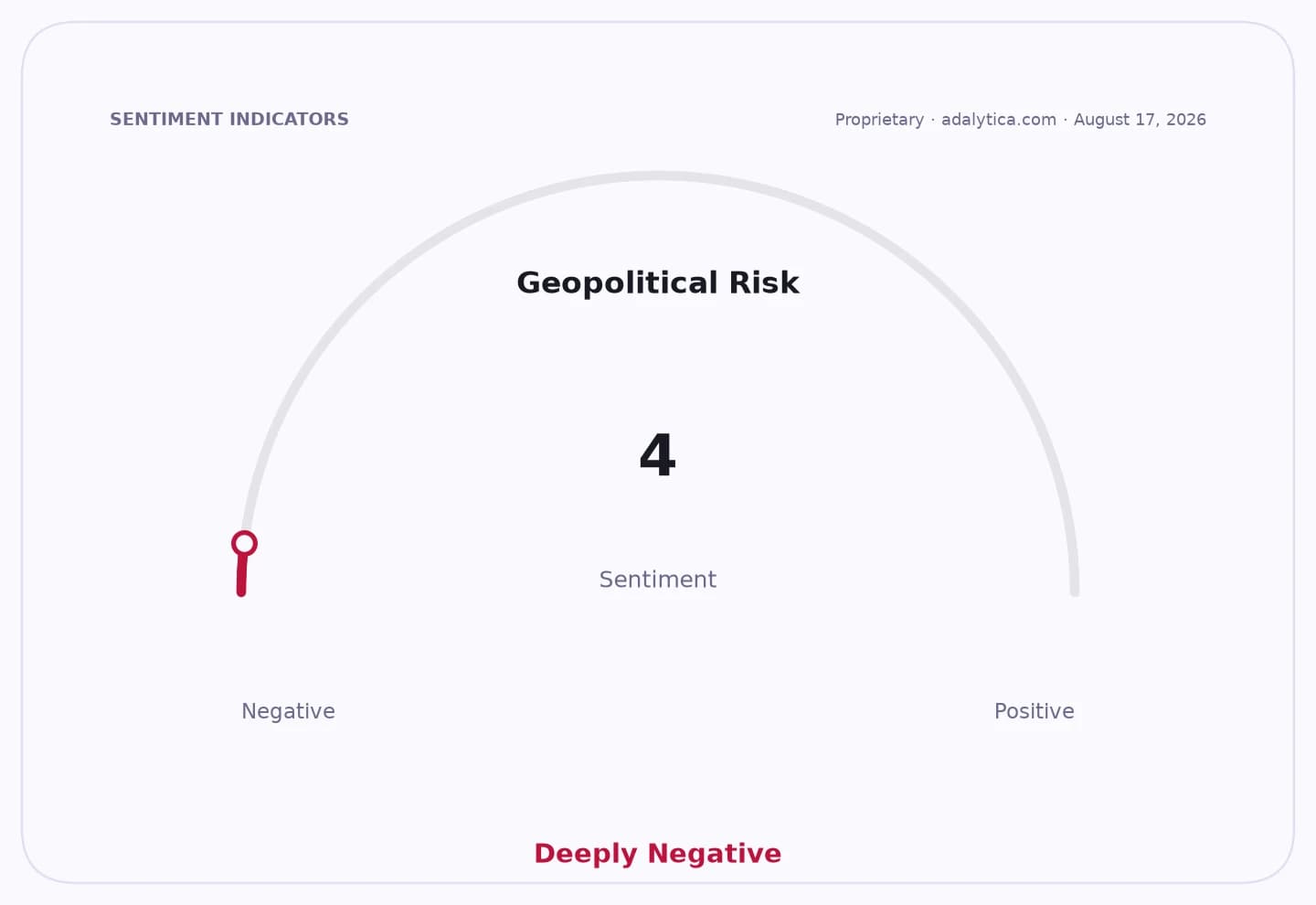
The market underestimates how fast a Moldova flare-up can travel through European policy. It can harden attitudes on military aid, border security and sanctions enforcement, while keeping pressure on governments to maintain procurement even as bond yields remain high. The Adalytica Global Stability Sentiment gauge has plunged into “Extreme Fear,” a sign that geopolitical stress is rising sharply even if broad markets have not yet cracked.
For investors, the asymmetric opportunity remains in the picks-and-shovels of security: defense primes, missile systems, surveillance, border technology and energy infrastructure tied to resilience spending. If Moscow’s playbook is to create chaos cheaply, Europe’s response is to spend expensively and repeatedly. That is a multi-year earnings tailwind, and the market still looks too relaxed about it.
| Entity | Gains | Losses |
|---|---|---|
| Defense contractors | ▲Higher procurement | ▼Peace dividend |
| Eastern Europe security spending | ▲Budget priority | ▼Discretionary capex |
| NATO and EU hawks | ▲Harder line | ▼Diplomatic flexibility |
| Russia’s proxy strategy | ▲Low-cost leverage | ▼Long-term isolation |