Moscow Exchange launches crypto futures Sept. 22
Moscow Exchange is moving crypto further into regulated markets by launching five futures contracts on Sept. 22, a step that broadens institutional access just as traders remain heavily tilted toward digital assets.
The exchange said the new products will track bitcoin, ether, solana, XRP and TRON, priced in dollars and settled in rubles. For Russia’s market, the significance is less about the individual tokens than the channel: a major exchange is giving approved traders a familiar, centrally cleared way to take exposure without holding coins directly. That matters economically because it deepens market infrastructure, supports liquidity and gives institutional money a path back into a sector still constrained in many jurisdictions.
The move also fits a broader pattern. Russia loosened crypto rules on Sept. 1, widening access for more traders, while Moscow Exchange said more than 72,000 approved traders have already used its crypto products. At the same time, Bitcoin is trading near $85,441 after holding above $85,000, with the 50-day moving average at $74,553 and the 200-day average at $70,764, underlining how far the market has recovered from earlier stress. The conventional RSI reading near 68.9 points to an overbought backdrop, but momentum remains intact, reinforced by a MACD reading above its signal line.
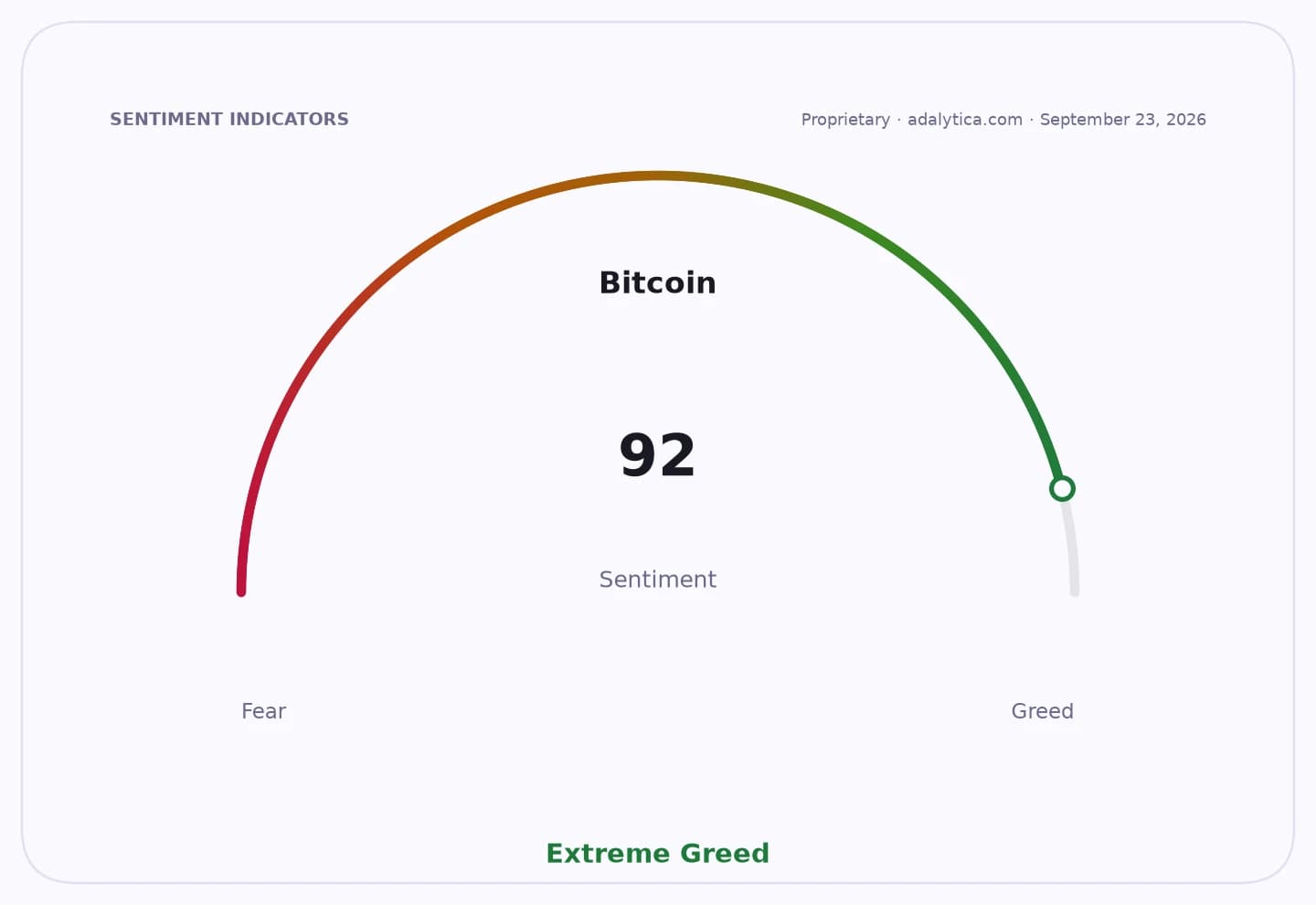
For investors, the launch is another sign that crypto’s next leg is being built through derivatives, not just spot markets. Futures expand hedging tools for miners, funds and proprietary desks, while also increasing the ability to express leverage on token prices. That can improve price discovery but also raise volatility if positioning gets crowded. Bitcoin’s extreme-greed reading in Adalytica’s Fear & Greed snapshot, at 92, suggests sentiment is already stretched, which may make the market more sensitive to any disappointment.
The listing comes as speculative capital keeps searching for the next trade. Crypto markets have been buoyed by rising institutional participation and by a wider acceptance of token-linked products, even as regulation remains uneven. In that environment, Moscow Exchange’s expansion is a reminder that exchanges are competing to capture fee pools and trading flow from a market that increasingly behaves like a global macro asset class.
The question now is whether regulated access in Russia can translate into lasting volume or simply a short burst of activity. If the new contracts attract flow, they could strengthen Moscow Exchange’s role in crypto price discovery and support demand for related products. If not, the launch will still signal where the industry is headed: more derivatives, more institutional wrappers and more competition among exchanges to own the next phase of crypto trading.
| Entity | Gains | Losses |
|---|---|---|
| Moscow Exchange | ▲New crypto trading revenue | ▼Offshore venues |
| Institutional traders | ▲Regulated exposure | ▼Direct custody complexity |
| Bitcoin, Ether, Solana, XRP, TRX | ▲Deeper liquidity | ▼Pure spot-only platforms |
| Retail speculators | ▲More tradeable products | ▼Lower edge if volatility rises |